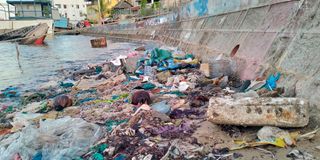
Mashaza Hashim is seated quietly on a greyish stretch of sand at Wiyoni beach in Lamu Island. Seashells are normally spotted in such environments. Not here. The calm beauty of the Indian Ocean is overshadowed by a devastating shoreline filled with old, ragged clothes and tangled, waterlogged garments.
The 45-year-old stands abruptly and points. "This isn't right at all. People must be responsible. How can you dump your old clothes in the ocean just like that? These torn denims, faded synthetic shirts, discoloured t-shirts and discarded mosquito nets you're seeing here today might end up harming our fish and turtles," he says.
Hashim is an environmentalist, and he is worried. Not just about plastic bottles, which have dominated public conversation for years, but about something newer, quieter, and in his view just as destructive: the surge of synthetic textile waste washing into Kenya's coastal waters.
Across the Lamu archipelago, from Wiyoni and Kililana to Manda, Matondoni, Ras Kitau, Siyu, and Kiunga, he has walked shorelines filled not with the familiar plastic bag or PET bottle, but with hundreds of filthy, discarded garments swept by relentless tides.
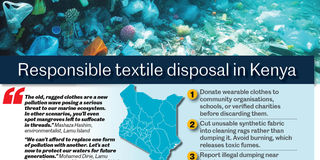
"I view the old, ragged clothes as a new pollution wave posing a serious threat to our marine ecosystem. In other scenarios, you'll even spot mangroves left to suffocate in threads. Something needs to be done urgently," he says.
Kenya's plastic problem is not solved either
Before turning to textiles, it is worth pausing on plastics because the country's much-celebrated fight against them is going backwards.
In 2017, Kenya enacted what was widely described as the world's toughest plastic bag ban, with violators facing fines of up to Sh4 million or four years in prison. The law was globally acclaimed and in its early years it worked. Reports at the time indicated an 80 per cent reduction in urban plastic litter.
Today, that gain is quietly unravelling. Seven years after Kenya outlawed single-use plastic bags, the banned carriers are creeping back into markets and shops across the country. At Kangemi market in Nairobi, traders openly pack sukuma wiki in the familiar thin plastic bags. Across several towns, from Kakamega and Kisumu to Nairobi's Gikomba and Muthurwa, the banned plastics are back in circulation.
The numbers confirm what the eye can see. A 2024 Nema survey showed an increase in single-use plastics found in urban drainage systems by nearly 40 per cent compared to 2020. A separate Nema report found that 35 per cent of plastic bags in circulation are illegally smuggled from Uganda and Tanzania.
While Kenya's plastic bag ban was globally applauded, enforcement has been inconsistent. Plastic bags are still smuggled through porous borders, and single-use plastics continue to flood the informal market with impunity. There is little follow-up or accountability for producers, importers, or distributors.
In September 2025, Nema was forced to issue a fresh public notice warning that banned plastic bags and packaging materials were re-emerging in the market, being imported, produced, used, and sold in retail outlets despite the law.
A new wave from the wardrobe
Against this backdrop, a second pollution crisis is building along the coast, one that receives almost none of the attention plastics do.
Athman Bakar, executive director of the Lamu Marine Forum, says what he sees on Indian Ocean shorelines reflects the severe impact of textile pollution, where rapid fashion waste, especially from Lamu Town, washes up and turns pristine beaches into landfill sites.
"It's worrying seeing the sudden overspill of fast fashion waste in our ocean and beaches. They definitely act as a silent killer of coastal ecosystems," he says.
Mohamed Dirie, Lamu County’s Climate Change chief officer, echoes this. While global attention has rightly focused on plastics, he argues that textile waste is emerging as a silent but equally destructive threat. He lists four specific dangers.
The first is microfibre pollution. Most discarded clothing today contains synthetic fibres: polyester, nylon, acrylic. When these textiles break down in seawater, they release microfibres that are ingested by fish, oysters, and other marine life, entering the food chain and ultimately affecting human health.
Research from the Kenya Marine and Fisheries Research Institute found a high presence of microplastics in Kenya's Indian Ocean, with the majority being fibrous materials from textiles and ropes, most likely from wastewater generated by washing clothes and from fishing activities. Globally, the textile sector accounts for nine per cent of microplastic losses to the oceans, according to the United Nations Environment Programme.
The second risk is chemical leaching. Textiles are treated with dyes, flame retardants, and other industrial chemicals. Once in the ocean, these substances leach into the water, altering its chemistry and poisoning marine habitats, including coral reefs and seagrass beds.
Third, Dirie points to habitat smothering, where large pieces of fabric sink and smother the seabed, destroying breeding grounds for fish and damaging mangroves and coral reefs. Researchers have found that synthetic fabrics smother the breathing roots that mangroves rely on, block crab burrows, and form an impermeable layer that prevents new seedlings from taking root.
Fourth is entanglement. Yunus Sahe, an environmentalist and fisherman in Malindi, says he has witnessed discarded clothes and synthetic nets entangling turtles, dolphins, and seabirds along the Vasco da Gama and Buntwan shorelines, causing injury, drowning, and death. "Such wastes cause injury, drowning, and fish death, threatening species that are vital to Malindi and the coast's marine ecology and cultural heritage," he says.
To understand why textile waste is overwhelming Kenya's coast, you have to follow the bale.
Kenya imported 230,535 tonnes of second-hand clothes in 2024, according to the 2025 Economic Survey. The country is among the top five largest importers of used clothing in the world. Most of it arrives at Mombasa Port in compressed bales before moving through clearing agents, wholesalers, and informal markets like Gikomba, Toi, and City Stadium. This is according to IEA Kenya.
A dirty ocean filled with old, ragged clothes and synthetic waste on Lamu Island on May 2.
Photo credit: Kalume Kazungu I Nation Media Group
The trade, known as mitumba, supports an estimated two million livelihoods and is deeply woven into daily economic life. Reports indicate that 91.5 per cent of households in
Yet, not all that arrives is wearable. A 2024 analysis estimated that 40 per cent of Africa's imported second-hand clothes end up as waste, contributing to 12 million tonnes of annual textile waste continent-wide. In Kenya, bales frequently arrive with a portion of clothing that is already too damaged to sell or repair. That fraction ends up burned, dumped in landfills like Dandora, or washed into rivers and eventually the sea.
Burning synthetic fabrics releases toxic fumes and causes respiratory problems, while harmful chemicals leach into soil and groundwater. The Nairobi River and Dandora dumpsite, particularly near Gikomba Market, are heavily burdened with textile waste.
The Flipflopi Project, a Kenyan ocean conservation organisation that has worked extensively along the Lamu coastline, has been direct about where it places the blame. "Fast fashion brands produce clothes designed to be disposable, export the 'affordable solution' of second-hand markets to Africa, then walk away while our communities pay the environmental price," says Dipesh Pabari, co-founder of the project.
The economic weight of blue
Mohamed Somo, chairman of the Indian Ocean Water Body lobby, frames the stakes clearly. A polluted ocean degrades the blue economy of the fisher community. It threatens fisheries, tourism, and the health of communities that depend on the sea. He adds that decomposing textiles in anaerobic marine conditions can also release methane, contributing to greenhouse gas emissions.
For Lamu, a UNESCO World Heritage Site, the intersection of tourism revenue and environmental health is direct.
In Kenya, the textile sector is responsible for approximately 56 per cent of total industrial pollution, according to research published in the journal Frontiers in Sustainability. Meanwhile, the fashion industry as a whole is responsible for an estimated eight to 10 per cent of global carbon emissions annually, according to the Ellen MacArthur Foundation, more than international aviation and maritime shipping combined.
The Lamu County Government has partnered with Nema, Kenya Forest Services, Beach Management Units, and WWF-Kenya to organise beach clean-ups, particularly those targeting textiles. Dirie says the county is also pursuing public awareness forums on responsible textile disposal, working toward policy enforcement against illegal dumping, and pushing for circular economy models including textile recycling, upcycling, and reuse enterprises.
In December 2024, the Ministry of Environment gazetted the Environmental Management and Co-ordination (Management and Control of Plastic Packaging Materials) Regulations, 2024, aimed at putting in place a clearer framework for the management and control of plastic packaging materials in the country. Whether enforcement will follow is the question that Lamu's shoreline continues to ask.
Local fishermen have already reported declining catches and polluted habitats, signs that the ecosystem is under intense pressure.
A floating recycled plastic house and boat on Lamu Island, part of an effort to save the ocean from pollution, in this photo taken on May 2.
Photo credit: Kalume Kazungu I Nation Media Group
"We can't afford to replace one form of pollution with another. Let's act now to protect our waters for future generations," Dirie says.