Fisheries experts have raised a red flag about the rise in Illegal, Unreported, and Unregulated (IUU) fishing in the Indian Ocean, due to poor surveillance.
The African Union - InterAfrican Bureau for Animal Resources (AU-IBAR) director, Huyam Salih, said Protecting Africa’s rivers, lakes, wetlands, and marine ecosystems is not an environmental luxury but an economic and social necessity for sustainable development.
“Overfishing and usage of illegal means of fishing are the biggest concerns, but lack of capacity in different countries has remained a hindrance to the fight against malpractice in the oceans,” she said.
Dr Huyam Salim, Director of the African Union–InterAfrican Bureau for Animal Resources, during a consultative meeting on improving veterinary product regulation in Africa at the Tamarind Tree Hotel, Nairobi, on November 17, 2025.
Photo credit: Dennis Onsongo| Nation Media Group
“The aquatic biodiversity is a strategic pillar for Africa’s food security, climate resilience, employment creation, and economic transformation,” Dr Salih added.
Dr Salih said IUU fishing operations exploit weak monitoring, control, and surveillance (MCS) systems and governance gaps, which are prevalent in many developing coastal nations due to a lack of resources and capacity.
“Without effective surveillance, it is extremely difficult to identify vessels, determine their authorization status, and enforce regulations. This means illegal fishing vessels can operate with minimal risk of being caught or penalised,” said the AU-IBAR director.
Kenya's director of fisheries and aquaculture development, Mahongah Joseph, said increasing illegal fishing, plastic pollution, and climate change have been cited as the main hindrances to the development of the blue economy, not only in Kenya but also in Africa.
Speaking during the Fourth Project Technical Committee meeting in Mombasa, organised by AU-IBAR, Mr Joseph said the government has completed the blue economy strategy, which will be launched to address overexploitation of resources, pollution in the Indian Ocean, and mitigate climate change.
“We are finalising the editorial bit of the strategy, and it will help in addressing the increasing challenges in the ocean apart from those affecting women and youth who play key roles in various blue economy projects,” said Mr Joseph.
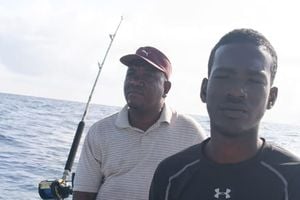
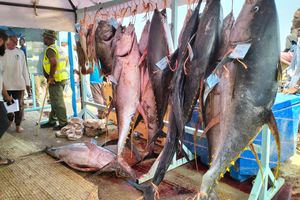
The biggest fish that were by fishermen during the Lamu fishing competition on display at the KPA Jetty on November 22, 2025.
Photo credit: Kalume Kazungu | Nation Media Group
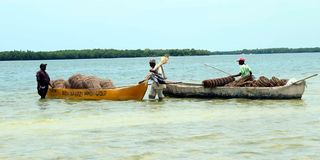
Kenya's marine fisheries are concentrated along the Indian Ocean coastline, encompassing artisanal, industrial, and recreational fisheries.
Most of Kenya’s international seaborne trade is, however, carried by foreign commercial or industrial vessels that mainly target shallow water shrimps, deep water shrimps, and lobsters. Some foreign trawlers, mainly Chinese, Tanzanians, and Italians, have been accused of overfishing in Kenyan waters and damaging the marine ecosystem.
Records by the State Department for Blue Economy and Fisheries show that Kenya has been developing its industrial fleet and is currently having twelve longliners, two pot vessels, six purse seiners, and six trawlers in its Economic Exclusive Zone (EEZ).
“The artisanal fishery accounts for most of the inland and marine water catches reported here, and consequently it is currently the most important fishery in the country, even though our EEZ, which is predominantly for commercial fishing, is underexploited with an estimated potential of between 150,000 and 300,000 tonnes,” the State Department said.