Two trends: Why some species rebounded while others declined
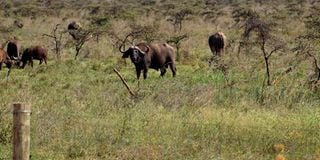
Buffaloes at Nairobi National Park.

What you need to know:
- The populations of rangeland buffalo, grevy's zebra, sable antelope and hirola have declined significantly compared to 2021, according to the Wildlife National Census Report 2024-2025
- The 2022 drought season led to widespread wildlife deaths across Kenya, as prolonged water shortages and depleted grazing areas pushed ecosystems to the brink.
The populations of rangeland buffalo, grevy's zebra, sable antelope and hirola have declined significantly compared to 2021, according to the Wildlife National Census Report 2024-2025, conducted between June 2024 and August 2025, covering 264,258 square kilometres, stated to be approximately 45 per cent of Kenya’s land mass.
Rangeland buffalo numbers have dropped from 41,659 in 2021 to 27,389, representing an annual decrease of 8.58 per cent. Meanwhile, the hirola antelope population fell from 497 to 245, a 12.68 per cent decline.
The number of Grevy’s zebra decreased from 2,649 to 2,465 in the wild, marking a 1.74 per cent drop, while the sable antelope dropped from 51 to 40, marking a 5.4 per cent drop.

According to Stephen Ndambuki, a senior research scientist at the Wildlife Research and Training Institute (WRTI), the decline in populations of Kenya’s rangeland species has been driven by a combination of human and environmental factors.
Habitat loss and degradation remain the most significant threats, fragmenting the areas where wildlife once roamed freely. In addition, the demand for bush meat, including animals such as giraffes, gazelles, antelopes, and zebras, continues to put pressure on several species, directly reducing their numbers and disrupting ecological balances.
According to WRTI, there is no scientific data at the moment to explain the reason(s) behind the drastic decrease of the rangeland buffaloes. However, the next phase after this report is collaborating with different partners and stakeholders to research and understand the reason behind the decrease.
“Beyond habitat loss and degradation, factors such as bush meat hunting and the 2022 drought have taken a heavy toll on these species,” Grace Karanja from WRTI said.
Extreme weather events, particularly the 2022 drought, have further stressed populations by limiting access to water and forage, making survival more difficult for already vulnerable animals.
The 2022 drought season led to widespread wildlife deaths across Kenya, as prolonged water shortages and depleted grazing areas pushed ecosystems to the brink.
With rivers, water pans, and seasonal wetlands drying up, thousands of animals succumbed to starvation, dehydration, and disease. Wildlife, particularly in the arid and semi-arid regions and in parks where natural water sources failed, were hit hard.
Weakened animals also became more vulnerable to disease outbreaks, compounding mortality rates.
Conservation authorities reported that the drought disrupted normal wildlife movement patterns, forcing animals to travel long distances in search of water, often straying into human settlements.
This not only increased human–wildlife conflict but also exposed already weakened animals to further stress and injury.
The scale of wildlife deaths during the 2022 drought underscored the growing impact of climate change on biodiversity, raising urgent concerns about the resilience of Kenya’s protected areas and the need for sustained investment in water provision, habitat protection, and climate-adaptive wildlife management.
In addition, outbreaks of diseases such as anthrax have deepened the toll of climate stress on wildlife, with buffaloes among the hardest hit in Nakuru National Park and other conservation areas.
Prolonged drought conditions left animals weakened and highly vulnerable, allowing the fast-acting disease to cause sudden deaths and sharp declines in herd numbers.
“Anthrax affected the buffaloes in Nakuru and other conservation areas,” Ms Karanja told Nation.
Buffaloes are a keystone species in many savannah ecosystems, and their decline has begun to alter grazing patterns and disturb ecological balance.
For wildlife authorities, the outbreaks have also posed major management and financial challenges.
Resources have been redirected to emergency surveillance, carcass disposal, and disease control measures to limit further spread. The anthrax cases have underscored the growing intersection between climate extremes and wildlife disease, reinforcing calls from conservation experts for stronger veterinary monitoring, early-warning systems, and climate-responsive wildlife management to prevent future losses.
These combined pressures, human exploitation, environmental stress, and disease, are explained to have contributed to the challenges wildlife face in surviving and recovering across their natural ranges and in the ecosystems.
Amid the losses recorded during the drought period, conservationists point to a positive trend in elephant black rhinos, giraffes (Maasai, Nubian, and Reticulated), mountain bongos, and roan antelopes populations, offering a rare boost for Kenya’s wildlife sector.
Elephants have marked a 3.99 per cent increase from a population of 36,280 in 2021 to 42,072 nationally.
Also read: https://nation.africa/kenya/health/-sh1-2bn-debt-of-pain-as-human-wildlife-conflict-persists-5206740
The national rhino population, comprising 1059 black rhinos, 1041 southern white rhinos, and the 2 only northern white rhinos, nationally marked a 4 per cent increase in its population from 1,812 in 2021 to 2,102 in 2025.
Giraffe numbers rose from 35,355 to a total of 43,002. The giraffe species is made up of Maasai with a population of 10,410, Nubian comprising 1,388 and Reticulated giraffes being 31,201, marking a 5.41 per cent increase.
The mountain bongo population increased to a national total of 179 from 150 in 2021, marking an annual change of 4.83 per cent, while the roan antelope has reached 21 from 15 in 2021, marking a 10 per cent increase.
Improved protection, reduced poaching pressure and sustained community conservation efforts have contributed to the steady recovery of these species even as climate shocks intensified. Notably, the “Big Five” is not a scientific name, but rather a kind of a name given for marketing purposes.
Elephants play a critical role as ecosystem engineers, opening up habitats and creating water access points that benefit other species, while giraffes support vegetation balance by browsing on higher tree canopies.
How the census was conducted
The census exercise is usually carried out at the ecosystem level every three to four years to capture meaningful changes in wildlife populations, including trends in births and mortalities.
For species such as elephants, which have a long gestation period of up to 22 months, this interval allows enough time for new calves to be born and counted, making it possible to generate more accurate population estimates.
According to Mr Ndambuki, the census began in June 2024 in the Maasai Mara ecosystem, as the initial focus was on the southern range region. This southern range included interconnected ecosystems, allowing wildlife to move freely from one park to another. They include the Magadi, Amboseli and Tsavo ecosystems.
"Animals in Kenya’s southern range can move freely across connected ecosystems,’’ Ndambuki said, “for instance, those in Maasai Mara can move and access the Magadi ecosystem, highlighting the importance of wildlife corridors," he added
Following the completion of the southern part, the census advanced northwards, covering key ranches in Machakos such as Athi and Kapiti before moving through Nairobi and the Naivasha–Nakuru corridor.
It then shifted to the central regions, including Laikipia, Samburu, and Meru.
“The south, north and central range regions have a high density of wildlife population,” Ndambuki said, “they are also gazetted protected areas,’’ he added.
The next phase focused on Ruma National Park, Mwea National Reserve, and Nakuru National Park, all of which are fully fenced, preventing wildlife from moving between ecosystems. The animal populations are isolated, making it essential to closely monitor both the animals and their habitats.
“They require key monitoring of the populations in these areas in relation to the habitat conditioning,” WRTI said.
When a population exceeds the ecosystem’s carrying capacity, the census recommends management interventions to maintain ecological balance.
According to WRTI, the wildlife population at Mwea National Reserve recently surpassed the area’s carrying capacity, forcing the government to relocate some elephants to Aberdare National Park as they were unable to move freely within the reserve.
Methods used
Due to the areas being protected zones containing a high density of wildlife, WRTI used the total aerial count. This is achieved by using light aircraft and helicopters in the process, making sure 100 per cent coverage of the area.
In expansive, low-density wildlife areas such as Marsabit, Wajir, Mandera, Garissa, and Turkana, aerial sample counts were employed.
This method involves surveying a portion of the area to represent the whole, typically sampling 30 to 50 per cent of the land to ensure balanced representation while minimising bias, particularly in regions where animals tend to congregate.
The type of animals targeted for sampling is said to be those that are active during the day those that are larger than Thompson gazelles.
For nocturnal (active at night) and elusive animals, such as carnivores like lions, the ‘Spatial Explicit Capture-Recapture (SECR)’ method is used.
The SECR technique involves identifying individual animals, recording their sightings and being able to resight or capture them to estimate population numbers accurately.
“A good example is the lion, we use the whisker marking to identify each lion since their whiskers are different,” WRTI explained.
Waterfowl for bird counts is used since it monitors birds in the waterbodies, signifying the health status of a water body in the ecosystem.
Primate counts us used for individual identification for small population animals such as the rhinos and the roans.
In Kenya, the roans are only found in the Ruma ecosystem, while the sable is only found in the Shimba Hills. Due to their small population, each rhino in Kenya is notched for referencing, sighting and close monitoring; health, birth and population status.
Over the years, observers used to watch while writing down as the plane was moving, thus high chance of missing to see some data. According to WRTI, technological advancement has improved the data collection method, thus they can voice record as the plane is still in motion.
“Voice recording has improved the quality of the data we collect in the field for easy transcription and recording of the information,” Ndambuki noted.
With the establishment and use of the Global Positioning System (GPS), WRTI can now pinpoint exact locations for flights and identify specific blocks for the census. Previously, aircraft were used to design blocks based on physical features such as rivers, mountains, or hills.
In addition, the GPS has also improved pilot navigation by providing real-time information on changes in ground elevation.
The report outlines several strategic recommendations, including the integration of data from the National Wildlife Corridor Mapping Initiative and the latest wildlife census into national and county spatial plans.
It also calls for stronger measures to support human–wildlife co-existence and urges the fast-tracking of the Wildlife Conservation and Management Bill (2025) alongside amendments to the Wildlife Act, 2023.
Additionally, the report proposes piloting science-guided game-farming and sustainable wildlife utilisation models in selected community conservancies and lastly recommends allocating a percentage of tourism revenue to support wildlife management and research.


