Year in review: Notable climate events in 2025
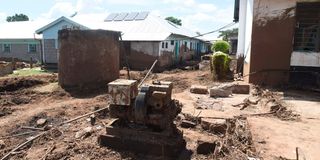
A view of Chesongoch Mission Hospital in Kerio Valley, Elgeyo Marakwet County on November 08, 2025, following landslides that occurred on October 31, 2025.
What you need to know:
- Many climatic events that have unfolded this year remain proof that the planet is in peril.
Many climatic events that have unfolded this year remain proof that the planet is in peril.
In Kenya, that reality played out across forests, rangelands, fragile hillsides and failing seasons. From local disputes over land and livelihoods to global climate negotiations, the year reinforced how deeply environmental choices now shape the country’s present and its future.
Here are the top climate and weather stories of 2025.
Eco-lodge at Ngong forest
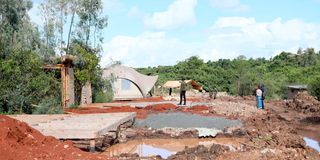
Construction site of a luxury camping facility hotel in Ngong Road Forest, Nairobi, pictured on May 27, 2025.
The construction of cabins at Ngong Forest was halted following a public uproar amid claims of secrecy and environmental breaches. and ties to a political figure.
The facility, which included tented cabins and cottages for eco-tourism, was reported to have proceeded without proper approvals, prompting intervention from the Ministry of Environment and calls for stakeholder engagement.
MPs raised questions about the project, while the DCI launched investigations into alleged illegal land sales and encroachment in the forest.


Carbon credit deals
Residents of Ewuaso Oonkidong’i Ward in Kajiado County petitioned the county assembly around mid this year, alleging that carbon credit brokers are locking communities into decades-long contracts worth millions, often without proper consultation or transparent benefit-sharing.
One was the 40-year carbon rights agreement allowing a private firm to generate credits from community rangelands while requiring locals to implement grazing plans and surrender control over carbon assets.
The scale of carbon projects in Kajiado is extensive, spanning over 2.5 million hectares, including REDD+ initiatives, soil carbon projects and the Kajiado Rangeland Carbon Project (KRCP).
Residents claim they have been kept uninformed about project scope, timelines and revenue distribution, with some payments made before proper verification, raising questions about the legitimacy of claimed carbon reductions.
The petition called for mandatory Free, Prior and Informed Consent (FPIC), transparent monitoring and equitable benefit-sharing.
While the county is developing policies to regulate natural asset trade, residents argued that it was too late for those already bound by long-term agreements.
Also read: https://nation.africa/kenya/health/kajiado-residents-demand-probe-into-exploitative-carbon-credit-deals-5136594
Logging ban lifted
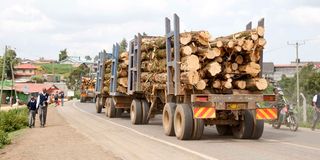
Trucks ferry logs along the Elburgon-Njoro road in Nakuru County on July 3, 2023. Timber traders have something to smile about after President William Ruto lifted a ban on logging that was issued by the government six years ago.
On October 27, 2025, President William Ruto lifted the long-standing moratorium on logging in the Mau Forest Complex and other public forests, allowing the harvesting of mature trees that had been previously protected under the ban.
Also read: https://nation.africa/kenya/blogs-opinion/blogs/lifting-logging-ban-erases-gains-against-deforestation-5248454
At the same time, he ordered a ban on furniture imports to encourage the use of locally sourced timber in Kenya’s domestic furniture manufacturing industry, aiming to create jobs and reduce reliance on imports.
Landslides in Elgeyo Marakwet
A view of Chesongoch Mission Hospital in Kerio Valley, Elgeyo Marakwet County on November 08, 2025, following landslides that occurred on October 31, 2025.
In late October 2025, Chesongoch in Elgeyo Marakwet County was struck by a devastating landslide after rainfall nearly 2.5 times heavier than the 25-year historical average.
Over ten days, the valley received 47.1 mm of rain compared to the usual 13.4 mm, saturating steep slopes and triggering the disaster.
The landslide claimed the lives of at least 40 people, with more than 30 said to be missing and destroyed over 1,000 homes across Chesongoch and surrounding villages.
Post-disaster analysis showed the collapse occurred on slopes averaging 28.8 degrees, nearly three times steeper than the surrounding terrain.
Also read: https://nation.africa/kenya/climate/the-slope-that-couldn-t-hold-why-scientists-saw-the-chesongochmudlslide-coming-5280706
The recurring landslide risk to climate change, deforestation, poor farming practices and settlement on vulnerable terrain, raises urgent questions about resilience, early-warning effectiveness and land management in steep, hazard-prone areas.
Depressed short rains
Some parts of the country are experiencing intensifying heat and drought conditions as this year’s short-rains season largely failed, particularly in arid and semi-arid counties.
According to the Kenya Meteorological Department (KMD), most monitoring stations reported rainfall deficits ranging from below average to severely low, with counties like Mandera, Wajir, Marsabit and parts of Lamu receiving less than 10 per cent of the expected rainfall.
The cumulative effect of back-to-back poor rainy seasons has heightened water scarcity, threatened livestock and stressed food production.
Meteorologists attribute these abnormal patterns to the combined influence of La Niña in the Pacific Ocean and a negative Indian Ocean Dipole, which suppresses moisture movement and cloud formation in East Africa.
Rising local temperatures have further amplified the crisis, creating what experts describe as a “perfect storm” of prolonged dry spells and heat streaks.
Also read: https://nation.africa/kenya/climate/a-collapsed-short-rains-season-what-it-means-for-food-and-water-security-5292968
KMD warned that without urgent intervention, the humanitarian and livelihood impacts will continue to worsen across 23 arid and semi-arid counties.
Conservation
The 2024–2025 National Wildlife Census revealed significant declines in Kenya’s rangeland species, including buffalo, hirola, grevy’s zebra, and sable antelope, largely due to habitat loss, drought, hunting and disease.
Amid these challenges, grassroots efforts are making an impact, with youth environmental activist Truphena Muthoni gaining national attention for a 72-hour tree-hugging marathon and planting over 11,000 trees.
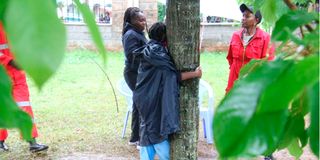
Truphena Muthoni, a climate and environmental advocate and mental-health survivor, braves a heavy downpour as she hugs a palm tree in Nyeri town during her 72-hour tree-hugging marathon.
President Ruto recognised her efforts with a Head of State Commendation and appointed her ambassador of Kenya’s 15 Billion Tree Planting Campaign, highlighting the role of citizen-led initiatives in supporting the country’s broader conservation goals.
Also read: https://nation.africa/kenya/news/truphena-muthoni-bags-guinness-record-as-72-hour-tree-hug-awaits-review-5296330
INC 5.2
The second part of the fifth session of the Intergovernmental Negotiating Committee (INC 5.2) in Geneva concluded with agreement on advancing a legally binding global treaty to curb plastic pollution, focusing on regulating production, use, and waste.
Also read: https://nation.africa/kenya/health/concerns-mount-as-fossil-fuel-interests-join-plastics-treaty-talks-5148078
The framework aims to establish uniform global rules, reduce inequalities in waste management and provide clear guidance for investors, marking a historic step toward coordinated international action against the escalating plastic crisis.
Africa climate summit 2.0
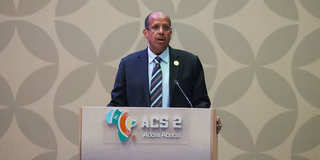
African Union Commission Chairperson, Mahmoud Ali Youssouf, speaks at the Second Africa Climate Summit (ACS2) in Addis Ababa, Ethiopia, September 8, 2025.
The ACS 2.0 in Addis Ababa brought African leaders together to promote unity and homegrown climate solutions, resulting in the Addis Ababa Declaration calling for reform of global climate finance and emphasising Africa’s capacity for low-carbon manufacturing and green trade.
Also read: https://nation.africa/kenya/health/kenya-takes-centre-stage-as-africa-charts-climate-future-5185198
Despite concerns over financing gaps, low attendance, and grassroots engagement, the summit launched major green industrialisation initiatives with over $150 billion pledged, reinforced Africa’s common climate position post-COP30 and highlighted the continent’s push for climate-positive growth driven by African-led finance and trade integration.
COP 30
At COP30 in Belém, Brazil, African civil society and non-state actors warned that insufficient climate finance threatens implementation of the Global Goal on Adaptation (GGA).
Also read: https://nation.africa/kenya/news/world/explainer-what-is-the-cop30-climate-summit-and-why-does-it-matter--5258680
Activists criticised developed countries for shifting adaptation costs to developing nations, while proposed funding indicators risk overburdening debt‑strained African states.
With adaptation needs estimated at $300 billion annually, groups called for tripling finance by 2030, predictable support for loss and damage, and full funding for the Gender Action Plan.
Despite these gaps, African leaders advanced a proactive agenda, including plans for a Global Wildlife for Climate Action Declaration at COP31.
UNEA- 7

UNEA-7 high-level segment national statements in session in Nairobi on December 11, 2025.
This year’s seventh United Nations Environment Assembly (UNEA-7) in Nairobi, Kenya, concluded with the adoption of 11 resolutions, three decisions and one ministerial declaration, including three backed by Kenya.
Also read: https://nation.africa/kenya/climate/kenya-scores-big-at-unea-7-as-all-its-environmental-resolutions-get-green-light-5295216
While a draft resolution co-sponsored by Kenya and Peru on combating environmental crimes was not adopted, Kenya supported Mexico’s proposal to strengthen UNEP’s role in Nairobi and enhance multilateral cooperation.
During the assembly, Kenya noted that even unresolved drafts remain important and could be reintroduced at UNEA-8.
However, while the resolutions are not legally binding, they were said to signal political commitment and often guide countries toward eventual formal treaties.
It was emphasised that Kenya’s existing laws and Vision 2030 are aligned with UNEA resolutions, allowing the country to implement them without legislative changes and stressed the potential of emerging tools, such as artificial intelligence, in addressing environmental challenges.
[email protected]


