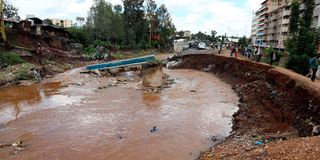
As worrying as it is, whenever the skies have opened up across the country, especially in recent days, the pattern is all too familiar: rivers burst their banks, roads turn into channels of brown water, and entire neighbourhoods, particularly in low-lying urban settlements, find themselves submerged.
The floods have always left losses in their wake, with homes washed away, and both lives and livelihoods disrupted. Yet, beneath the chaos lies a troubling paradox. Even as the country grapples with too much water, it remains on the brink of having too little.
Kenya is, by most measures, a water-scarce country. Water availability has been declining steadily due to a combination of factors, including population growth, climate variability, and environmental degradation. Experts have long warned of "water bankruptcy" and a future where demand will far outstrip supply. And yet, when the rains come, millions of litres of freshwater are lost, rushing unchecked into rivers and, ultimately, the ocean.
A global report now places nearly four billion people worldwide as facing severe water scarcity for at least one month each year as the planet enters a new post-crisis reality. The United Nations report, titled Global Water Bankruptcy: Living Beyond Our Hydrological Means in the Post-Crisis Era, found that billions across the world face severe water shortages.
In Kenya, the report observed, the crisis has accelerated, with water availability per person dropping to 647 cubic metres, well below the global security benchmark of 1,000 cubic metres. It further projects that this figure will fall to just 426 cubic metres by 2030, a mere four years away.
Kaveh Madani, director of the UN University's Institute for Water, Environment and Health, noted during the launch of the report that many regions were already "living beyond their hydrological means."
Societies, according to Madani, have overspent their annual renewable water income from rivers and rainfall and depleted long-term savings stored in aquifers, glaciers, and wetlands. This describes a physical reality in which the world is drawing down its natural resources at a rate nature cannot replenish, leading to the total insolvency of critical water systems.
But even before the UN report was released, Kenya was already staring at a deepening crisis fuelled by a massive $2.52 billion (Sh325.57 billion) funding shortfall. Experts warned in early 2025 that if the government and private sector do not act with urgency, the cost of inaction could drain billions from the economy and leave millions without reliable access. To secure universal access to safe water and sanitation by 2030, Kenya requires nearly Sh995 billion, yet the current funding trajectory remains inadequate.
On the ground, changes to the landscape have exacerbated the problem. In rural areas, the alteration of natural land cover through settlement, road construction, deforestation, livestock grazing, and cultivation has led to a significant increase in storm runoff. A greater proportion of rainfall now runs off the surface, and this flow is more rapid and erosive. Consequently, less water infiltrates the soil to replenish groundwater stores.
Within urban environments, the challenge requires a fundamental redesign. Regional Director, Nile Basin Initiative Isaac Alukwe tells Climate Action that adapting our cities for a changing climate demands a firsthand approach from engineers, urban planners, and architects. "It is about moving beyond traditional concrete solutions to create living, breathing urban environments," he says.
He suggests three primary methods for storing runoff water: constructing dams and reservoirs, implementing rainwater harvesting, and recharging groundwater through the use of water pans.
He explains that floodwaters can be channelled into underground aquifers via controlled infiltration basins, ensuring groundwater availability during arid periods. "Rainwater can also be collected and stored from the roofs and runoff, and used for livestock watering, irrigation, and other uses," he says.
Beyond these techniques, he argues that cities now need urban green infrastructure, which plays a crucial role in adapting to climate change through nature-based solutions.
Some ways to incorporate this include developing urban green spaces (such as green gardens and roofs) and constructing man-made wetlands to bolster city resilience against heatwaves, floods, and droughts.
This school of thought is echoed by Engineer Caroline Owako, the acting deputy director of Bulk Water Operations at Athi Water Works Development Agency. She argues that Kenya can build surface dams to store water, which can then be used during dry seasons. The runoff can also be used for aquifer (groundwater) recharge, Owako explains, and later be drawn off through boreholes. Additionally, water can be stored in subsurface dams, particularly at the household level in the dry eastern regions.
On individual capacities, Kenyans are advised to practice rainwater harvesting and construct water pans to store water. Owako also suggests exploring inter-basin water transfers to move water from flooded areas to dry river basins.
As engineers, she says, redesigning cities to become more climate resilient is the way to go. "This can be done by creating and maintaining adequate drainage systems to avoid flooding, creating and enforcing policies requiring buildings to have rainwater harvesting systems, and installing porous pavements to allow for rainwater percolation into the ground (this reduces runoff," Owako explains.
She adds that constructing water recycling systems for gardening, washing pavements, and industrial cooling systems will assist in water demand management, especially during dry seasons.
Methods like green roofs and walls, urban forests, bioswales, and wetland restoration, according to Dr Alukwe, can be used to integrate nature into urban design for better health and sustainability. Bioswales are channels designed to concentrate and convey rainwater runoff while removing debris and pollution. They help in recharging groundwater and therefore reduce flooding and erosion.
"These offer various advantages such as cooling, enhanced air quality, and biodiversity while promoting social equity. Incorporating green infrastructure in urban planning significantly helps minimise disaster risks by utilising natural systems and involving communities," he adds.
Nairobi, just like its name suggests, is a place of cool waters. Dr Alukwe agrees that for cities like Nairobi, where people are building over wetlands and river corridors, "we are essentially robbing the land of its ability to store floodwater."
He also worries that concrete-heavy development is turning cities into heat traps, ignoring the need for green spaces, vertical gardens, and urban forests.
"We need to get the community involved from day one. Engaging residents and stakeholders is not just a checkbox; it builds trust, creates tailored solutions, and ensures that green infrastructure is maintained by the people who live there," he says. Current efforts in the country have always been reactive, and more about fixing problems after floods or shortages occur rather than building resilient, preventative infrastructure to stop them in the first place.
"The biggest obstacles are not just a lack of resources but poor enforcement of existing rules and a failure to plan. While Kenya is building infrastructure, these efforts are undermined because city design does not account for long-term climate risks," Dr Alukwe explains.
Flash floods in cities and towns like Nairobi, Mombasa, Kisumu, and Narok are becoming more frequent, driven by rapid, unplanned growth that pushes communities onto dangerous floodplains.
"As we lose natural buffers like wetlands," Dr Alukwe warns, intense climate extremes overwhelm outdated drainage systems. "Widespread littering, illegal construction, and failing infrastructure maintenance exacerbate these risks. Protecting our communities requires strict adherence to urban planning, active environmental stewardship, and consistent enforcement by authorities to keep waterways clear," he says.
However, he observes that Kenya's floods underscore a key difficulty. "While surplus water can be harnessed through dams, reservoirs, and rainwater harvesting using advanced scientific methods for climate adaptation and resilience, deficiencies in urban planning and enforcement make cities like Nairobi prone to flash floods," says Dr Alukwe.
He argues that the biggest gap lies not in infrastructure alone, but in long-term strategy and consistent implementation.
Already, in what is seen as a proactive effort to avert a looming water shortage, the Ministry of Water and Sanitation, in collaboration with development partners, has launched an ambitious project to artificially replenish Nairobi's metropolitan groundwater aquifers using modern technology at a cost of Sh200 million. Aquifers are essentially underground layers of permeable rock or soil that store water like a sponge, collecting rainfall and surface runoff as it slowly seeps down through the soil in a process known as percolation.
According to Dr Alukwe, Kenya's battle with climate change is a mixed bag of promising initiatives and frustrating, preventable failures. "While we are making headway in water security, our progress is being severely hindered by weak governance and a lack of accountability," he says.
"We cannot fix what we do not understand. By analysing climate data such as flood risks and heat island effects, planners can select the right interventions.”
He highlights a notable example: the collaboration between Kigali, Addis Ababa, the French Development Agency, and the World Resources Institute, which created a strategic framework to guide safer, more sustainable development.