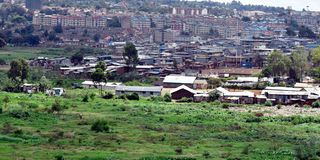
A beehive of activity around the hyacinth-covered Nairobi Dam paints a picture of the difficult path ahead of the evictions planned by the Water Resources Authority.
Looking down from a vantage point, one can see the sheer number of lives woven into the riparian land, clearly showing that any attempt to restore the dam will be a monumental struggle for the Nairobi County Government.
In the weeks since the eviction warning from Nairobi Governor Johnson Sakaja, a visit to the site revealed a reality that is far more grounded in survival. Within the dam’s boundaries, farmers have carved out small plots to plant arrowroots — providing a source of livelihood and food for nearby settlements.
The farmers move with practised ease across the floating silt, a stick in hand as they navigate the dam to till the land and earn an income by selling the arrowroots. From a bird’s-eye view, one can see children playing at an area where the silt has formed a crust of dry land as their parents work on the land.
Ms Eveline Anyango, who lives in Mugumoine in Lang’ata— a slum near the dam — says she is yet to recover since the last time they were evicted from the riparian land.
“I remember the last time they came in 2024. We had been told they would come on a Monday. I went to church, and when I came back, they had flattened our houses. Everything was gone; I could not save a single thing,” says Ms Anyango.
She moved to a different part that is still near the dam in Mugumoine, thinking that it would be safer there.
“The people who live in parts of Undugu have been told to move. On our side, no one has told us anything yet. I do not have an issue with moving, but how do we leave without money to help us resettle? That money can help me get a good place for my family,” says Ms Anyango.
She says squatting on the land has given her family a roof over their heads, adding that vacating the place without any compensation would be difficult for her since she has no income.
A distance away, Ms Ann Natasha, who moved into a tin house less than five metres from the dam a month ago, says she has nowhere to go.
Nairobi Dam.
Photo credit: File | Nation Media Group
“Since I moved here, I have never seen water entering my house. They now say we should move. I do not know where to go with my children. If they had given me money, I would have moved to the upper side, but there are rumours that those houses will be flattened too,” says Ms Natasha.
Speaking during a recent interview with NTV’s Fixing the Nation, architect Mumo Musuva — who serves in the Nairobi Rivers Commission — says the 350,000 square metres of a dam with a capacity of 98,000 cubic metres is a ticking time bomb. He says the dam, which was constructed in 1953, started to deteriorate after the El Nino rains of 1998, which caused heavy siltation. Because of poor maintenance, the dam is now degraded and a safety risk.
“The floods caused heavy siltation, and because the dam was not being maintained, it led to severe degradation. The dam is showing signs of hydraulic failure. Its structure and function are no longer what they were designed for,” says Mr Musuva.
He explained that the dam is now in a state of hydraulic failure, meaning it has lost its capacity to hold water.
“Because the basin is choked with silt, we are seeing overtopping, a dangerous scenario where floodwaters bypass the designated spillway and instead pour directly over the earthen wall. As this water rushes over the top, it acts like a giant pressure washer, rapidly eroding the embankment that protects thousands of homes below,” says Mr Musuva.
A walk around the dam shows that the government has already flattened some makeshift houses next to Highrise Estate, which is adjacent to the dam. Squatters had encroached on the land and built structures, leaving a small pathway as the only entry in and out of the settlement.
In parts of Undugu Estate, on the dam’s outskirts, residents living less than five metres away go about their daily activities, seemingly oblivious to the impending danger. Children play unsupervised while their parents are away at work.
For Mr Silas Magero, who has lived his entire life near the banks of the dam and may be affected by the planned eviction, said the rains are not a concern for him.
“The rains are always there, and we are used to them. There is no danger. Water usually gets into our houses during that time, but afterwards, it just goes,” says Mr Magero.
He notes that it has been close to four years since heavy rains hit the area, and they have learnt to live with the situation.
“This is our home, and we are used to it. However, if Governor Sakaja gives us money, for those within the five-metre radius that he talked about, then we will gladly leave,” adds Mr Magero.
Another resident, Mr Louis Dimore alias Tunya, who lives slightly further away from the dam, pleads with the government to restrict the evictions to the five-metres radius. If not, he says, many youths will be left without an income.
“We accept what the governor said. You see, I am a landlord here. I’m even fixing a gate for my tenants. Governor Sakaja is for the youth; he should let us continue earning an income. Imagine me going back upcountry. Let the evictions not affect people living 30 metres away from the dam, according to the rumours doing rounds,” Mr Dimore says, as he points towards his houses.
The 25-year-old says that he was raised in the area and has a deep connection to it, having created many memories in that part of the city. He said that he lost his brother in the dam. The brother went missing for about a week and was later found dead in the waters. He was laid to rest at the nearby Lang’ata Cemetery.
Mr Juma Saina, who is also a resident, says they have received threats about the demolition of their houses.
“I paid someone before I was able to build my house. So people coming at night and saying they will flatten our houses is not good. The governor should be considerate,” says Mr Saina.
Despite the residents’ pleas, the government remains focused on its directive to clear the area.
Mr Musuva says the decision is not born out of malice, but due to necessity so as to secure the city’s future.
“We are at a point where the dam is no longer just a water resource, but a failed structure that poses a risk to the very people living on its banks. We cannot ignore the signs of hydraulic failure any longer. Restoration is the only way to ensure the dam acts as a buffer again rather than a threat. It is a painful process for the residents, but the reality is that the dam wall is reaching its breaking point, and we must act before nature does it for us,” he says.
While developers are lobbying for the dam to be decommissioned to free up prime real estate, Mr Musuva warns that this would be disastrous. He says without the dam to attenuate floodwaters, residents of Nairobi West and South C will face even more devastating floods as the city's natural buffer disappears.
He adds that these troubles are partially due to human activity that has turned the water resource into a septic tank.
“The dam has essentially become a large septic tank, leading to the growth of water hyacinth and altered water characteristics due to high nutrient levels. People have encroached to the point where they have built structures on floating masses of earth above the dam, a problem that has persisted for nearly 20 years,” says Mr Musuva.
The immediate priority is a forced retreat from the red flag zones, including the encroached settlements at the dam's toe, followed by an emergency reconstruction of the silted spillways.
“The areas we are concerned about include the bottom end of Mbagathi Road past the Administration Police area, sections of Nyayo Highrise, and the structures sitting precariously at the toe of the dam,” said Mr Musuva.