The slow death of Athi River: A toxic mix of industrial greed and climate change
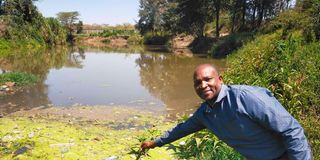
Daniel Wanjuki, an environmental scientist, showing Azora (Nile cabbage) that covers a section of the polluted Athi River in Machakos County on December 20 2025.

What you need to know:
- Once home to hippos and fresh water, the river is now a stagnant sewer used for irrigation, sparking fears of a public health disaster for thousands downstream.
Heavy pollution and the adverse effects of climate change are choking the iconic Athi River, endangering the lives of thousands of residents in Athi River township, Machakos County, and communities downstream.
The vibrant flow of water and the thriving aquatic life—hippopotamuses and diverse fish species that locals say once defined the River Athi in the 1980s and 1990s—are gone.
Now, stagnant water blanketed by Azolla (Nile cabbage) and the emission of methane gas signal a river in decline.
Residents report that raw sewage flows freely into the river from informal settlements and factories. Several high-end rental and commercial buildings in the township and adjacent estates are also accused of discharging untreated waste directly into the the iconic river.
In 2020, dozens of fish and fingerlings were found dead along the banks of the River Athi within Mavoko township, following allegations that a local company had discharged chemically-tainted effluent into the water. This incident underscored the severe pressures facing the river, which winds from the Mbagathi area in Nairobi through parts of Kajiado, Ngong, Mavoko, Joska, and onward to Thika.
Today, the river flows through the heavily industrialised and populated Athi River township, where it remains the sole water source for many communities. Once a lifeline that provided clean water for decades and home to thriving aquatic life, the river now represents a stark example of industrial pollution and ecological decline.
James Musyoka, 56, a resident of Athi River, told Healthy Nation that since 2017, the river has largely dried up, flowing only during rainy seasons and even then, it often breaks its banks, flooding the dozens of families who have encroached on its riparian land. At least six slums now line its course.
Flowed in abundance
“I was born and raised here. In the 80s and 90s, fresh water flowed in abundance. We used it for everything at home,” said Musyoka. “Fish and hippos thrived in the river. Now, the riverbed is mostly dry, broken only by lagoons of foul-smelling, stagnant water.”
Today, the view from the Namanga Highway Bridge reveals a stark contrast to the past: an empty river bend and stagnant lagoons of sewage. Here, where fresh water once flowed, locals from nearby slums now sunbathe on the parched bed. The erratic impacts of climate change have taken a severe toll on the river’s flow.
Near Bridge 39, on the south side of Athi River township, dozens of farmers continue to irrigate their crops using the polluted water despite the known health risks posed to consumers of their produce.
The National Assembly Public Participation Committee, chaired by Kitui East MP Nimrod Mbai, noted in a report approved on April 11, 2024, that severe pollution in the river is largely caused by both industrial and domestic waste from upstream companies and the Mavoko industrial zone.
Over several months, the 15-member committee inspected the river from Nairobi City downstream through Mwala Constituency to the outlet at Thwake Dam.
The committee also conducted on-site visits to industries accused of discharging raw effluent and summoned key stakeholders for questioning. These included the management of the Export Processing Zone (EPZ), the Mavoko Water and Sewerage Company, and the County Government of Machakos.
The committee recommended a formal engagement with the government chemist and the National Environment Management Authority (Nema). The goal was to identify the specific chemicals and heavy metals contaminating the River Athi and trace them back to the offending companies. It mandated that, within 60 days, the government chemist in collaboration with the Water Resources Authority (WRA) produce a sample analysis report. This report would then empower the WRA to issue immediate restoration orders to the polluters.
The committee further ordered Nema to conduct inspections of all companies and industries within the River Athi basin and submit a report to the relevant parliamentary committee within six months, among other recommendations to curb pollution.
However, a recent Healthy Nation spot check of the River Athi within Mavoko area, at least a year after the report was adopted by the National Assembly, revealed that heavy pollution continues unabated. Sprawling informal settlements were observed emptying both solid and liquid waste directly into the already choked river, indicating a significant failure in implementing the committee's directives and enforcing environmental regulations.
Daniel Wanjuki, 53, a lead expert and environmental scientist, told Healthy Nation that alongside the severe pollution, which is causing dangerous methane gas emissions, climate change has significantly impacted the river.
“The river is dying due to global climate change. The water that once flowed from Ngong Hills is gone, as the water towers suffer the effects of climate change. Additionally, farmers upstream have diverted water for irrigation,” explained Wanjuki.
The expert, who is also a member of the International Organization for Standardization, further explained that the effluent discharged from companies contains heavy metals.
These metals do not break down easily and form a layer on the water's surface, which acts as a catalyst for producing dangerous methane gas.
“The river is now choked with textile materials, plastic, and other solid waste, all covered by the Azolla plant. We have detected emissions of methane gas, which significantly contributes to global warming. We are courting disaster with our heavily polluted rivers,” he added.
The dusty industrial zone of Athi River township hosts textile, agro-chemical, liquor, leather, cement, steel, and pharmaceutical companies, whose collective impact continues to strain the dying river.