Acute milk shortage continues to bite as prices double in some regions

A shopper carries a basket with milk. A 500ml packet of processed milk has become scarce and now retails at up to Sh100 in some regions.

What you need to know:
- A 500ml packet of processed milk has become scarce and now retails at Sh100.
- A 250ml packet, which ordinarily sells for between Sh25 and Sh30, now costs Sh50 to Sh60 as supplies have remained low.
Acute milk shortages across the country continue to bite, with prices rising by an average of 100 per cent over the past week in some regions.
In South Rift, the shortages have affected Bomet, Narok and Kericho counties, which are major sources of milk in the region.
A 500ml packet of processed milk has become scarce and now retails at Sh100, up from between Sh50 and Sh55 in shops and supermarkets.


A 250ml packet which ordinarily sells for between Sh25 and Sh30 now costs Sh50 to Sh60 as supplies have remained low over the past two weeks.
“Currently, a litre of raw milk which sold for between Sh50 and Sh60 now retails for Sh100, with demand outstripping supply,” said Mr Peter Bett, a milk vendor in Bomet town.
Also Read: Are Kenya’s cows stressed? Expert explains milk shortage, gives tips for detecting adulteration
Hotels, schools and hospitals are among those most affected by the shortages, which are expected to persist until the anticipated rains are received in parts of the country.
Mr Bett attributed the decline in production to the ongoing drought, which has reduced the availability of pasture.
Ms Beatrice Kering, a farmer in Sogoo, Narok County, said the high cost of commercial animal feed has also affected milk production, as farmers struggle to afford feed for their livestock. The rising cost of production has, in turn, pushed up retail prices.
“Local streams and water sources have dried up, there is a sharp decline in water volumes in rivers and pasture has been depleted both in stores and fields,” Ms Kering said on Tuesday.
Farmers engaged in pasture production, both on a subsistence and commercial scale, have recorded poor harvests over the past three months. A bale of Boma Rhodes grass now retails for an average of Sh280 to Sh300 in the South Rift region.
Milk from Bomet and Kericho is supplied to outlets in Kisumu, Kisii, Nyamira and Narok counties. However, declining production has affected the business over the past three months, with the situation worsening by the day.
Local cooperative societies have reported a decline in raw milk deliveries by farmers, with some recording drops of up to 50 per cent as vendors increasingly source fresh milk directly from farmers.
The government has admitted that the shortages of milk has partly been contributed by the low payments dairy farmers get from some cooperative societies in their backyards.
Principal Secretary for Livestock Development Jonathan Mueke said the prevailing drought conditions were not the only contributing factors in the shortages being realised across the country that have seen price hikes in the last few months.
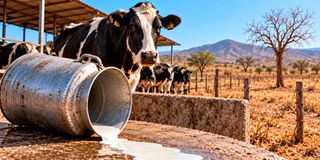
Declining production has affected the milk business over the past three months, with the situation worsening by the day.
Also Read: Kenyans face longer wait for milk on shelves
“The cooperative societies that are paid high prices by the processors should pay farmers well so as to spur production. Some of the cooperatives, unfortunately, underpay the dairy farmers for their supplies, thus discouraging those involved in the sector,” Mr Mueke said on Tuesday.
Mr Mueke stated, “Some of the farmers have chosen to take their produce to the informal sector, which offers them better prices. It is important that dairy-based cooperative societies pay the farmers well for milk supplies”
The PS revealed that some of the dairy farmers were considering quitting the enterprise altogether as a result of the poor milk prices and high production costs.
Most of the processors in the country go through cooperative societies which have the milk in bulk, to get the supplies which are transported with cooling tanks to various factories for processing and release to the retail market.
Consumers have also been flocking to milk-cooling plants, with some making prepayments to secure supplies as demand continues to outstrip supply.
County governments in the region have supported cooperative societies in improving livestock breeds among their members in an effort to boost milk production, including through the deployment of animal production and veterinary officers.
“The county government of Bomet has subsidised artificial insemination, which has led to improved dairy livestock in the region and, subsequently, higher milk production. But the prevailing drought has negatively affected production,” said Dr Kibet Sitienei, Bomet County Chief Officer for Agriculture and Livestock Production.
Dr Sitienei said farmers were being encouraged to harvest and store rainwater, produce pasture in large quantities and preserve it for use during dry seasons to stabilise milk production.
“Without water and pasture, milk production will be negatively impacted, thus the need for intervention measures, including early planning and raising pasture production levels, especially during rainy seasons,” Dr Sitienei said.
Nakuru, Narok and Kericho are the region’s leading producers of pasture because of the large farms that are still available. In Bomet, land fragmentation has affected pasture production over the years.
Milk shortages have been reported across the country for the past two months, with some supermarkets running out of stock.
Follow ourWhatsApp channel for breaking news updates and more stories like this.