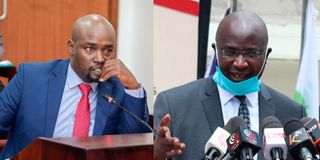
The spotlight on corruption intensified on Thursday after President William Ruto’s tough talk on graft coincided with the Director of Public Prosecutions (DPP) clearing charges against Bomet Governor Hillary Barchok and former Bungoma Governor Wycliffe Wangamati.
Dr Ruto’s declaration on Wednesday that “no office, no title and no individual is above the law” now piles pressure on sitting and former county bosses under investigation, coming just a day after DPP Renson Ingonga confirmed that the two governors will face trial over conflict of interest and embezzlement of public funds.
The twin developments signal an escalation of the State’s anti-graft war, with at least six serving governors and 11 former county chiefs said to be on the radar of the Ethics and Anti-Corruption Commission (EACC).
The charges against Dr Barchok and Mr Wangamati are expected to test whether the renewed political will expressed by President Ruto will translate into actual convictions in court.
Analysts say the move marks a defining moment in the country’s fight against corruption, especially in the counties where accountability for billions of shillings allocated annually has remained elusive.
Governor Barchok’s case follows the review of inquiry files from the Ethics and Anti-Corruption Commission (EACC), which had been investigating allegations of conflict of interest against him over a tender worth Sh2,750,500 awarded to companies that traded with the county between the 2019/2020 and 2024/2025 financial years.
The county boss is accused alongside the director of Chemasus Construction Limited Evans Kipkoech Korir, which was awarded the tender.
The Bomet Governor faces two charges: conflict of interest, contrary to Section 42(3) as read with Section 48 of the Anti-Corruption and Economic Crimes Act, 2003; and unlawful acquisition of public property, contrary to Section 45(1)(a) of the same Act.
In addition, Governor Barchok, Mr Korir and Chemasus Construction Limited will face charges of acquiring proceeds of crime, contrary to Section 4(a) as read with Section 16 of the Proceeds of Crime and Anti-Money Laundering Act, 2009.
The DPP also concluded its review of files implicating former Bungoma Governor Wycliffe Wangamati, who is accused of embezzling Sh70,205,882 together with relatives and county officials through private companies.
“Upon thorough review, I have directed that the following individuals be charged: Wycliffe Wangamati, with conflict of interest contrary to Section 42(3) as read with Sections 38 and 48 of the Anti-Corruption and Economic Crimes Act,” Mr Ingonga said.
The DPP added that Michael Wangamati, Nicholas Wangamati, and Edward Barasa Wangamati — directors of Skyman Freighters Ltd and Nabwala Construction Ltd — will be charged with acquiring proceeds of crime.
Others implicated include Edward Maaya Makhanu (Director of Fastec Suppliers Ltd), Sandra Soita Nasambu, Valeria Construction Ltd, and Wakoli Chesitit, who will face charges of aiding fraudulent practices in a procurement process.
The DPP further directed the EACC to reopen investigations into allegations of conflict of interest against the Marsabit County Finance and Economic Planning Executive in relation to tenders awarded by the county government to six companies.
According to the DPP, the files showed payments amounting to Sh309 million between the 2016/2017 and 2023/2024 financial years, but contained gaps that require further investigation.
Additionally, the DPP has returned two corruption files from Kiambu County and another from Marsabit County for further inquiry.
This comes a week after EACC Chief Executive Officer Abdi Mohamud revealed that at least six sitting governors and 11 former governors are under investigation for corruption-related offences.
The approval of charges comes a day after President William Ruto acknowledged the presence of corruption within the Executive and vowed a more aggressive approach to ensure those stealing taxpayers’ money are arrested and prosecuted.
While leading the country in commemorating Katiba Day in Nairobi, the President said there would be no climb-down in his administration’s sustained crackdown on corruption.
Dr Ruto declared that more heads would roll in the fight against graft, which he admitted had permeated all arms of government and dented the image of his administration.
“Yet, I admit there is still much more to be done to combat corruption within the Executive. Corruption must be chased down every alley, every corridor and every corner of the Executive by every well-meaning citizen whenever it is spotted. I fully support the rigorous and expeditious prosecution of any corruption case backed by evidence. This is the only way to restore trust, uphold the Constitution, and assure Kenyans that no office, no title, and no individual is above the law,” Dr Ruto said.
The President said he had personally drawn the line on pervasive corruption and challenged the Judiciary and other multi-agency teams mandated to fight graft to do the same.
His remarks are seen as an affirmation of his intention to put more effort into the anti-corruption war in his first term.
“Parliament, too, must rise to its duty by passing laws that entrench transparency and close avenues for abuse. I commend Parliament for passing the Conflict of Interest Bill, which I have signed into law. This law strengthens ethical standards and closes loopholes that allowed abuse of office,” he said.
He further urged the Judiciary to confront corruption within its own ranks, stressing the importance of impartial and swift justice.
“The Judiciary must guarantee swift, impartial and credible justice. Justice delayed, including in corruption cases, is justice not only deferred but also denied. “If the institution mandated to dispense justice is perceived as corrupt, it not only erodes confidence but undermines the very Constitution it is sworn to protect. The Judiciary must rise to its highest calling: to cleanse itself, uphold its independence with integrity, and prove itself the true temple of justice for all Kenyans,” he added.
The President warned that judicial corruption, if unchecked, threatens to derail the promise of the 2010 Constitution.