President William Ruto’s meeting on Friday with a section of Kisii and Nyamira legislators was framed publicly as a routine development briefing, but it underscored a deeper recalibration now underway in the Gusii region, where former Interior Cabinet Secretary Fred Matiang’i has emerged as a formidable rallying point for opposition forces ahead of the 2027 elections.
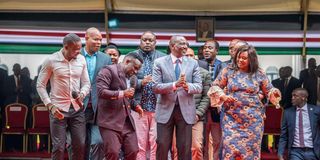
The closed-door engagement at State House, which lasted about two hours, brought together lawmakers allied to the ruling United Democratic Alliance (UDA) and a handful of opposition figures who have recently shifted toward President Ruto’s “broad-based” government.
While participants insisted that development was the sole agenda, the timing and composition of the delegation pointed to a more strategic objective which is reclaiming political ground lost in recent by-elections and blunting Mr Matiang’i’s growing appeal.
The meeting came barely weeks after candidates associated with Mr Matiang’i and the Jubilee Party swept ward by-elections in Nyamira County, dealing a symbolic blow to UDA-aligned leaders and raising questions about the ruling party’s grip on a region long regarded as politically fluid.
South Mugirango MP and National Assembly Majority Whip Silvanus Osoro, who led the delegation, dismissed suggestions that Matiang’i featured in the State House discussions.
“Matiang’i is a non-issue to ever be placed on a serious menu for discussion, especially one chaired by HE (the President),” Mr Osoro said. According to him, the talks focused on preparations for President Ruto’s planned development tour of the Gusii region later this month, during which several projects are expected to be launched or commissioned.
Yet Mr Osoro’s own remarks outside the meeting betrayed the political anxieties animating the outreach. In a sharp critique, Nyaribari Chache MP Zaheer Jhanda questioned Mr Matiang’i’s organisational capacity and dismissed his mobilisation efforts as informal and unserious.
“We cannot support someone just because he comes from the Kisii region,” Mr Zaheer said, arguing that national leadership demands structured campaigns and resources. “He has been fundraising on WhatsApp for his engagements. Do you expect me to take him serious?”
At the centre of the development agenda discussed was a Sh4.7 billion cancer treatment centre, jointly funded by the Kenyan and Saudi governments, alongside a slate of road infrastructure projects earmarked for tarmacking across Kisii and Nyamira counties.
UDA leaders have increasingly leaned on such projects as tangible evidence of government presence, hoping development delivery can translate into political loyalty.
Kisii Senator Richard Onyonka, however, offered a sharply different reading of the political mood in the region, arguing that the State House outreach is disconnected from the realities on the ground.
According to Mr Onyonka, the electorate has already made up its mind and is firmly aligned behind Dr Fred Matiang’i, not out of ethnic sentiment but frustration with what he described as a persistent failure by the political class to listen to the people.
In his view, the losses suffered by UDA-linked candidates reflected accumulated anger over unfulfilled promises, rising living costs and what residents perceive as transactional politics. Mr Onyonka suggested that the rush by some leaders to seek proximity to State House risks deepening that disconnect.
“Politics is about choices, and all choices have consequences,” Mr Onyonka said. “But I do wish them the best. I wish them well.”
His remarks sharpen the contrast between two competing strategies now playing out in the Gusii region: one anchored in state power, development projects and access to resources; the other rooted in popular sentiment and the symbolic weight Matiang’i continues to carry as a national figure perceived to have stood up to political authority.
The Gusii region represents both risk and opportunity for President William Ruto. While he performed relatively well there in the 2022 election, his support has since been tested by economic pressures, localised political discontent and Mr Matiang’i’s re-emergence as a potential national figure with deep roots in the area.
The inclusion of Nyaribari Masaba MP Daniel Manduku in the State House delegation illustrated this shifting terrain in the region. Mr Manduku, elected on an ODM ticket has been a supporter of Mr Matiangi’s presidential bid. He recently announced his decision to support the President’s broad-based government, citing the need for unity and development. After the meeting, he said President Ruto had committed to commencing construction of the Keroka–Ibacho–Kiamokama–Nyanturago–Ekona road by February 2026.
Also present was Bonchari parliamentary aspirant Jonah Ondieki, an ODM-affiliated figure who struck a cautious tone after the meeting. While affirming support for the President’s development agenda, he emphasised that such backing would not be unconditional. “Loyalty to the nation must always supersede loyalty to individuals,” Ondieki said, pledging to speak out against any actions that violate the Constitution or the rule of law.
The delegation at State House also reflected the breadth of the coalition UDA is attempting to assemble in Gusii. It included UDA National Treasurer Japheth Nyakundi, Kisii Woman Representative Dorice Aburi, Nyamira Woman Representative Jerusha Momanyi, UDA Nominated Senator Essy Okenyuri, and MPs Joash Nyamoko (North Mugirango), Zaheer Jhanda (Nyaribari Chache) and Irene Mayaka (ODM Nominated).
Over the past month, Osoro and his allies have intensified grassroots mobilisation across Kisii and Nyamira counties under the banner “Uongozi Mashinani,” holding rallies and conducting door-to-door engagements to drum up support for government initiatives. Analysts say the effort is as much about restoring political confidence after recent electoral losses as it is about countering Matiang’i’s narrative.
That strategy has not been without controversy. At several rallies, Osoro and his team have openly acknowledged the distribution of cash -locally referred to as “goserwa”- to attendees, a practice critic argue reinforces patronage politics. Mr Osoro has been unapologetic, framing the approach as political realism rather than inducement.
“Ruto has the purse of Kenya,” he told residents at a recent gathering, urging them to support the government to benefit from development. He likened political competition to an open market, where voters are free to choose among competing offers.
With Mr Matiang’i’s shadow looming large and 2027 slowly coming into view, the State House meeting signalled that the battle for Gusii loyalty has entered a more deliberate and openly strategic phase.