Mineral-rich counties which have been starved of billions in mineral royalties will begin receiving their shares from next month, with some Sh2.9 billion currently held at the National Treasury according to Mining Principal Secretary (PS) Harry Kimtai.
This development follows mounting pressure from senators who demanded an explanation for the prolonged delay in disbursing the royalties to beneficiary counties and mining-affected communities. The delays date back as far as 2016.
Appearing before the Senate Lands and Environment Committee, Mr Kimtai explained that the delay in disbursement was due to the lack of enabling legislation to guide the process.
This comes after leaders from mineral-rich counties accused the government of deliberately withholding the funds.
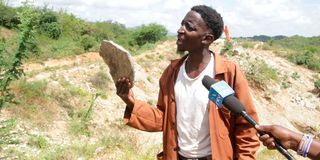
Harrison Kiura, a resident of Embu County, displays a piece of mica mineral at a coltan mining site at Kiangunguru village on February 2, 2024.
Photo credit: Joseph Kanyi | Nation Media Group
However, the PS clarified that the royalties are currently held in the Consolidated Fund and cannot be released until enabling legislation is gazetted by Attorney-General Dorcas Oduor.
At least 32 counties are yet to receive their mineral royalties. Some of the biggest beneficiaries include Kwale, Kajiado and Kilifi, while others include Makueni, Taita Taveta, Homa Bay, West Pokot, Kericho, Kakamega and Elgeyo Marakwet.
The PS cited Kwale County as an example, noting it is owed more than Sh1.38 billion in mineral royalties by the national government.
The Mining Act, 2016 stipulates that royalties paid by holders of mineral rights are to be shared among the national government, county governments and communities in a 70-20-10 percent ratio respectively. However, the Act lacked clarity on how this distribution should be executed.
PS Kimtai disclosed that the ministry has since developed the the Mining (Mineral Royalty Sharing) Regulations which is currently awaiting the Attorney-General’s approval and subsequent gazettement expected later this month.
Although he admitted that the process has taken a long time, the PS assured the committee chaired by Mombasa Senator Mohamed Faki that the process is nearly complete. He said the department has addressed the AG's proposed amendments and resubmitted the regulations for gazettement.
Additionally, the ministry has already prepared a disbursement schedule and submitted it to the National Treasury. The only step remaining is the allocation of funds to pave the way for distribution.
“What we need are the regulations to guide the process, and they are now ready. We are just waiting for their gazettement. This will allow for the allocation of what we have collected so far and subsequent disbursement,” said Mr Kimtai.
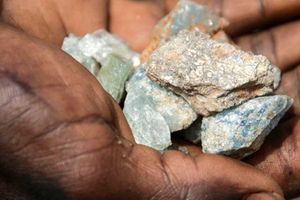
A resident of Embu County displays samples of precious stones extracted at a mining site in Kiangunguru village on February 2, 2024.
Photo credit: File| Nation Media Group
“Once we get the approval, we will start requesting the funds this financial year. I agree that we need to move with speed,” he added.
Official data shows that at least Sh7.5 billion has been collected from mineral royalties in Kenya since 2016.
Kirinyaga Senator James Murango questioned why the ministry took so long to finalise the regulations causing delays in disbursement.
“When will this process end? It has dragged on for more than a year. This is unfair to the beneficiary counties and communities,” said Mr Murango.
Senator Faki inquired why counties and communities cannot be allowed to open their own accounts so that royalties could be deposited directly instead of being swept into the Consolidated Fund.
“Our people are suffering from Migori and Kakamega to Kwale. Why can’t you just send the money directly to them once it is collected? Look at Base Titanium which wound up its operations in Kwale yet the county and community have not received any royalties,” said Mr Faki.
In response, Mr Kimtai said the Treasury has now allowed the ministry to open a royalty account which will be used to hold the counties’ and communities’ share of royalties moving forward.
He explained that the lack of such an account previously meant all royalties were swept into the Consolidated Fund.
“I will only be disbursing the 70 percent due to the national government to the Consolidated Fund,” he said.
The PS acknowledged that the delay in disbursing royalties has made communities increasingly hostile toward mining firms seeking permits.
“Any mining firm that goes to request a permit from the community now faces a challenge,” he said.
Section 183 of the Mining Act, 2016, requires that holders of mineral rights pay royalties to the State for minerals won under the license. The resulting revenues are then to be shared among the national government, beneficiary counties, and local communities.