High school principals are in a dilemma over a directive to remove and dispose of asbestos roofing materials, which poses a health risk to the students and staff with the continued deterioration of the roofing.
Chief principals of Mangu High School, Kenya High School, Alliance High School, Limuru Girls School, Starehe Boys Centre and School, and Kabare Girls High School say they require huge finances, face disposal challenges, and lengthy approvals from the environmental watchdog to reroof century old colonial buildings.
Appearing separately before the National Assembly’s Public Investment Committee on Education and Governance, the principals said disposal of the asbestos materials is the greatest challenge.
The principals appeared before the committee chaired by Luanda MP Dick Maungu to respond to audit queries for financial years 2020/21 to 2024/25.
Auditor General Nancy Gathungu had, among other issues, flagged the use of asbestos roofing materials in a number of schools.
Ms Gathungu found that Mangu High School has 16 staff houses, two laboratories, 14 classrooms, 10 dormitories, three laundries, one library, two workshops, one dining hall, and one administration block with asbestos roofing.
She said the Fourth Schedule of the Environmental Management and Coordination (Waste Management) Regulations, 2006 classifies materials containing asbestos as hazardous and potentially carcinogenic.
“Physical verification of the school's infrastructure conducted in March, 2026 however, revealed 16 staff houses, two laboratories, 14 classrooms, 10 dormitories, three laundries, one library, two workshops, one dining hall, and one administration block with asbestos roofing,” Ms Gathungu said.
“This was contrary to the Ministry of Environment, Climate Change and Forestry circular Ref: MEF/EMCl111 dated August 23, 2024 that directed the removal of asbestos roofing by government agencies including offices, houses and learning institutions' premises as a means of providing a clean, safe, healthy and sustainable environment.”
Ms Gathungu said in the circumstances, the school poses a health risk to the students and staff with the continued deterioration of the roofing.
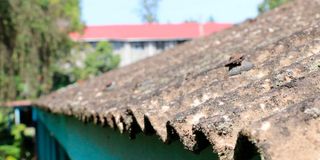
Asbestos roofing at a primary school in Nakuru City on April 2, 2025.
Photo credit: Boniface Mwangi | Nation Media Group
The directive by the Ministry of Education follows the Cabinet approval in 2025 requiring nationwide asbestos removal from all public and private facilities in a bid to enhance public health and safety.
The Cabinet chaired by President William Ruto said the directive would mitigate health risks associated with asbestos exposure.
"Asbestos, extensively used in Kenya’s construction industry in the 1960s and 1970s, remains in government buildings, hospitals, schools, and even water supply systems,” the cabinet said while announcing the ban.
The Cabinet said asbestos is classified as a human carcinogen, with the exposure linked to severe health conditions including lung cancer and mesothelioma, a cancer that develops in the tissue lining of the lungs, abdomen and heart.
It mandated the National Environment Management Authority (Nema) to oversee the safe removal, disposal, and handling of asbestos with county governments asked to establish designated disposal sites, with property owners directed to bear the costs of removal under the ‘Polluter Pays’ principle.
Mangu High School chief principal Bernard Kingah told MPs that whereas the school had managed to remove asbestos roofing from some classes, there remains a challenge to remove all roofing materials.
“We have written to the Ministry of Education to assist us finance the removal of asbestos materials in phases,” Dr Kingah said.
“We have ageing buildings that were constructed during colonial times. We intend to continue removing the asbestos roofing particularly during the long school holidays of November to December.”
Appearing before the MPs separately, Kenya High School chief principal Edith Koech said the institution has some buildings with asbestos roofing and has reached out to experts on how to replace and dispose of the materials.
“We have some buildings with asbestos and we have reached out to experts. We are yet to receive a report from Nema on how to work on its removal,” Ms Koech said.
“We are also looking for funds to redo the roofing. We understand it will cost a lot of money but we have not done the costing. Nema has assessed the buildings and we are waiting for its final report.”
At Alliance High School, Ms Gathungu said physical verification of the school's infrastructure conducted in March 2026 revealed that the school had three staff houses and five dormitories with asbestos roofing.
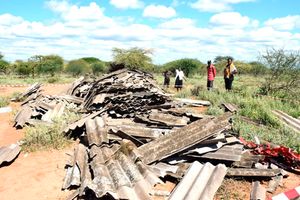
Asbestos, extensively used in Kenya’s construction industry in the 1960s and 1970s, remains in government buildings, hospitals and schools.
Photo credit: Shutterstock
Ms Gathungu said a site visit to Limuru Girls School infrastructure conducted on March 3, 2026 revealed the existence of two dormitories with asbestos roofing.
“The school poses a health risk to the students and staff with the continued deterioration of the roofing and management was in breach of the law,” Ms Gathungu said in the report.
At Kabare Girls High School, the auditor found that the school’s buildings and structures are roofed with asbestos roofing material that were installed over 30 years ago.
She said asbestos has been listed as a hazardous substance and its threshold limit values are given, therefore the Nema rules, 2026 apply to all workplaces where asbestos is present.
“As at the time of the audit in April, 2025, even though the school made an application to have the matter resolved, no evidence has been provided on any action taken by the Ministry of Education to solve the issue of asbestos roofing,” Ms Gathungu said.
“This means that the students as well as other stakeholders, continue being exposed to the hazardous effects of the asbestos roofing. Management was therefore in contravention of Factories and Other Places of Work (Hazardous substances) rules, 2007.”
Starehe Boys Centre and School audit revealed that students and staff were being housed in asbestos roofed structures hence exposing them to the risk of poisoning.
“This is contrary to Section 3 of the Public Health Act Cap 247) which requires that a provision may be made by regulations under the Act for the purpose of protecting persons against risks of poisoning by poisonous substances arising from the use of those poisonous substances and employment of employees at places in which or on which those poisonous substances are being or have been used; and Regulations for protection of persons against risks of poisoning,” Ms Gathungu said.
Limuru Girls High School chief principal Susan Kariuki acknowledged Ms Gathungu’s findings that there is existence of two dormitories with asbestos roofing.
Ms Gathungu said the continued use of asbestos roofing was contrary to Ministry of Environment, Climate Change and Forestry Circular Ref: MEF/EMC/1/1 dated August 23, 2024 that directed on the removal of asbestos roofing by government agencies including offices, houses and learning institutions' premises as a means of providing a clean, safe, healthy and sustainable environment.
Kiminini MP Kakai Bisau asked the principals to approach roofing materials firms such as Mabati Rolling Mills to chip in as part of community social responsibility.