Six counties that have not had electricity for years can now breathe a sigh of relief after Parliament approved Sh600 million to jumpstart 13 dead mini-grids.
The 13 mini-grids are in Mandera, Samburu, Wajir, Turkana, Marsabit, and Lamu counties.
The National Assembly’s Public Investment Committee on Commercial Affairs and Energy, however, rejected Treasury’s proposal to reallocate Sh1 billion in the 2025/26 budget for Rural Electrification and Renewable Energy Corporation (Rerec).
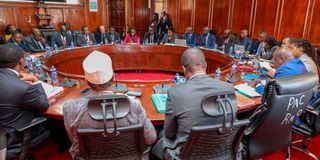
The committee chaired by Pokot South Member of Parliament David Pkosing directed Treasury Principal Secretary Dr Chris Kiptoo and his Energy counterpart, Mr Alex Wachira, not to touch the Sh1 billion that is meant for public facilities.
This follows revelations by Mr Wachira that the Treasury proposal to reallocate Sh1 billion would affect public services such as electrification of schools, hospitals, and markets.
“We do not agree with the Treasury proposal to relocate Sh1 billion from the Rerec budget because it will affect electrification of public institutions,” Mr Wachira said.
The parliamentary committee had invited Dr Kiptoo, Mr Wachira, Kenya Power and Lighting Company, Rerec, and Energy and Petroleum Regulatory Authority (Epra) to a round table meeting to discuss payment of Sh30 billion owed to Kenya Power for the Rural Electrification Scheme.
Kenya Power is owed the money by the Ministry of Energy and the National Treasury for provision of subsidised power under the Rural Electrification Scheme, which the utility firm administers on behalf of the government.
The scheme is funded by the government and implemented by Kenya Power on behalf of the Ministry of Energy and Petroleum. It is considered sub-economic as operational and maintenance costs exceed revenue. It was agreed that the government will reimburse Kenya Power any deficit arising from the scheme.
Dr Kiptoo told the committee that to repay the debt, electricity tariff had been increased to support the Rural Electrification Scheme from Sh1.4 billion to Sh2.5 billion per year. The Treasury provides Exchequer funding of Sh800 million annually and Epra approved a pass-through for the average annual deficit of Sh5.6 billion to forestall future accumulation.
The PS said the mechanisms had reduced the Rural Electrification Scheme deficit to Sh25.33 billion by June 2024.
“To resolve the accumulated deficit, the National Treasury proposes an increase of the Exchequer allocation for the Rural Electrification Scheme for Kenya Power from Sh261 million to Sh1.66 billion in the 2025/26 financial year,” Dr Kiptoo said.
The meeting that was attended by Kenya Power Managing Director Joseph Siror, and Rerec Chief Executive Rose Mkalama was also meant to discuss issues surrounding 56 mini-grid generation stations operated by Kenya Power .
Out of this number, 30 hybrid stations (diesel and solar powered) are not functioning optimally due to non-functional lithium batteries and inadequate fuel storage infrastructure resulting in frequent power blackouts in remote rural areas.
Mr Pkosing said the mini-grids were white elephants. He said that they were to use solar during the day and switch to diesel at night, but were fitted with the wrong lithium batteries and small diesel tanks leading to power cuts.
“When will the 13 mini-grids that are currently in the Intensive Care Unit (ICU) be repaired for the people of seven counties to have power?” Mr Pkosing asked.
“We cannot be sitting here when people have no power and the Treasury and the Energy Ministry have money to supply this very critical services,”
Dr Kiptoo told the committee that after a high-level inter-agency consultation of key stakeholders, it was agreed that Rerec undertakes replacement of the non-functional lithium batteries and hybridise the mini-grids at an estimated cost of Sh5.2 billion.
He said Sh3 billion will be factored in the current financial year out of which Sh1.4 billion will come from payment of Rural Electrification Programmes five percent levy by Kenya Power to Rerec, Sh1 billion reallocations within the financial year 2025/26 budget for Rerec from public facilities and Sh600 million additional exchequer funding.
“In the financial year 2026/27, Sh2.2 billion balance will be prioritised in the national budget,” Dr Kiptoo said.
He said Treasury and Energy Ministries had agreed to separate functions between Kenya Power and Rerec where KPLC undertakes distribution and retailing of electricity while Rerec manages the rural electrification/ last mile schemes. Rerec will also manage and maintain mini-grid stations.
Mr Wachira told the committee that hybridisation of 20 diesel stations will cost Sh4 billion and includes replacement of defective batteries and upgrade of the hybrid generation.