Forty-five counties burned through Sh160.1 billion paying salaries, wages and allowances, while spending only Sh32.49 billion or 17 per cent on development programmes in the first six months of the 2025/26 financial year.
A new report from the Controller of Budget (CoB) covering the first half of the current financial year shows that counties spent almost four times more on payment of salaries and wages than on development activities.
Out of the recurrent expenditure, Sh115.39 billion was spent on employee compensation, accounting for 60 per cent of the total funds during the period under review. The balance of Sh44.71 billion, or 23 percent, went to operations and maintenance.
On the flip-side, only Marsabit and Mandera counties spent more than 30 percent of their budgets on development programmes.
Interestingly, the development expenditure for the first six months is only 14 percent of the annual development budget of Sh228.2 billion.
The disparities explain stalled projects in devolved units, as most counties continue to violate the Public Finance Management Act, which caps spending on recurrent expenditure at 35 percent of revenue for counties.
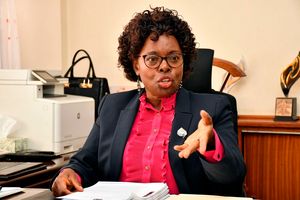
The expenditure details are contained in the county government's budget implementation review report for the first half of the financial year ending June 30, 2026, released on Monday by CoB Margaret Nyakang’o.
Controller of Budget Margaret Nyakango at a past event.
Photo credit: Jared Nyataya | Nation Media Group
According to the report, 17 counties had a development absorption of 10 percent or less of their annual development budgets during the period.
They include Laikipia, Nakuru, Mombasa, Migori, Kisii, Nyamira, West Pokot, Samburu, Nyeri, Kisumu, Vihiga, Nairobi, Kajiado, Elgeyo-Marakwet, Siaya, Tana River and Lamu.
Lamu and Tana River spent just three percent of their development budget, with Lamu spending just Sh41.6 million on development programmes while Tana River only put Sh121 million into projects.
Interestingly, Lamu spent Sh1.3 billion on recurrent activities, with Sh1 billion going toward payment of salaries, while Tana River spent Sh1.8 billion on recurrent activities, with Sh1.24 billion on compensation of employees.
Siaya Governor James Orengo.
Photo credit: Alex Odhiambo | Nation Media Group
Kajiado, Elgeyo Marakwet, Nairobi and Siaya spent about six percent of their total budget, while Vihiga managed only seven percent.
Mombasa, Laikipia, and Nakuru counties’ expenditure on development activities was at 10 percent.
Counties with development expenditure above 20 percent included Isiolo (25 percent), Garissa (24 percent), Kilifi and Bomet (23 percent), and Trans Nzoia and Wajir at 21 percent.
Nyeri, Samburu and Kisumu spent just eight percent on development, leaving the lion’s share of their budgets to recurrent activities.
Kisii County Governor Simba Arati.
Photo credit: Evans Habil | Nation Media Group
Governor Simba Arati’s Kisii, Migori of Ochilo Ayacko, West Pokot and Nyamira dedicated only nine percent of their total expenditure on development programmes.
Tana River, Kajiado, Siaya, Kisii, West Pokot, Vihiga, and Laikipia Counties now stand out as devolved units not keen on spending on development expenditure.
In the report for the first quarter, the seven counties were part of 20 county governments which did not spend even a shilling on development programmes.
Under Section 107(2)(b) of the Public Finance Management Act, 2012, county governments are required to allocate at least 30 percent of their budgets to development expenditure over the medium term.
Regulation 25(1)(g) of the Public Finance Management (County Governments) Regulations, 2015 further requires actual spending to align with this threshold, a benchmark many counties are yet to meet.
The Controller of Budget fingered counties over the low expenditure on development programmes, urging the devolved units to increase development expenditure.
“In the first half of FY 2025/26, development expenditure was Sh32.49 billion, translating to an absorption rate of only 14 percent of the total annual development budget of Sh228.20 billion,” said Dr Nyakang’o.
“Alarmingly, 45 counties reported development absorption rates below 29 percent, with only two counties exceeding 30 per cent, namely Marsabit (32 percent) and Mandera (30 percent).”
However, counties like Nairobi and Mombasa said they are grappling with huge wage bills, occasioning the high expenditure on personnel emoluments.
Nairobi Governor Johnson Sakaja at his office in Nairobi.
Photo credit: File | Nation Media Group
Governor Johnson Sakaja’s City Hall, for instance, spends some Sh1.5 billion monthly on its 19,000-plus employees.
“We are grappling with a lot of issues, including Mombasa having one of the highest wage bills among counties. What the Controller of Budget has does not mean work is not ongoing on the ground. At the end of the day, however, the proof of the pudding is in the eating,” said Governor Abdulswamad Nassir.