More than 1,000 days into President William Ruto’s tenure, his administration’s record on devolution presents a study in contrasts—marked by both progress and persistent shortcomings.
To supporters, President Ruto has shown a firm commitment to devolved governance, working with governors across the political divide and launching regional development projects. Critics, however, contend that his administration has failed to resolve long-standing challenges faced by county governments, and in some cases, has deepened them.
Some governors accuse the President of dragging his feet on key issues, while others commend him for fostering stronger ties between national and county governments, with tangible gains on the ground. Homa Bay Governor Gladys Wanga is among those who credit effective collaboration for her county’s notable progress.
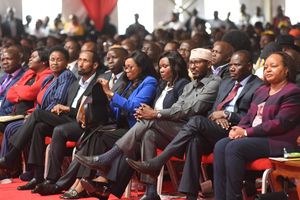
President William Ruto with governors and Ministry of Health officials during a meeting to prepare for the launch of Universal Health Coverage at State House, Nairobi.
Photo credit: PCS
“What we are learning is simple: when national and county governments truly work together, devolution stops being just an idea and becomes a driver of real change in people’s lives. We’re seeing improvements that create jobs and boost local enterprise,” she said.
Her administration cites improved road infrastructure that has eased the transport of farm produce, benefiting local farmers. Flagship projects include the renovation of the Homa Bay Pier and the construction of an ultra-modern fish market—set to become East Africa’s largest freshwater fishing port.
Ms Wanga further lauds the hosting of Madaraka Day celebrations and the upcoming Devolution Conference as milestones of effective cooperation. Still, she acknowledges persistent challenges, citing “issues like delayed disbursements” that “undermine service delivery.”
“But if we can address these hurdles, the potential of our lake economy is immense.”
Yet elsewhere, optimism is in short supply. Counties continue to grapple with delayed transfers, inadequate allocations, and disputes over devolved functions under Schedule Four of the 2010 Constitution.
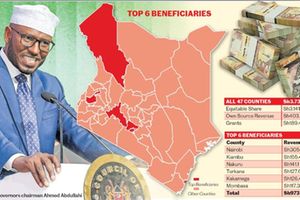
Funding remains the most contentious issue. County governments have on occasion, threatened to shut down operations over delayed disbursements. The Council of Governors has strongly opposed the proposed Sh405 billion allocation in the 2025 Division of Revenue Bill, far below its recommended Sh536.88 billion.
The Orange Democratic Movement party, which is led by Mr Raila Odinga , has included devolution among its top 10 demands to President Ruto. Its memorandum calls for protecting devolution from roll-backs, ensuring timely and predictable transfers, and increasing county budgets.
Critics also argue that the national government is reluctant to cede full control over key functions and resources. On regional tours, President Ruto has pledged millions for markets, hospitals and water projects—areas constitutionally assigned to counties—drawing criticism from leaders such as Kisumu Governor Prof Anyang’ Nyong’o. On 22 April 2025, he accused the President of reversing devolution gains.
“Governors have proven they can manage health services effectively. They should be entrusted with other devolved functions, including roads,” he said, while accusing the Ruto administration of “regressing to the Nyayo era.”
“The 2010 Constitution stands in the way of (the administration’s) primitive accumulation schemes,” he wrote.
Mr Odinga has echoed these sentiments, calling for the abolition of national road agencies and the transfer of their responsibilities to counties. He has also demanded the removal of the National Government Constituency Development Fund from MPs, arguing they cannot be both implementers and overseers. There have been signs of progress.
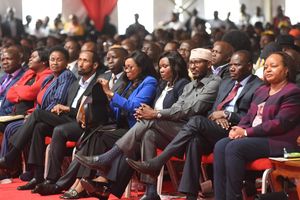
County Governors during the Biennial Devolution Conference at Eldoret Sports Club in Uasin Gishu County on August 17, 2023.
Photo credit: File I Nation Media Group
On December 16, 2024, the transfer of multiple functions from the national government to counties gained momentum following their official gazettement. At the 11th National and County Governments Coordinating Summit at State House, Nairobi, President Ruto directed that funding for these functions be included in the new financial year starting July.
“I now direct the committee to take the next step by systematically identifying and transferring the requisite budgetary and other resources linked to these functions,” he said, referring to the Inter-Governmental Relations Technical Committee, which facilitated the unbundling process.
The President reaffirmed his commitment to resolving county challenges, citing fiscal constraints—including high public debt, pending bills, an unsustainable wage bill and inefficiencies in revenue collection—as the main obstacles.
“This challenge should not be mistaken for a lack of commitment to devolution. It is a temporary difficulty arising from inherited vulnerabilities and incomplete devolution implementation,” he said. He pledged continued engagement with counties to align strategic priorities.
Scepticism remains, particularly in the health sector. The Council of Governors recently rejected a national government proposal to shift payroll responsibilities for 8,571 Universal Health Coverage workers to counties, insisting that the state retain this obligation.
Deputy President Kithure Kindiki has emphasised that devolution remains central to bringing services closer to the people, decentralising power, and ensuring equitable development across the country.