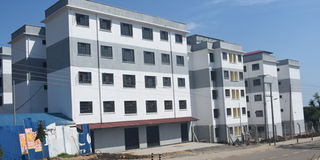
Boma Yangu Estate in Homa Bay County has won an award for incorporating environmental conservation features that will enable occupants to use less water and energy.
The affordable housing project comprises 110 units—30 two-bedroom houses, 40 one-bedroom units, 30 studio apartments, and two studio-cum-shops. It has taken the lead in environmental protection by using green materials.
This has resulted in the project being awarded the Excellence in Design for Greater Efficiency (EDGE) certification, which recognises green building practices.
Used in over 100 countries, EDGE is an international green building certification system. Created by the International Finance Corporation (IFC), a member of the World Bank Group, EDGE promotes designs that use less energy, water and embodied energy in materials.
Homa Bay affordable housing project in this photo taken on May 29, 2025.
Photo credit: George Odiwuor | Nation
EDGE recognition means that the building's orientation, window sizes and floor-to-ceiling height enable it to maximise natural lighting, meaning tenants can use natural lighting instead of electricity during the day.
At the same time, the design enhances ventilation in the houses, which is especially important given that Homa Bay is a hot area. Therefore, tenants will not need to use fans or artificial air conditioning.
This certification recognises the project's environmentally friendly design, which is expected to achieve energy savings of 27-30 per cent.
The National Housing Corporation's Managing Director of Construction and Project Management, Eng. Thomas Ofwa, said that one of the features that makes the buildings unique is the water-efficient plumbing system.
He said that the houses have aerators installed on the sanitary fittings to reduce water consumption.
This ensures only the right amount of water is dispensed, thereby conserving between 32-37 per cent of the water used.
“The toilets use three litres for short calls and six litres for long calls. Other toilets in other buildings can consume up to nine litres,” Eng Ofwa said.
Homa Bay affordable housing project in this photo taken on May 29, 2025.
Photo credit: George Odiwuor | Nation
In terms of lighting, the designers installed Light Emitting Diode (LED) bulbs that use less energy, ensuring between 52-62 per cent of energy is conserved.
“Lights in common places and the ones installed as security lights use solar energy,” he said.
To prevent occupants from using lights during the day, the windows have clear panes and are large enough to let in adequate light.
“Homa Bay is a hot area and some people would use fans and ACs when in the house. This project put this into consideration and the design ensures the rooms stay cool even on a hot day,” he said.
The buildings, which are located near the County State Lodge off the Homa Bay-Kendu Bay road, also have green spaces.
Tenants will use gas to cook. A gas tank will be installed by a provider, and tenants will connect to it to cook.
“Tenants will purchase gas as tokens and use it to cook,” Mr Ofwa said.
Homa Bay affordable housing project in this photo taken on May 29, 2025.
Photo credit: George Odiwuor | Nation
The first phase of the project has been completed, and President William Ruto is expected to hand over the keys to the new homeowners on Friday.
Architect Stanley Ng’eny said that the project's artisanal work was carried out by Homa Bay residents.
“All windows and other materials that could be assembled locally were made by artisans from Homa Bay,” he said.
It is estimated that Sh11 million was paid to local jua kali artisans for supplying doors and windows, and Sh1 million to local women's groups for landscaping services.
Around 2,000 skilled and unskilled workers were employed during the project's lifespan, all of whom were sourced from the local community.
Mr Ng’eny announced that the second phase of the project will begin soon. The buildings will be 10 storeys high and have lifts.