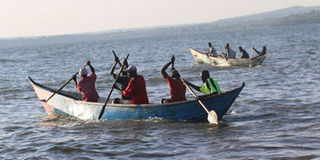
When a maritime accident occurs on the shores of Lake Victoria, fishermen often abandon their normal fishing activities and immediately launch a search-and-rescue mission.
For several minutes or even hours, they search for survivors. However, when time passes with no success, the operation shifts from rescue to the retrieval of bodies, as the community resigns itself to the belief that the victims have drowned.
What follows is a set of deeply rooted cultural practices that have been observed for generations among fishing Luo communities.
One of the first steps involves taking the personal belongings of the deceased to the beach and hoisting them on a pole. In most cases, fishermen use clothes that the deceased was particularly fond of. This practice is believed to ease the retrieval process and is firmly rooted in spiritual beliefs.
Lake Victoria near Rusinga Island in Homa Bay County.
Photo credit: File | Nation Media Group
Suba South Beach Management Unit (BMU) Chairperson William Onditi says there is a strong belief that bodies can be recovered more quickly if items that belonged to the deceased are placed in a public and visible location at the beach.
“Sometimes it takes up to four days for bodies to be retrieved from the lake after an accident. To ensure the exercise takes only a few hours, fishermen believe that hoisting items belonging to their departed colleagues helps speed up the process,” he said.
Even after death, fishermen believe the spirit of the deceased can still see and hear. Hoisting personal items is thought to alert the spirit and guide rescuers to the body.
“There is a belief that a dead fisherman will see his belongings hanging on the beach and make it easier for those searching to locate his body in the vast lake,” Mr Onditi added.
In some cases, fishermen also call out the names of the deceased when bodies cannot be spotted. This, they believe, causes the body to float to a position where it can be easily seen and retrieved.
This practice was evident at Sindo Beach in Suba Central, where three fishermen drowned last Wednesday.
The men died after their boat was hit by a ship sailing across the lake near the Kenya-Uganda border. They were identified as Wycliffe Ouma Mino, 30; Fredrik Odhiambo Onditi, 31; and Brian Onyango, 20.
By Saturday evening, two bodies had been retrieved and were kept at the beach, as fishermen believed this would help in locating the third body.
At the beach, portraits of the deceased were also hung in public view, with the belief that seeing their images would prompt their spirits to guide the search.
Beyond hanging personal belongings, families of the deceased also participate in the search process. Although they do not enter the lake, they remain at the shore, a presence believed to be spiritually significant.
Camping at the lakeshore following a drowning incident is a common practice among the Luo community. The tradition is deeply rooted in cultural beliefs, where the community gathers to perform rituals and await the recovery of the body.
As the search continued, families appealed to the government to improve safety measures on the lake to prevent similar tragedies.
Mr Brighton Okoth, who lost his brother Brian, said the young man had dreams of starting a family.
“He had plans of building his own house. He began fishing to raise money for the project,” he said.
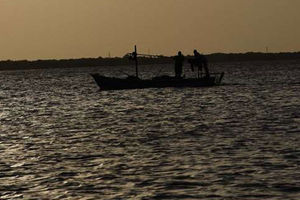
Fishermen in Lake Victoria.
Photo credit: File | Nation
Mr James Wyatt, brother to Fredrik, described him as a mentor and a key pillar of their family.
“He supported our mother financially and paid school fees for his siblings,” Mr Wyatt said, adding that the family had been left vulnerable by the loss.
Homa Bay County BMU Chairperson Edward Oremo said the fishermen had set out from Sindo Town for a fishing expedition but unknowingly ventured into a shipping lane used by cargo vessels operating across East Africa.
“The boat was shattered into pieces after the impact, throwing all the fishermen overboard,” he said.
According to Mr Oremo, the sole survivor reported that his colleagues were asleep as the boat floated on the water after they had cast their nets.
“They were resting in the darkness, waiting to pull in the nets later,” he said.
Their rest was abruptly interrupted by a loud bang when the boat was struck by the ship. None of them had time to react, and all fell into the water.
Fishermen on Lake Victoria.
Photo credit: Pool
“One of them survived by clinging to pieces of the broken boat. Other fishermen nearby rushed to rescue him,” Mr Oremo said.
Suba South Police Commander Caxton Ndunda confirmed that the accident occurred near the Kenya-Uganda border.
“The ship was sailing from Tanzania to Uganda when it hit the fishermen,” he said.
By Thursday morning, none of the bodies had been retrieved, prompting fishermen to suspend their activities and dedicate the day to searching for their colleagues.
“We urge fishermen to always wear life jackets when going to the lake. They are meant to save lives,” he said.
Mr Oremo appealed to agencies such as the Kenya Maritime Authority (KMA) to assist in body retrieval efforts and improve lake safety.
He noted that maritime accidents are not uncommon on Lake Victoria and called for measures to reduce their occurrence.
“We suspect the ship operators were sailing without navigation lights, making it difficult to spot the vessel. KMA should investigate this,” he said.
Suba Central BMU Chairperson Gideon Ochieng called for coordinated efforts between the national and county governments in responding to maritime accidents.
He urged agencies such as the Kenya Coast Guard Service and the Kenya Maritime Authority to take responsibility and respond promptly to emergencies on the lake.