At 8am, the Nginyang' market in Tiaty, Baringo County, is a beehive of activity.
The scorching sun turns the open-air market into a furnace, but traders and buyers from as far away as Nairobi brave the heat to haggle and negotiate livestock prices.
To an outsider, the camaraderie between the buyers and sellers may seem routine, but to locals, the very existence of the market is a miracle.
Just over a year ago, rampant banditry and cattle rustling shut down this vital trading hub, leaving the community in economic despair.
Cattle and goats, the market's main commodities, became a liability - to own them was to risk violent attacks, even death, at the hands of rustlers.
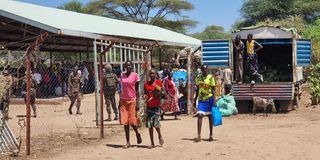
Traders and buyers at the Nginyang' market in Baringo County on February 17, 2025.
Photo credit: Steve Otieno | Nation
The situation in the North Rift counties - Baringo, Turkana, Samburu, West Pokot, Elgeyo Marakwet and Laikipia - became so dire that in 2023 the national government declared them troubled areas.
A strict 6pm to dawn curfew was imposed, and in early 2024, major markets, including Nginyang', were closed.
For months, traders avoided the region, unwilling to risk their lives and livelihoods against the prevailing lawlessness.
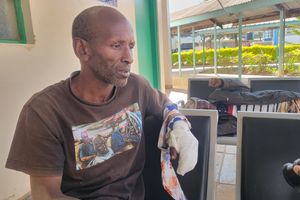
One such trader, Barako Wako, has painful memories of those violent times. In 2014, bandits hijacked his truck in Marigat, stealing 160 goats and leaving him seriously injured.
A decade later, in February 2024, he was robbed again on his way to Nginyang' and lost a lot of money.
“I never set foot in Baringo after that second attack when my lorry was vandalised. It was only in January 2025, after hearing that security had improved, that I came back. This is my fourth trip since mid-January, and I am glad peace has returned,” he said.
Now back in business, Mr Wako is a regular at Nginyang’ every Monday, purchasing at least 150 goats for resale in Nairobi’s Kiamaiko slaughterhouses.
“Nginyang’ has the best goat market in the country, and its closure really hurt our business. We are so glad it’s back,” he said.
Joseph Kwopin, secretary of the Livestock Marketing Association in Nginyang market, Baringo County speaks to journalists on February 17, 2025 at the market.
Photo credit: Steve Otieno | Nation
Joseph Kwopin, secretary of the Livestock Marketing Association (LMA) in Nginyang', recalled how the closure of the market had disrupted lives.
Before its closure, it facilitated the weekly sale of 15,000 goats, 5,000 cows, 20 donkeys and 50 camels. Its closure meant millions of shillings in lost revenue, leaving families struggling.
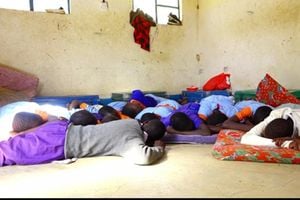
“Many children, already impacted by banditry, had to drop out of school as their parents lost income. Even herding livestock became a life-threatening risk,” Kwopin says.
Now, with the launch of Operation Maliza Uhalifu (OMU)—a multi-agency initiative involving the National Police Service, Kenya Defence Forces (KDF), National Intelligence Service, and local leaders in 2023—stability is slowly returning to North Rift. Guns are going silent, and peace is being restored.
Chris Ochieng, the assistant county commissioner of Mondi Division in Tiaty East, attributes this success to the involvement of community leaders in security discussions.
“Community leaders gather intelligence on planned cattle raids or conflicts and relay it to OMU officers, allowing us to prevent violence before it happens,” he explains.
The Anti-Stock Theft Unit (ASTU), which is part of the specialised units of the National Police Service operating at the command of Assistant Inspector-General Joseph Limo, has also changed its strategy. Instead of merely tracking rustlers, they now mediate in conflicts over water and grazing land. New grazing committees ensure that herders register their livestock with local chiefs and stick to designated grazing zones, reducing clashes.
“This has significantly reduced disputes because everyone knows their grazing areas. Plus, we now have a database of herders across six counties, making it easier to track individuals in case of conflicts,” Commandant Limo said.
Anti Stock Theft Unit Commandant Joseph Limo speaks to journalists at Loruk Police Station, Baringo County on February 21, 2025.
Photo credit: Steve Otieno | Nation
The unit has also been working with the KDF to persuade locals to surrender their weapons, and Commander Limo says that many weapons have been recovered, although he declined to give exact figures.
The impact of these security efforts is visible in markets like Loruk, 20 kilometres from Nginyang’. While Nginyang remains the larger trading centre, Loruk sees a resurgence of business every Wednesday.
For years, this market on the border between Baringo North and Tiaty East was a war zone where the Pokot and Tugen communities clashed over cattle raiding. Today, they trade peacefully.
Richard Kabuskun, a Pokot elder at Loruk market, recalled the hostilities that once defined the area.
“Loruk was a battlefield. Now, the Tugen and Pokot buy and sell cattle to each other, thanks to OMU’s peacekeeping efforts,” he says.
To prevent stolen livestock from entering the market, experienced elders check the clan tags on the animals before each transaction. A police contingent patrols the area, working alongside LMA officials to ensure security.
For women like Joyce Chirchir, 43, the revival of the market means more than safety – it means financial stability.
Cultural norms prevent women from participating in the livestock trade, but Chirchir has carved out a niche selling food and drink to traders.
“We love seeing the police, chiefs and soldiers here. Their presence alone has scared away criminals. My children are back in school, and I no longer fear for my safety,” she said.
Moses Ondige, Officer Commanding Station (OCS) at Loruk, emphasised the role of weekly community meetings in maintaining harmony. Locals air grievances, discuss security concerns and come up with joint solutions to prevent small disputes from escalating.
About 90 kilometres from Loruk is Kolowa market, on the border of Baringo and Elgeyo Marakwet counties.
This market was once crippled by banditry, which made trade between the two regions almost impossible. Traders were often ambushed at the dangerous Kerio River bridge, disrupting the flow of essential goods.
Elgeyo-Marakwet, rich in agricultural produce, and Baringo, known for its livestock and honey, rely on each other for trade.
However, constant conflict has led to massive loss of life and financial loss as goods perish before reaching their destination.
The turning point came with the establishment of the Kolowa Forward Base, led by Major John Maluli.
His troops neutralised the threats at the bridge and now provide security escorts for traders transporting goods whenever necessary.
“Though this area looks deserted now, it used to be a crucial agricultural hub thanks to the water from Kerio River. Many people were forced to flee due to constant banditry and cattle rustling. It is our mission to ensure that this bridge is forever wrested from the arms of bandits and trade between the two counties thrives,” Major Maluli said.
Since 2024, months after the establishment of OMU, the Kerio River bridge has regained its status as a vital trade route.
The positive impact is evident at Kolowa market, where traders can now move goods freely between the two counties, restoring economic stability and growth.
Traders showcase their goats at Loruk Market in Baringo County on February 19, 2025.
Photo credit: Steve Otieno | Nation
Speaking for the entire operation in the North Rift, Brigadier Stephen Huria, Commander of OMU, emphasised that this operation differs from previous interventions in that it focuses on sustainable peace.
"OMU is not just about security; we are investing in socio-economic development and education to break the cycle of violence," he said.
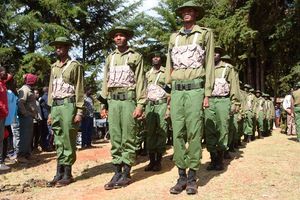
On the security front, KDF troops are stationed in hotspots across the six counties to deter attacks and eradicate cattle rustling. At the same time, the military is involved in community-based initiatives such as drilling boreholes, distributing food and medicine, and renovating schools.
These efforts, says Huria, are key to integrating North Rift with the rest of the country.
“The more children in school, the more families return home. Parents realise their children need education, so they stay and rebuild their lives. We encourage those still displaced to return, live peacefully, and continue their social and economic activities,” he said.
While the road to full recovery is far from complete, one thing is clear – like the mythical phoenix bird, the once volatile North Rift is rising from the ashes, one market day at a time.