President William Ruto’s ambitious push to collapse Kenya Kwanza affiliate parties into a single dominant outfit under the United Democratic Alliance (UDA) is increasingly colliding with a stubborn political reality.
While allies publicly toe the line, many are quietly holding onto their parties as strategic lifeboats ahead of the 2027 General Election.
What is emerging is a delicate double game — one played on paper and another behind the scenes — where declarations of unity mask deep-seated mistrust, succession anxieties, and calculations for survival in a volatile political landscape.
At the heart of this unfolding contradiction lies the fate of the Amani National Congress (ANC), associated with Prime Cabinet Secretary Musalia Mudavadi.
Despite its much-publicised dissolution and merger into UDA last year, ANC is legally still alive and fully operational following an unchallenged High Court ruling that nullified the process.
The court decision — which has not been appealed — has effectively restored ANC as a political entity, raising fresh questions about the sincerity of the merger drive and exposing what insiders describe as a calculated strategy by key players to “keep one foot in and another out.”
Registrar of Political Parties John Cox Lorionokou confirmed the party’s status, stating: “Following the judgment of the High Court, ANC is a fully registered political party.”
President William Ruto, his deputy Prof Kindiki Kithure and Foreign Affairs Cabinet Secretary Musalia Mudavadi arrive for the UDA National Governing Council meeting at State House, Nairobi on January 26, 2026.
Photo credit: PCS
The ruling marked a significant legal and political turning point. In January, the court quashed Gazette Notice No. 3449 that had formalised ANC’s dissolution, declaring that the process violated constitutional provisions and excluded party members from a critical decision.
“ANC remains a duly registered political party whose legal personality had never been lawfully terminated,” ruled Justice Bahati Mwamuye, ordering the immediate restoration of the party’s status and assets.
The judgment not only reinstated ANC but also disrupted a carefully choreographed political narrative of consolidation under UDA — a narrative that President Ruto has aggressively championed as key to his re-election strategy.
“We cannot move forward as a coalition of small parties; we must unite under one party to strengthen our agenda and leadership,” Dr Ruto has repeatedly said.
He has also argued that: “A fragmented coalition cannot effectively serve Kenyans; a single, solid party will give us the strength to deliver on our promises.”
Yet, behind these calls for unity, cracks are widening.
Despite public declarations of loyalty, several Kenya Kwanza affiliate parties are neither fully dissolving nor entirely independent — instead opting for a strategic pause.
While Mr Kingi has pledged that PAA will not field candidates in 2027 and will support UDA, the party remains legally intact.
The move, insiders say, is less about loyalty and more about caution.
By retaining the party structure, Mr Kingi preserves a bargaining chip in the event of shifting alliances — particularly amid the emerging rapprochement between UDA and the Orange Democratic Movement (ODM).
Similarly, National Assembly Speaker Moses Wetang’ula has drawn a firm line, insisting that Ford Kenya will not fold into UDA.
Through Secretary-General John Chikati, the party has dismissed calls for dissolution as “blackmail” and warned against attempts to revert the country to a de facto one-party system.
“To demand the dissolution of Ford Kenya now is to bite the finger that once fed you,” Dr Chikati said, underscoring simmering tensions within the coalition.
Ford-Kenya Secretary-General and Tongaren MP John Chikati.
Photo credit: File | Nation Media Group
In Lower Eastern region (Ukambani), the contest between Labour Cabinet Secretary Alfred Mutua and Kibwezi MP Mwengi Mutuse has burst out in the open after the MP led a faction of Maendeleo Chap Chap Party (MCCP) leaders in ditching the party, which is associated with Dr Mutua.
Mr Mutuse, the promoter of the impeachment motion against former Deputy President Rigathi Gachagua has instead embarked on popularising the United Democratic Alliance (UDA) to the chagrin of Dr Mutua, as details of a sustained push by President Ruto on MCCP to dissolve emerged.
The reluctance by affiliate parties to fully dissolve reflects deeper tensions within President Ruto’s broad-based government — an uneasy alliance that now includes former rivals from ODM led by Dr Oburu Oginga.
Far from consolidating power, the arrangement has instead transplanted opposition-style rivalries into the heart of government.
Former Deputy President Rigathi Gachagua has already charted a separate political path after his impeachment, forming the Democracy for the Citizen’s Party and joining the opposition.
Mr Gachagua has previously lamented entering the 2022 election without a political party of his own — a miscalculation that many within Kenya Kwanza now appear unwilling to repeat.
Having formally dissolved in January last year, the party’s sudden resurrection has exposed what critics describe as procedural shortcuts and political expediency.
The court found that the Special National Delegates Congress that approved the merger was conducted in violation of the Constitution, failing to involve grassroots members and bypassing internal democratic processes.
A section of Western Kenya MPs has warned Mr Mudavadi that dissolving ANC weakens his bargaining power within the coalition, especially at a time when ODM is reasserting its influence in the region.
Insiders within government now suggest that the failure to appeal the court ruling may not have been accidental.
“A decision not to challenge the judgment raises serious questions. It points to a deliberate scheme to retain the party while appearing loyal to UDA,” said a senior government official familiar with the matter.
The continued operation of ANC — including its recent public statements condemning police actions against opposition leaders — further reinforces the perception that the party remains politically active despite its supposed merger.
In the run-up to the 2013 elections, the Jubilee Party successfully absorbed multiple affiliate parties, including Dr Ruto’s United Republican Party (URP) and former President Uhuru Kenyatta’s The National Alliance (TNA), creating a formidable electoral machine.
However, the current political environment is markedly different.
President William Ruto's United Democratic Alliance merges with Musalia Mudavadi's Amani National Congress.
Photo credit: Pool
Unlike Jubilee’s relatively cohesive formation, Kenya Kwanza is a coalition of parties with distinct regional bases, entrenched leadership structures, and competing ambitions.
Moreover, the stakes are higher.
Advocate Chris Omore argues that: “with the opposition regrouping under new formations and internal divisions threatening to erode the Kenya Kwanza coalition’s base, affiliate parties are increasingly wary of surrendering their identities without clear guarantees.”
“For many within Kenya Kwanza, the strategy appears to be simple; comply publicly but preserve privately.”
By keeping their parties alive — even if dormant — leaders retain the flexibility to renegotiate alliances, contest independently, or pivot in response to shifting political winds.
Nandi Senator Samson Cherargei has been among the most vocal proponents of dissolution, warning that parties that refuse to fold risk exclusion from government positions.
“Those who are in a coalition with UDA… must dissolve those small parties so that we get into a bigger ship called UDA,” he said.
Instead, they have deepened suspicions and reinforced the perception that the merger drive is less about unity and more about control.
As the 2027 election draws closer, the question remains whether President Ruto can translate his vision of a unified political machine into reality.
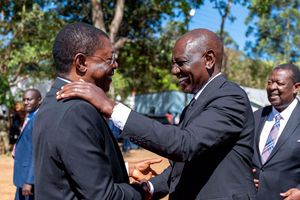
President William Ruto meets National Assembly Speaker Moses Wetang’ula in Bungoma on January 3, 2025.
Photo credit: PCS
“Kenya Kwanza parties may be dissolving on paper, but in practice, they are very much alive — repositioning themselves and quietly preparing for a high-stakes contest where survival is paramount.”
Analysts say that in the complex chessboard of Kenyan politics, where yesterday’s ally can quickly become tomorrow’s rival, keeping options open may prove to be the most enduring strategy of all.
Thus, they argue that folding Kenya Kwanza affiliates into UDA is a rational move to streamline candidate management, enhance cohesion and consolidate power.
“Managing one party under a unified brand is smoother than juggling multiple coalition candidates competing for the same seat, which can lead to internal disputes and predictable electoral losses,” argues political analyst Mr Dismas Mokua.
He adds that; “A single party brand prevents conflicts over messaging and ensures consistent communication to voters, while absorbing affiliate parties prevents MPs and local leaders from leveraging coalition numbers as bargaining chips, centralising authority within UDA.”
Political commentator Ishmael Oyoo notes, “A fragmented Kenya Kwanza coalition weakens UDA. Consolidation is necessary to secure a critical number of parliamentary seats and prevent affiliate MPs from challenging central leadership.”
While the absorption of ANC for instance secures Mr Mudavadi a high-ranking government role, analysts say it comes with long-term political costs, “perhaps that’s why his team is reluctant to challenge the High court ruling that voided the merger.”
The backlash has been increasingly vocal. During the burial of former Lugari MP Cyrus Jirongo, Luhya leaders from across the political divide took aim at Mr Mudavadi, accusing him of betraying the community’s collective bargaining power through ANC dissolution.
Bumula MP Jack Wamboka led the charge, accusing Luhya leaders in government of enriching themselves while the community remained economically marginalised.
“You leaders in power are only enriching yourselves, but we have a clear plan in 2027 to field one of our own as a presidential candidate,” Mr Wamboka said.