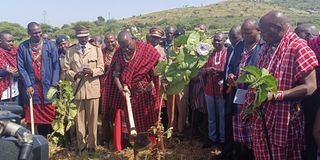
The Kajiado County government has declared toxic Ipomea weed a disaster because of its negative effects on pastures.
The pasture-colonising weed, known as 'oltiameleteti' in the Maa dialect has spread rapidly across Kajiado County since 1997, when it was first discovered after El Niño rains, and now occupies at least 40 per cent of the total land area.
During Madaraka Day celebrations on June 1, Governor Joseph Lenku launched the Ipomea uprooting exercise to be replicated by pastoralists across the vast county.
"This weed has become a monster that threatens our food security. The weed has thrived due to poor land use, including overgrazing in a small part of the grazing land. The only way to eradicate this weed is to uproot it," said Governor Lenku.
He is keen to partner with other stakeholders to eradicate the weed, especially now that the county is on the path to modulated pastoralism.
"Although the county government is implementing several programmes to eradicate the weed and boost livestock production, additional funding is needed. The eradication of the plant requires a holistic approach," he added, saying that researchers at the University of Nairobi have initiated advanced research on how to scientifically eradicate the weed.
Kajiado Senator Samuel Seki said he has petitioned the Ministry of Agriculture and Livestock through the Senate seeking answers on the government's preparedness to eradicate the weed that has spread to most Arid and Semi-Arid counties.
"I am waiting for the ministry's response on its preparedness to eradicate the weed. Both levels of government should allocate funds to eradicate Ipomoea and I want a replica of the 'Kazi Mtaani' programme to be rolled out for youths in the affected counties," said Senator Seki.
Kajiado County Director of Livestock Eric Aheda said the plant has a high seed rate, heavy foliage, well spread and developed root system, aggressive natural pasture competitor and smothers natural pasture in its proximity.
"This weed is highly adaptable to harsh conditions and outperforms the traditional grass. Despite the recent heavy rains, pastoralists will soon face fodder shortages," he said.
Kajiado West, South, Central, East and North sub-counties have borne the brunt of the weed, causing panic among pastoralists.
"The highly invasive plant, which is inedible to livestock, has spread so fast. Livestock farming seems untenable in the near future," said Mr Moses Lenkaso, a pastoralist.
Mr Sankare Japan, a pastoralist from Kajiado Central Sub County, told the Nation that the weed has affected honey production in the county.
"The highly flowering weed attracts bees and in return, the honey produced makes consumers doze off after consumption. The honey is said to be of poor quality and unmarketable."
Ipomoea belongs to the sweet potato family. This species is reported to be a recent weed colonising rangelands in Kajiado County. The species is characterised by prolific growth, and a beautiful inflorescence and is highly responsive to even marginal rainfall. The weed can grow to a height of more than 2 metres and a stool can spread up to 4 metres in diameter.
The weed exacerbated the severe drought of 2020-2022 in Kajiado. Hundreds of livestock succumbed to the drought, shaking the food security of the local community, and at least 350 families faced starvation, according to the National Drought Management Authority.
The county's livestock sector has seen its annual turnover drop from Sh3.2 billion to Sh1 billion in the past three years.