Premium
Dreaded tree worms its way to essential livestock drugs list
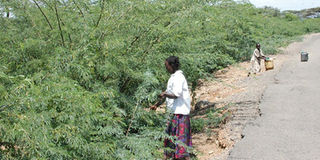
Prosopis juliflora commonly known as mathenge. It is a tree that has been perceived as poisonous to both humans and livestock, but Prof Patrick Kareru of Jomo Kenyatta University of Agriculture and Technology has managed to come up with a livestock de-wormer from it. PHOTO|FILE.
What you need to know:
- Using about Sh4.5 million, Prof Patrick Kareru of Jomo Kenyatta University of Agriculture and Technology has managed to come up with a livestock de-wormer from prosopis juliflora, commonly known as the mathenge tree.
- “This tree has more advantages than disadvantages,” says Prof Kareru.
- The mathenge tree was first introduced into the country in the early 1980s by a botanist who went by the name Mathenge.
- Apart from being used to manufacture medicine for livestock, the mathenge tree can also be used to improve the livelihoods of desert communities by providing shade, high quality timber, charcoal, and animal feed.
It is a tree that has been perceived as poisonous to both humans and livestock, but a professor from a local university is working to change this perception.
Using about Sh4.5 million, Prof Patrick Kareru of Jomo Kenyatta University of Agriculture and Technology has managed to come up with a livestock de-wormer from prosopis juliflora, commonly known as the mathenge tree.
The money, according to the professor, was provided by the university through its research, production and extension (RPE) arm.
And with the help of some chemistry students at the university, he has conducted research to show that the tree can be used to manufacture de-wormers for livestock.
Although many animals — especially goats — which have fed on the mathenge tree for a long time are said to have lost all their teeth, Prof Kareru says the tree is not poisonous.
Instead, he says, the green pods bearing the seeds contain high levels of reducing sugars which, when consumed in plenty by livestock, cause tooth decay.
“This tree has more advantages than disadvantages,” says Prof Kareru.
MEDICINAL VALUE
However, he says that after carrying out research, he found that the leaves had higher medicinal value than the roots or any other part of the tree.
Although Prof Kareru did not want to disclose how he goes about his research and how he prepares his content, he says he is investigating the tree’s medicinal value.
The de-wormer is normally given to ruminants.
His research began in April 2009 and is scheduled to be completed by the end of this year.
However, he says, preliminary trials have found it to be an effective de-wormer.
In the in-vitro tests to determine efficacy of the plant, toxicity, and hence dosage of the extracts, he used rats.
Prof Kareru also notes that the researchers have used sheep in order to confirm the efficacy of the plant as a de-wormer.
“After every stage, we had to test our solution using a sheep that had worms and we found the solution to work.
Recently, we dewormed a number of sheep at a farm in Ruiru. The results amazed the owner of the stock,” says Prof Kareru.
INVASIVE NATURE
According to the professor, many farmers do not like the tree because of its invasive nature.
“We think that we can use this “apparently useless and unwanted” tree for a noble cause so that local residents and others can benefit.
If and when commercialised, a herbal alternative anthelmintic drug (non-toxic, no resistance, unlike conventional de-wormers) and cheap product will be available for local livestock farmers,” he says.
Conventional drugs, notes Prof Kareru, have been found to be ineffective and this has led to farmers incurring high losses, “prompting me to look for an alternative”.
The team is currently in the final stages of the research before formulating the extract into tablets, capsules, and syrup.
They will, however, need to get certification and patents before marketing it as an alternative drug.
According to Mr Jackson Mutembei, one of the students in the team, the team will finalise the process by the end of this year.
“Our target is to have the drug on the shelves of agro-vet stores come March next year,” says Mr Mutembei.
APPLY FOR PATENT
As soon as re-confirmation is done, he says, the university and the researchers involved will apply for a patent.
The university may partner with pharmaceutical companies interested in commercialising the innovation.
This will be done as soon as is practicable since there are other formalities involved in drug control and registration in Kenya.
The mathenge tree was first introduced into the country in the early 1980s by a botanist who went by the name Mathenge.
The key reasons the tree was introduced was to curb soil erosion and desertification, which had become a major problem in Baringo.
According to Mr Simon Choge, a researcher with the Kenya Forest Research Institute (Kefri), records show that the tree was introduced to Africa through Senegal in 1822.
It did not come to East Africa, until the late 1960s when various environmental organisations advocated the weed to curb desertification.
Mr Choge said that widespread planting of the tree, spearheaded by the governments of Kenya, Djibouti, Ethiopia, and Somalia, took place in the 1970s and 1980s.
In Kenya, the weed is found in several districts including Garissa, Taveta, Bura, Hola, and Baringo.
“In the 1980s, government officials keen on preventing soil erosion launched an aggressive tree-planting campaign.
The officials gave top priority to trees indigenous to the area,” he says.
Mathenge trees, says Prof Kareru, are drought-resistant and can help to stem desert encroachment by growing where virtually nothing else will.
Apart from being used to manufacture medicine for livestock, the mathenge tree can also be used to improve the livelihoods of desert communities by providing shade, high quality timber, charcoal, and animal feed.
“It is worth noting that during the life cycle of mathenge, nutritious human food can be derived from its pods,” says Mr Joseph Karanja, another student in the research team.