Kajiado municipalities struggle to provide services

The aerial view of Kitengela town in Kajiado County on December 1, 2025.

Over the past six years, the Kajiado County government has elevated its satellite towns into municipalities in an ambitious effort to accelerate urban growth.
Under Governor Joseph Lenku’s clarion call of "habitable towns," Ngong town has been elevated into a municipality, with its jurisdiction extending to Kiserian and Ong’ata Rongai towns in Kajiado North Sub-County.
Kajiado town, which hosts both the county headquarters and key national government offices, has also been promoted to a municipality. Recently, Kitengela town, one of the county’s fastest-growing satellite towns, attained the same status.


However, the financially strained and understaffed units are struggling with waste management, chaotic planning and lack of basic services, including access to fresh water, despite growing populations.
The proliferation of illegal kiosks along major roads is now common in all satellite towns.
In Kitengela, uncollected garbage is a persistent problem. In many areas, bags of waste form large, unattended heaps.
“Kitengela municipal management has not been collecting garbage on time despite our complaints. We expected the elevation of the town to municipality status to improve conditions,” said John Ngamau, a local trader.
Last year, garbage collection bins were placed across the town, but residents complain that they are emptied too infrequently.
Kitengela Municipality Board Chairperson Julius Ntaiya attributed the challenges to the lack of financial autonomy for municipalities.
The county government also launched the Mazingira Unit to oversee and enforce environmental hygiene, yet the town’s sanitation situation remains dire.
Kitengela Municipality Board Chairperson Julius Ntaiya attributed the challenges to the lack of financial autonomy for municipalities.
“The new Kajiado municipalities lack financial independence to provide services to residents within their jurisdictions,” said Mr Ntaiya. “It is high time the county grants these new units financial autonomy.”
Mr Ntaiya added that Kitengela municipality has developed an operational blueprint to transform the town but is experiencing challenges due to insufficient resources.
Conflicts have also arisen between municipality officials and the county government over the collection of parking fees and dumping charges at the Noonkopir landfill.
The elevation of towns to municipalities is anchored on the Urban Areas and Cities Act, 2011, operationalized by the Urban Areas and Cities (General) Regulations, 2022.
These regulations outline the criteria and procedures for classifying an area as a municipality, including population, infrastructure, and revenue generation requirements. The process is initiated by either the county government or the Cabinet Secretary and includes boundary delineation and a public consultation period.
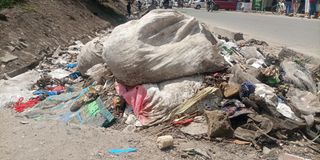
Heaps of garbage in Kitengela town on December 1 2025.
While recent amendments to the County Public Finance Management Act have granted financial autonomy to County Assemblies, the question of financial independence for municipalities remains under discussion and advocacy.
Currently, municipalities in Kenya have limited financial autonomy and must rely on county executives for funding, often leading to operational conflicts.
Follow our WhatsApp channel for breaking news updates and more stories like this.