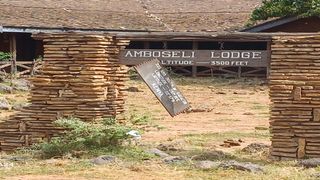
After 14 years of ignoring an inherited Sh303 million fine that killed a hotelier's dream, Kajiado County is staring into a financial abyss as interest has pushed the debt past the Sh1 billion mark.
Inside Amboseli National Park in Kajiado County, two lodges that were once bustling tourist hubs lie abandoned, falling into disrepair with each passing day.
In ideal circumstances, the two lodges - Amboseli Lodge and Kilimanjaro Safari Lodge - would be generating rent and other income for the county government, which has leased the land to private companies to set up shop.
However, in their current state, the lodges continue to siphon money from the county government, thanks to a fine that has yet to be fully repaid since 2009.
A county council leases land to a hotelier. The hotelier builds buildings and sets up a hotel business that attracts tourists from far and wide.
Years later, a dispute arises over the payment of rent. In the midst of the dispute, the county council sends auctioneers to collect the rent, who, with the help of rioting youths, cause havoc in the lodge, frightening tourists and destroying property. The council takes possession of the hotel. The hotelier goes to court and, after months, obtains a repossession order. The hotelier later sues for compensation for money and goodwill lost in being out of business. The hotelier wins the case and receives an award.
This is a sketch of how Olkejuado County Council, whose successor is the Kajiado County Government, found itself with an order to pay compensation to Kilimanjaro Safari Club, the hotelier that ran the two lodges.
The Amboseli Lodge in September 2023. It is one of the hospitality investments that was by the Kilimanjaro Safari Club before disputes arose in 2007, leading to disruption of business and eventual closure.
Photo credit: Pool
The way the county council used an auctioneer to oust the hotelier from Amboseli Lodge in 2007 was found to be illegal in a subsequent arbitration brought by, among others, the late Rajnikant Desai, who was chairman of the board of the Kilimanjaro Safari Club. The hotelier, once a heavyweight in Kenya's hospitality industry, had been operating at the site since 1968. At the time of the 2007 invasion, the hotelier's second lodge had ceased operations, having been damaged by El Nino rains in 1997. It needed extensive renovations to get back in business.
The county council was also found guilty of allowing a rival lodge to operate adjacent to the lodges, contrary to the terms of the lease, which stated that no other establishment would be given a lease within a two-mile radius.
The award to Kilimanjaro Safari Club was made in both Kenyan shillings and US dollars, as Kilimanjaro proved that it used to receive some of its income in US dollars. It included general damages of Sh1 million, special damages of Sh75 million and another set of special damages of $2.84 million (Sh435.5 million). The Sh75 million and the $2.84 million were to bear interest at 12 per cent per annum until paid in full.
The arbitration, presided over by John Ohaga, also found that the Kilimanjaro Safari Club owed Sh39.88 million in rent arrears, despite the county's waivers pending rehabilitation. It was also ordered to pay the money to the county council in addition to the compensation it was due from Olkejuado. This sum was to bear interest at 15 per cent per annum until it was paid in full.
At the time of the award, one dollar was worth about Sh80, which meant that the amount the county had to pay the hotelier was about Sh303.86 million, compared to the Sh39.88 million the hotelier had to pay. However, due to interest earned and the depreciation of the Kenyan shilling over the years, the amount owed to Kilimanjaro Safari Club has reached Sh1.3 billion. It is growing by about Sh4 million a month. The rent payable by the hotelier under the contract is approaching Sh200 million.
November 9 marked the 14th anniversary of the award. The manner in which it has ballooned has attracted the attention of the two High Court divisions (which have ruled against the county on separate occasions), the Senate (where some members in 2020 expressed concern that the amount was accelerating out of control), the Controller of Budget (who has warned the county not to allow interest-bearing fines to accumulate when it can act), the Solicitor-General and others.
At some point, the county sought the intervention of the then Solicitor-General Kennedy Ogeto. In an April 2021 pact, Kilimanjaro Safari Club agreed to receive Sh392.3 million as a compromise. It would also receive other benefits, including a rent moratorium from the county once it had renovated the premises and resumed operations. It would also receive lease extensions, among other benefits.
However, the county reneged on its word to pay the Sh292 million in addition to the Sh100 million it had transferred in May 2021. Correspondence filed in court shows that the county wanted Kilimanjaro Safari Club to withdraw all cases before going beyond the Sh100 million payment.
Now, Kilimanjaro Safari Club has told the court that it has reneged on the 2021 pact and is seeking the full amount. It argues that the pact was not adopted as a court order and therefore has no standing.
A hearing on the case is scheduled for December 21 at the Judicial Review Division of the High Court in Nairobi. In that case, the former Kajiado chief officer was found guilty of contempt of court for failing to pay the debt, although he has not yet been sent to civil prison.
The matter was discussed in the Senate in July 2020, when then Governor Joseph ole Lenku was responding to audit queries. Senator after senator expressed concern.
“The auditor is raising a red flag that this liability is growing in leaps and bounds and that there does not seem to be sufficient mechanism to prevent it from snowballing into a monster,” said Dr Ochillo Ayacko, then the senator of Migori. “It was raised to our attention, not just for capture, but to note that a monster is developing.”
Nandi Senator Samson Cherargei noted: “The amount of Sh670 million [the amount of the award then] is quite astronomical and you can use it to do a lot of things in Kajiado County.”
Governor Lenku betrayed his stand on the matter when he told the Senate: “Seeing as this is a threat to the entire county government … one company should not be allowed to swallow a county government.”
The Amboseli Lodge in September 2023.
Photo credit: Pool
He added: “The county government has lost this case several times from the time of arbitration, first appeal and several other court engagements. The court has been outrightly saying that the county government has an obligation to pay this. In a conscious situation, this is not right; though legally right.”
Speaking in April 2021 after the Sh392.3 million pact, Governor Lenku said he was out to right the wrongs of past administrations.
“We are committed to correct the ills of yesteryears. This is a hole that we were put in due to lack of sensitive leadership during those years,” he told the Press.
But a series of letters written to his office, which have since been produced in court, show that after the initial Sh100 million was paid, the Kajiado administration became aloof.
“We have written numerous letters over the course of 11 months, calling for engagement from the county government towards resolution of the outstanding issues. Our requests have been completely ignored despite our consistent efforts,” the Kilimanjaro Safari Club said in a July 2022 affidavit to the High Court.
In its defence, the county says the delay in fulfilling its end of the bargain was due to lack of allocation of funds by the Budget Controller. In an affidavit filed in court on September 23, Kajiado County lawyer Augustine Siamito Sekeyian said the administration will pay Sh10 million to Kilimanjaro Safari Club in the first quarter of the county's 2023/24 financial year.
“The county is committed to settling the debt owed and I humbly request this honourable court to issue it with reasonable time to finalise the payments due,” he stated.
“The county has not received full disbursement of its allocation from the national government and shall continue settling the debt owed as it is put in funds. The Controller of Budget is yet to authorise any payment of contingent liabilities due for this financial year,” added Mr Siamito.
However, in a letter dated October 2021 and addressed to the Kajiado County Finance executive, Controller of Budget Margaret Nyakang’o warned against delays in settling the bill.
“The public finance management framework requires that payments are settled on time as specified in contract agreements to avoid accumulation of arrears. Further, note that failure to make payments as and when due constitutes a serious material breach of the principles of public finance as provided under Article 201 of the Constitution and is a violation of the Public Finance Management Act,” Dr Nyakang’o said when informed that the county had failed to keep its word as per the April 2021 pact.
Currently, the national government is seeking to transfer half of the revenue from Amboseli National Park to the county government. The leases granted to the Kilimanjaro Safari Club are still in force as the legal wrangling continues and the 2009 award continues to balloon.