The completion of the Sh4 billion Ngong–Suswa tarmac road has provided motorists heading to the South Rift, Western Kenya, and the Nyanza region with a much-needed alternative to the heavily congested Nairobi–Maai Mahiu highway.
The 70-kilometre road, long viewed by residents as a catalyst for economic growth, was launched in 2018 by retired President Uhuru Kenyatta.
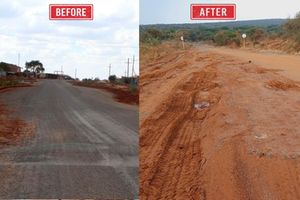
However, construction stalled in 2020 with the final seven-kilometre stretch leading into Suswa town left incomplete.
The road, which snakes across rugged terrain while running parallel to the Standard Gauge Railway (SGR) line, was initially scheduled for completion by December 2021, according to Kenya Rural Roads Authority (KeRRA) records.
The aerial view of the newly completed Ngong-Suswa road on January 6 2025.
Photo credit: Stanley Ngotho| Nation Media Group
Despite the contractor missing the deadline, work remained stalled for nearly six years before resuming and finally being completed in December 2025.
Classified as a Low Volume Seal (LVS) road, the Ngong–Suswa route is expected to ease pressure on the Nairobi–Maai Mahiu highway, particularly for travellers heading to Narok and beyond.
On December 15, 2023, while launching the Riruta–Ngong commuter railway line, President William Ruto assured residents that the stalled road would be completed once funds became available.
“I came to launch the Ngong–Suswa road, but things did not turn out as expected. We have completed 63 kilometres and the remaining seven kilometres will also be completed,” President Ruto said at the time, without giving a specific timeline.
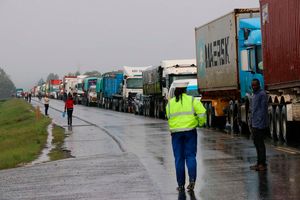
The road’s completion has now opened a new route for both private motorists and Public Service Vehicles (PSVs), offering relief from the Maai Mahiu highway, which is notorious for traffic snarl-ups caused by long-haul trailers.
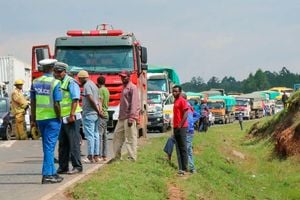
During the Christmas holidays, the new tarmac attracted hundreds of motorists, particularly during daytime hours, resulting in heavy traffic within Ngong town and along the steep Kimuka section.
Motorists stranded in a traffic jam at Ngong town on January 6, 2025, occasioned by the influx of vehicles using the newly completed Ngong-Suswa road.
Photo credit: Stanley Ngotho| Nation Media Group
Local herder Amos Lankas said the festive season brought an unusual spectacle with traffic jams stretching for kilometres, especially in the evenings.
“This road has become an escape route for motorists avoiding Maai Mahiu. The number of vehicles is amazing. It has also attracted hawkers who are making tidy profits from motorists,” Mr Lankas said.
A Nation spot check on Tuesday revealed flourishing businesses in previously sleepy shopping centres such as Kibiko, Kimuka, Nachu, Ewaso Kedong, the SGR Inland Container Depot (ICD), and Suswa.
The increased flow of traffic has stimulated the growth of new trading centres, turning the road corridor into a hive of activity.
Agribusiness in Kibiko, Kimuka and Nachu areas is also booming, with farmers saying they can now access Ngong town markets more easily.
“This road is a saviour to us. We can now reach Ngong and Kiserian markets with ease. Previously, accessing the Ewaso Kedong market was difficult and brokers exploited us, reducing our profit margins,” said Nancy Kinyua, a vegetable trader and farmer.
Narok Line Services Limited is among the matatu Saccos that have introduced public service vehicles on the new route, establishing stages along the Namanga–Kajiado–Kiserian–Ngong–Suswa–Narok corridor.
Travellers heading to Narok, Kericho and beyond no longer need to pass through Nairobi to board PSVs.
Motorists using the new Ngong-Suswa road on January 6 2025.
Photo credit: Stanley Ngotho| Nation Media Group
Sacco chairperson Andrew Mwangi said the operator seized an opportunity away from the Maai Mahiu route.
“It is faster and cheaper compared to Maai Mahiu, which is synonymous with traffic jams and accidents. Even some Nairobi-based matatus are now opting to use this road,” Mr Mwangi said.
While most PSVs charge about Sh600 from Nairobi to Narok, the new route costs passengers Sh500 from Ngong to Narok.
Jane Naserian, a beadwork trader who frequents open-air markets across Kajiado County, said the introduction of PSVs on the route had brought immense relief.
“It is now easier and cheaper to connect to Suswa and Narok markets. Previously, I had to travel to Nairobi to board a matatu, which was inconvenient,” she said.
A PSV vehicle plying the new Ngong-Suswa road on January 6, 2025. The new highway offers an alternative route to motorists heading to South Rift and Western Kenya.
Photo credit: Stanley Ngotho| Nation Media Group
Samson Nanga, a traditional herbalist and honey trader, described the road as “a gem.”
With its sweeping landscapes, arable expanses, and breathtaking curves, the scenic road is increasingly attracting tourists and motoring enthusiasts. The region is gradually transforming into a local and international tourist magnet.
Several high-end tourist hotels are in the pipeline along the route, owned by both local and foreign investors and are expected to create employment opportunities.
On Tuesday, January 6, Nation encountered a tourist vehicle parked at a scenic viewpoint, where visitors were enjoying a sundowner while taking photographs of a striking cliff illuminated by the setting sun.
“From Maasai Mara, we now use this route to connect to Amboseli, Kyulu and Tsavo national parks via the Kajiado–Isinya–Emali–Loitokitok road. The scenic drive and sundowners are a big attraction for our tourists,” said tour driver John Musa.
Kajiado West MP George Sunkuiya said the road would serve as a key economic artery linking Kajiado and Narok counties, with residents using it to transport livestock to the Suswa livestock market.
“This is a magic road for our people. It has ended years of suffering and boosted economic activity. It is a critical link in the Kajiado–Narok economic bloc,” Mr Sunkuiya said.
However, residents are calling on KeRRA to erect speed bumps and install more road signage to curb speeding and prevent accidents.
Ewuaso Oonkidong’i MCA Joseph Toris said locals had resorted to erecting makeshift bumps using cotton soil.
“This endangers both motorists and residents. There are also areas with frequent livestock crossings that need to be clearly marked,” he said.
Kajiado County KeRRA Resident Engineer Washington Mugambi said the contractor was finalising feeder roads, signage and road markings.
“The contractor temporarily halted work during the festive season due to high traffic volumes but has since resumed. Feeder roads, signage, and markings are being completed,” Eng Mugambi said.
Meanwhile, Ngong’s land market has recorded an annual growth of 10–12 per cent in prime areas in 2025, driven by infrastructure development and demand for satellite-town living.
Property listings updated in 2025 show average residential land prices in Ngong at Sh5.25 million, ranging from Sh2 million to over Sh7.5 million in prime locations—drawing land speculators in droves.