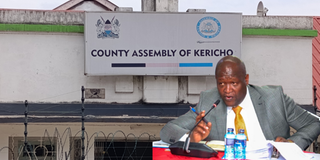
Kericho Governor Erick Mutai is fighting for his political survival after an ad hoc county assembly report linked him to suspicious payments totaling Sh85 million to 46 companies for undelivered goods, ghost services, and inflated contracts.
The report—now the basis of a fresh impeachment motion by MCA Kiprotich Rogony—details systemic procurement breaches, split tenders designed to evade open bidding and payments made before delivery.
In some cases, critical records such as delivery notes, tender adverts, inspection reports and ETIMS invoices were missing, raising serious doubts about value for money.
Deputy Governor Fred Kirui, who blew the whistle, has written to the Ethics and Anti-Corruption Commission demanding an investigation into the transactions.
The assembly recommends a forensic audit, recovery of funds from suppliers, and disciplinary action against top county officials, including Chief Officers in six key departments.
The report cites staggering anomalies, including Sh7.7 million paid for public participation events with no proof they occurred; Sh2.8 million for overpriced sanitary supplies irregularly awarded; and Sh14.9 million for animal feed raw materials, only partly delivered after scrutiny.
Contracts were awarded and paid for before tender opening dates, with some procurements completed in as little as a single day.
MCAs say the scale of irregularities points to “collusion and blatant theft of public resources.” Dr Mutai, a first-term UDA governor, now faces his second impeachment attempt in less than a year, with the outcome set to determine his political future.
Governor Mutai has also thrown the county into political turmoil after calling for its dissolution following the tabling of an impeachment motion against him in the County Assembly.
The motion, filed by Soin/Sigowet MCA Kiprotich Rogony, accuses Dr Mutai of gross misconduct and violating Kenyan law and the Constitution.
The first-term UDA governor now faces a double challenge: defending himself in the assembly while rallying residents to sign a petition for the county’s dissolution.
Governor Erick Mutai asks President Ruto to dissolve the Kericho County Government
If successful, Mutai’s move would trigger fresh elections for the governor, deputy governor and all 47 MCAs—a political reset unprecedented in Kenya since devolution began in 2013.
Under Article 192 of the Constitution and the County Governments Act, dissolving a county is no small feat.
The President can only suspend a county in exceptional cases such as war, internal unrest, or other extreme circumstances—none of which have yet been met.
Even then, the law requires a Commission of Inquiry to investigate the allegations, Senate approval to authorize suspension, and strict timelines—only 90 days are allowed before fresh elections must be held unless the Senate lifts the suspension.
During that period, a caretaker team appointed by the President would manage county affairs. In emergencies, the President may act without Senate approval, though such powers are rarely invoked.
MCA cites alleged tender irregularities as grounds for Kericho Governor Erick Mutai impeachment bid
A petition to dissolve a county must have the backing of at least 10 percent of its registered voters.
Once presented, the President forwards it to a Commission of Inquiry, which investigates and submits findings within set timelines. If the President agrees with the commission’s report, the matter moves to the Senate.
If approved, the President gazettes the suspension, paving the way for IEBC to declare all county elective seats vacant and organize by-elections.
Kericho County Assembly in this photo taken on August 7, 2025, a day after the second impeachment motion under one year was tabled against Governor Erick Mutai by Soin Sigowet Member of the County Assembly, Kiprotich Rogony.
Photo credit: Vitalis Kimutai| Nation Media Group
The closest attempt came in 2015 when then-Makueni Governor Kivutha Kibwana, at loggerheads with his MCAs, petitioned for his county’s dissolution.
The Senate rejected the petition, and Mr. Kibwana went on to win a second term.
Dr Mutai’s gamble mirrors Mr Kibwana’s—except this time, the call for dissolution comes amid an active impeachment bid. Critics see it as a last-ditch survival strategy; supporters hail it as bold leadership to break the endless wrangling with MCAs.
If Kericho’s dissolution push gathers momentum, it would set a historic precedent and plunge the county into a high-stakes political campaign.
All leaders, including dr Mutai himself, would have to seek fresh mandates.