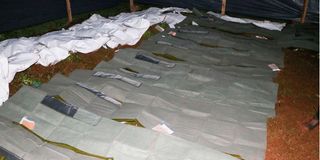
Authorities on Tuesday dug up 32 bodies – seven adults and 25 children – from a mass grave at Makaburini Cemetery in Kericho, a figure that more than doubled the initially disclosed number.
A pungent smell emanated from the freshly dug mass grave on Tuesday evening as body bags were exposed, marking the first step in the ongoing inquest into the origins of the bodies and their identities.
The site was cordoned off with black polythene sheets to shield the operation from cameras and the prying eyes of the public.
Grave diggers began work mid-morning but took a break barely an hour later, only to resume briefly around 2pm.
An afternoon downpour disrupted the exercise forcing the 21 grave diggers to pause as Government Pathologist Dr Richard Njoroge and Director of Homicide Martin Nyuguto held a closed-door briefing inside a tent for nearly two hours.
“What we have found is quite unusual. Some bodies look like they have come from morgues and others from hospitals. Most bodies are decomposed but the neonates are likely fresh,” Dr Njoroge said.
Government pathologist Dr Richard Njoroge addresses the media after exhumation of 32 bodies from Makaburini cemetery in Kericho on March 24, 2026.
Photo credit: Boniface Mwangi | Nation Media Group
Around 4pm, the team resumed digging and the stench of decomposing bodies quickly filled the air, confirming to members of the public who were watching from a distance that the grave had been reached.
Journalists were pushed back behind the police tape as the operation entered what appeared to be its final phase.
Anxiety has gripped the area since Saturday when police disclosed that a report had been filed at Kericho Police Station about the secret burial of 14 bodies by unknown individuals.
Five youths have since confirmed they were hired to dig the grave on Thursday, with the burials carried out early Friday at the cemetery, which is owned by the National Council of Churches of Kenya.
The council has denied any knowledge of the burial. Kericho County officials, local police, and administrators have also distanced themselves from the incident, deepening the mystery and raising more questions than answers.
Pathologists are expected to conduct DNA and toxicology tests as investigators seek to establish the identities of the deceased and the circumstances surrounding their deaths.
Makaburini cemetery is sandwiched between Kericho’s central business district and the sprawling Nyagacho residential estate.
The Tiony Soet River separates Nyagacho estate from the cemetery. On the eastern side stands a newly constructed three-storey residential house, while a perimeter wall is coming up a few metres away, an indication of ongoing development in the area.
Secret burial of 14 bodies
Goats and sheep graze freely on the open fields as residents move to and from town using footpaths that cut across the cemetery, avoiding the official tarmac road running past Kiprugut Chumo Stadium and the main Kericho market.
The scene reflects a bustling town in rural Kenya still adjusting to rapid urbanisation that is steadily reshaping its way of life.
But the secret burial of 14 bodies over the weekend has thrust the cemetery into the national spotlight, with many questions about the circumstances surrounding the interment still unanswered.
The 32 bodies that were exhumed from a mass grave in Makaburini in Kericho on March 24, 2026 by homicide detectives.
Photo credit: Boniface Mwangi | Nation Media Group
It lies adjacent to another cemetery used by the Muslim community, while a few metres away is a cremation facility used by the Asian community.
It has since emerged that Kericho County does not have a public cemetery of its own and residents largely rely on the NCCK-managed facility.
“It is true, the county government of Kericho does not have a public cemetery in the town, which is its headquarters,” a senior county official said.
He added that the county only has a cemetery in Kapkatet, Bureti Constituency, which is rarely used by either the government or local residents.
“Members of the local community – the Kipsigis sub-tribe of the Kalenjin – do not bury their loved ones in cemeteries due to deep-rooted cultural beliefs. The bodies are buried in private farms belonging to the deceased or their relatives,” said Mr David Ngetich, a resident.
“It is considered taboo to bury someone in a cemetery as it is seen as abandoning the body. It is believed such a spirit may haunt family members,” he added.
As a result, setting aside land for a public cemetery was not prioritised during town planning under the defunct local authorities or even the current county government.
Freshly dug and covered graves dot the cemetery, alongside older burial sites some marked with tombstones, others with wooden inscriptions and many unmarked. Flowers scattered across the grounds indicate recent burials.
DCI Homicide detectives at Makaburini cemetery in Kericho Town on March 22, 2026 where 14 bodies were buried in a mass grave.
Photo credit: Vitalis Kimutai | Nation Media Group
Reverend Andrew Tum of the Anglican Church in Kericho confirmed that the cemetery belongs to NCCK and that there are clear procedures governing burials at the facility.
“One must present the relevant government permits and demonstrate that the body intended for burial is that of their kin,” Rev Tum said.
He explained that once the documentation is verified, a bill is issued and payment receipted before the caretaker is notified of the intended burial. The records are then filed at NCCK offices.
“The caretaker of the cemetery is informed after all documentation is confirmed and filed,” he added.
Rev Tum confirmed that the recent burial was conducted without NCCK’s approval and that the news caught officials by surprise.
For the past four days, the area has remained under tight security.