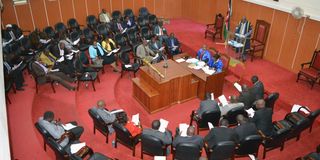
The High Court has quashed a proposal to block nominated members of the Kiambu County Assembly from voting on crucial matters such as the annual budget and money bills.
The proposal had sought to amend the County Assembly's Standing Orders to ensure that only elected members cast their votes on money bills and all matters related to Ward development.
If passed, the nominated MCAs, who are selected by political parties to represent specific groups like women, youth, or persons with disabilities, would have lost significant influence in the House to their elected colleagues.
The contested amendment was sponsored by Riabai Ward MCA Hezron Gachui. It sought to provide that "any question affecting wards and money Bills proposed for decision by the County Assembly shall be determined by a single delegation of members of the County assembly".
Mr Gachui made the proposal through a motion dated November 11, 2024, sparking a court action by his nominated colleagues who claimed discrimination and breach of their rights.
Justice Abigail Mshila agreed with them after finding that the proposal contravened the Constitution as it sought to limit the role of the County Assembly to one category of membership and excluding others.
"The import of the proposal is that if it passes, only elected members of the County Assembly are allowed to vote on questions affecting wards and money bills proposed for the decision by the County Assembly. This evidently flies in the face of the Constitution because contrary to the impugned proposal, the Constitution does not restrict membership of the County Assembly to elected members," said Justice Mshila.
The court declared the motion as "unconstitutional, null and void".
"The proposed amendment to Part XVII- Voting and Divisions of the Standing Orders of Kiambu County Assembly threatens and is in contravention of both the Constitution and the rights of the petitioners," said Justice Mshila.
While ruling on two petitions filed by eight nominated MCAs challenging legality of the motion, the court said the proposal would have led to discrimination.
The court noted that the essence of the contested amendment was exclusion of a category of membership of the County Assembly from performing specific roles.
"If the proposed motion passes, the petitioners would be reduced to vestigial members despite having similar roles as those of elected members under the Constitution and the County Governments Acts. This definitely threatens the petitioners’ right against discrimination as representatives of special groups being women, youth, minorities and persons living with disabilities," said Justice Mshila.
In its verdict, the court referred to Article 27(4) of the Constitution which prohibits direct or indirect discrimination against any person on any ground.
In their case, the petitioners claimed that they were on the edge of being reduced to “ceremonial representatives” if the motion passed. They claimed that they stood to be shut out of voting on House businesses.
However, the mover of the motion, Mr Gachui, explained that the intention was to introduce equal voting rights for all MCAs.
Court papers show that he cited the Senate’s Standing Orders (PART XVII- Voting and Divisions) as the justification for the proposed amendment. The section talks about voting by county delegations, where each delegation has one vote.
Since some sub-counties in Kiambu were over-represented in the County Assembly with both elected and nominated members, Mr Gachui wanted the MCAs to be voting through a delegation system.
Besides representing interests of the marginalised groups and ensuring gender parity in the House membership, nominated MCAs have the same roles and responsibilities as their elected colleagues, including legislation, representation, and oversight.