When security agencies arrested controversial preacher Paul Mackenzie and his accomplices over Shakahola deaths, the forest was declared a crime scene and remains restricted to date.
To further secure the forest, the National Police Service deployed officers to guard the area around the clock.
At least 30 officers are stationed there daily to prevent entry into the site where members of the Good News International Church were buried in shallow graves after starving to death in a deadly fast.
According to the government, these measures were meant to curtail movement in and out of the forest.
However, driven by the urge to continue committing atrocities in the name of religion, followers of the Shakahola cult abandoned the cordoned forest and shifted deeper into Chakama Ranch.
There, they found a new hideout to continue radicalising followers into the deadly sect, this time employing even more brutal methods.
Two years later, a fresh and more disturbing scene is quickly unfolding at Kwa Binzaro village, about 27 kilometres from Shakahola, where hundreds perished while fasting “to meet Jesus.”
Kwa Binzaro is more than 30 kilometres from the nearest police station. Locals say the limited or total lack of security presence in the area has contributed to the criminal activities now being unearthed in the forest.
The government itself has acknowledged that the vastness of Chakama Ranch makes it fertile ground for illegal activities, which often go unnoticed by security agencies until disaster strikes.
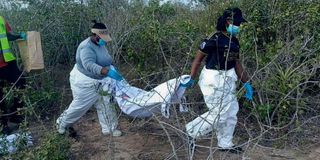
Another round of exhumations is now underway. This time, the graves are hidden deep in the thicket and are much harder to trace. Skeletons are recovered scattered.
Detectives say perpetrators changed tactics. Unlike in Shakahola, where most victims were buried with clothes, sheets or blankets, the Kwa Binzaro bodies were buried naked and facing upwards.
In Kwa Binzaro, the victims were laid on their backs facing upwards, whereas in the Shakahola case most were buried on their sides, facing sideways.
The graves are extremely shallow, barely a foot deep, suggesting perpetrators were in a hurry to dispose of the bodies and flee.
Grave diggers exhume bodies of suspected cult members at Kwa Binzaro village in Kilifi County on August 21, 2025.
Photo credit: Brian Ocharo | Nation Media Group
In some cases, the skeletal remains are dismembered due to advanced decomposition, with a strong stench emanating from the sites.
Thorny bushes conceal almost all the graves, seemingly to prevent detection.
While Shakahola victims were wrapped in sheets or nylon papers, Kwa Binzaro victims were stripped bare. Detectives describe the burials at Kwa Binzaro as even more brutal.
Investigators believe the victims were buried at least a year ago. This means they were alive during Mackenzie’s arrest in 2023 and through much of 2024.
The burial patterns, however, remain similar to Shakahola. Several graves contain two or more bodies dumped together, barely covered with soil.
In contrast to Shakahola, where some victims were found under tree shades, all Kwa Binzaro victims were buried, albeit in very shallow pits and inside the thicket.
Officers from the Directorate of Criminal Investigations at the site where more graves were discovered at Kwa Binzaro area, within Shakahola Forest, Kilifi County on August 15, 2025.
Photo credit: Kevin Odit | Nation Media Group
The shallowness appears to explain why detectives have found scattered body parts, likely exhumed and dragged away by wild animals.
So far, at least nine bodies have been exhumed from Kwa Binzaro, pushing the number of Kenyans confirmed dead due to cult activities to more than 470 since 2023, when the first mass graves were discovered in Shakahola.
In one grave, only clothing believed to belong to victims was found.
These included women’s undergarments and children’s clothes. Detectives noted the soil was still damp, leading them to suspect the perpetrators had hurriedly buried the garments to conceal evidence.
The compound had two temporary soil-and-grass structures and a small dam, apparently under construction.
Deeper in the forest, investigators stumbled upon scenes chillingly reminiscent of Shakahola.
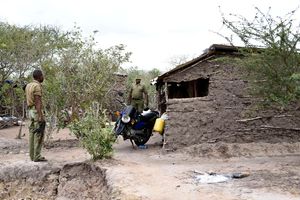
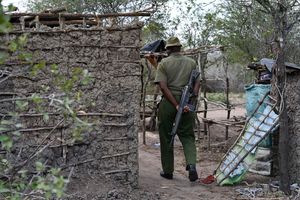
Police officers secure the Binzaro homestead in Chakama Ranch where the body of a middle-aged man was found. Authorities say at least 11 people are being investigated in what appears like the Shakahola cult.
Photo credit: Wachira Mwangi | Nation Media Group
Shallow graves scattered beneath tall bushes yielded more bodies, reviving painful memories of 2023 when more than 459 people were exhumed from the forest.
Police say the graves appear strategically dug to avoid detection, raising questions over how perpetrators managed to inter victims unnoticed.
As in Shakahola, children appear to have suffered the most. In one case, six minors from a single family were buried in the forest.
Morticians carry an exhumed body at Kwa Binzaro village within the vast Chakama Ranch in Kilifi County on August 21, 2025.
Photo credit: Brian Ocharo | Nation Media Group
So far, 27 graves have been identified by homicide and forensic experts after combing three homesteads in the forest. The area has since been sealed off with armed officers guarding the exhumation site.
The decomposed remains will undergo DNA testing to establish identities and allow families to claim the bodies for burial.
Meanwhile, 419 bodies exhumed from Shakahola in 2023 are still lying at the Malindi Sub-County Morgue, with the government preparing for a mass interment at Shakahola.