To get to the so-called “holy wilderness” in Kwa Bi Nzaro—a place where tens of people walked or rode to only to starve themselves to death in the name of salvation—one must travel through the winding, rugged interior of Kilifi County. The route is as unforgiving as the story it hides.
The journey begins either from Malindi or Kilifi town—we began it in Kilifi. The shortest route spans about 86 kilometres, and quickly reveals the contradictions of modern Kenya: perpetual roadworks, villages caught between neglect and change, and forests where life and death collide.
The Kilifi-Ganze road is the first test of endurance. On paper, it is a lifeline connecting Kilifi to its interior villages. In reality, it has been a construction site for as long as locals can remember.
“This road has been like this since I was a young man. I am now married with two kids, and the construction—or is it repair work—keeps increasing by the day. It appears the plan is not to finish the road,” Babu, a resident of Ganze, said.
The evidence of construction is everywhere: fleets of trucks emptying murram, labourers digging trenches for massive culverts and diversions that force motorists off the road. Travel feels less like progress and more like a perpetual loop; the road exists only in half-finished fragments. The diversions funnel travellers into villages like Kibarani, once a quiet settlement now morphing into a commercial hub dotted with mansions and shopping centres.
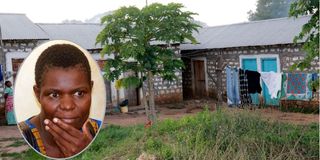
A homestead in Kaoyeni Village in Malindi, Kilifi County, in this photo taken on September 12, 2025.
Photo credit: Kevin Odit | Nation Media Group
Yet, just a few kilometres away in Dzongoloni, life slows again, hushed by two funerals held during our visit. From Dzongoloni, the road snakes through Kikanjuni and into Dida, a lively market town where commerce and chatter pulse back to life.
But even here, the landscape carries the ghosts of colonial history. Villages bear names like Dzunguni (“where white people live”) and Ughaibuni (“abroad”), reminders of missionaries and settlers who left indelible marks.
Beyond Dida lies the dense Arabuko Sokoke Forest Reserve. The road narrows into a dusty corridor under towering canopies. Electric wires sag ominously across the path.
“Don’t touch those wires, you’ll be electrocuted. They keep elephants from invading farms,” a villager warned.
Godoma Training Institute
The murram road winds for another eight kilometres through the thickets before ending abruptly at Kafistoni Primary School.
From there, another two kilometres bring travellers to Godoma Training Institute and soon after, Vitengeni Baptist Secondary School. By now, one has covered some 31 kilometres to get to Matanomane centre—aptly named from makutano manne (the junction of four roads)—where the road splits. Here, the right turn is key.
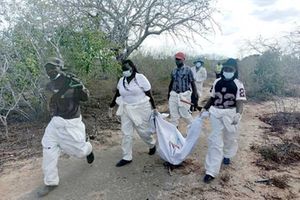
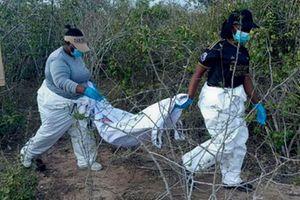
Morticians carry the remains of a person exhumed at Kwa Bi Nzaro village within the vast Chakama Ranch in Kilifi County on August 28, 2025 as part of investigations into a suspected cult.
Photo credit: Brian Charo | Nation Media Group
For 25 kilometres, the murram road meanders through Ngamani, Kiembeni and past churches and schools, including the storied Mekatilili Memorial Secondary School, named for the legendary Giriama freedom fighter Mekatilili wa Menza. Her spirit of resistance hangs in the air, even as the villages she fought for now host a darker struggle—one for survival against religious extremism.
The road finally spills into Baolala, where dust gives way to the C103 Malindi–Salagate tarmac road. It is the first taste of civilisation after hours of bone-jarring travel. Yet, the smooth ride is deceptive. The loneliness of the road is palpable.
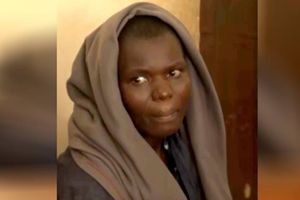
Sharlyne Anindo Temba, who is suspected to be the “chief priestess” of the Kwa Bi Nzaro cult.
Photo credit: Pool
From Baolala to Kwa Idi Farm junction, the C103 road cuts through 23 kilometres of emptiness. Houses are rare, sometimes appearing once in ten minutes. Yet scattered across this desolate landscape are giant stones painted with land-for-sale adverts. Chakama Ranch, a vast expanse stretching tens of thousands of acres, is being sold in phases.
Kilifi Governor Gideon Mung’aro, in an interview with the Nation, explained that the sale in bits is part of the government’s strategy to put the large underutilised tract of land to good use.
“The government has already sold off phase one and two of the Chakama Ranch and is now on the third phase. By selling to investors and home builders, we hope to end negative uses of the land,” he said.
It was a chilling reminder that this same land has twice been turned into a burial ground under the guise of faith.
As the tarmac continues, the modern world slowly fades. Electricity poles dwindle, cables thin, and then vanish altogether. Within five kilometres of Baolala, the villages sink into total darkness after 6.30pm. It is a silence so thick that even the hum of a passing motorbike feels like a rupture.
Kwa Idi Junction itself is easy to miss, a modest turn-off leading towards the grim notoriety of the deaths and secret graves of Kwa Bi Nzaro, located some seven kilometres from the tarmacked road. A careless driver might pass it altogether and find themselves in Shakahola town—barely 13 kilometres away—another name etched in Kenya’s recent history of horror.
In 2023, Shakahola became synonymous with death after mass graves were unearthed in its forest. The discovery shocked the world: 430 men, women and children starved to death under a cult leader’s command.
Kwa Bi Nzaro, once an unassuming village, is now infamous for the same type of tragedy—followers lured to a “holy wilderness” where fasting became their final act.
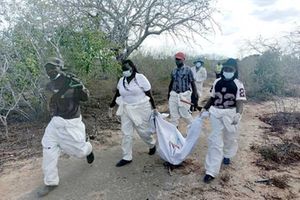
Morticians carry the remains of a person exhumed at Kwa Binzaro village within the vast Chakama Ranch in Kilifi County on August 28, 2025 as part of investigations into a suspected cult.
Photo credit: Brian Charo| Nation Media Group
The name Bi Nzaro itself has roots in ancestry. Retired ACK Bishop Joseph Kalu, born and raised in the area, explained.
“Bi Nzaro is a Giriama term meaning Baba Nzaro. It refers to the founding figure of the village; Nzaro’s father. His descendants spread out, but the place still bears his name,” he said.
Today, Kwa Bi Nzaro is a village overshadowed by death. The first sign of settlement is Binzaro Primary School, its playground alive with children playing football—some with a proper leather ball, others with the polythene creation. Their laughter, however, does little to erase the dread that the name “Binzaro” now evokes.
Kwa Bi Nzaro prime suspect Sharlyne Anindo Temba (right) with her co-accused at the Malindi Law Courts in Kilifi County on September 12, 2025.
Photo credit: Kevin Odit | Nation Media Group
Our three-hour drive from Kilifi had been punctuated by constant stops for directions. Each time, locals reacted the same way: a shudder, a sharp intake of breath and then hesitant instructions. Their words always carried the same cadence: “Waona hii barabara, lifuate, kisha pita centre, utaona duka moja, achana nayo, utaona ingine, achana nayo, kisha piga kushoto, nyoosha kabisa! (See this road, follow it, then pass the centre. You’ll see one shop, ignore it; another shop, ignore it; then turn left, go straight ahead.)” The refrain—“achana nayo, nyoosha kabisa (ignore it, go straight)”—echoed like a ritual chant, as though guiding us not just through roads but into a place few dared to speak of openly.
Yet reaching Binzaro centre does not mean reaching the heart of the tragedy. The crime scene lies deeper, hidden in the dense bush of Shakahola Forest, which borders Tsavo East National Park. Police tape now seals off the site where at least 34 bodies and over 100 body parts were exhumed last month. Locals warned us against attempting to enter unaccompanied.
The forest is treacherous, riddled with confusing paths and home to elephants that wander in search of water. Without a guide, one could easily get lost—or worse.
The sect members who flocked here did so believing death was deliverance, that starving themselves in the wilderness would secure their place in eternity. What they found, instead, was an unmarked grave beneath the trees.
It is disturbing to note how history repeated itself within the same ranch. In 2023, it was Shakahola. In 2025, it is Kwa Bi Nzaro. The land seems cursed to witness Kenya’s most macabre chapters of faith gone astray.
But until the forests are reclaimed from their sinister associations, every traveller down the C103 will whisper the names Shakahola and Binzaro with unease.
Tomorrow: A journey through the exact paths sect members walked, and the chilling rituals that turned hope into horror.