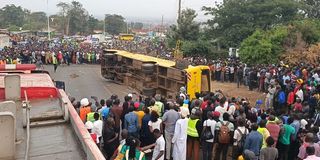
Twenty five people are dead after a bus ferrying mourners overturned at Coptic Roundabout on Kisumu-Kakamega Road, Nyanza Regional Traffic Commander Peter Maina has confirmed.
Among the dead are ten men, ten women and an eight-month-old baby.
The scene of the accident at Coptic Roundabout, Kisumu, on August 8, 2025.
Photo credit: Alex Odhiambo | Nation Media Group
The 5.30pm incident occurred after the bus ferrying mourners overturned at the Coptic Mamboleo roundabout in Kisumu County.
According to witnesses, the 51-seater bus overturned after the driver lost control of the vehicle while negotiating a bend.
"All we heard was a loud bang after the bus veered off the road and rolled," said Mr Erick Omondi, a local resident of Mamboleo, Kisumu.
The scene of the accident at Coptic Roundabout, Kisumu, on August 8, 2025.
Photo credit: Angeline Ochieng | Nation Media Group
Dr Elly Charles, an emergency response doctor, said both injured persons and the casualties have been moved to Jaramogi Teaching and Referral Hospital (JOOTRH) and mortuary.
The scene of the accident at Coptic Roundabout, Kisumu, on August 8, 2025.
Photo credit: Angeline Ochieng | Nation Media Group
Locals have been calling on the government to upgrade the road, terming it a "badly designed roundabout".
Mr Omondi said Friday's accident is the highest number of fatalities witnessed on the road from one accident.
"Looking at the wreckage, more fatalities are likely to be reported. For how long are we going to lose our loved ones to such accidents?" he wondered.
In a previous interview with Nation , Kenya National Highways Authority (KeNHA) Nyanza Regional Director Engineer Julius Mak’Odero had indicated that while the Kakamega-Kisumu road was initially meant to be a single carriage way, the move to transform it to a dual carriage was inspired by road safety concerns.
What the Authority realised was that upon completion, motorists using the road became excited about the upgrade and lowered their guard. This, he said, led to driving at higher speeds while paying little attention to road safety rules, thus resulting in more accidents.
The engineer said that after conducting their own research, they discovered most accidents at the roundabout involve heavy commercial vehicles such as trailers, lorries and buses.
He explained that this has been worsened by the extended distance between the Coptic Roundabout and the next roundabout at Kona Mbaya, something he said encouraged motorists to speed.
Mr Mak’Odero, however, cautioned that removing the roundabout is not an option since the drivers will have a longer free flow which may be risky to oncoming vehicles and other road users.
In an effort to reduce the accidents around the round-about, KeNHA introduced road signs, markings and rumble strips to control speed while approaching the roundabout.
“What we are doing from July 17 is that we are going to retain the roundabout, but will introduce two sets of rumble strips and road markings at different intervals which will act as a warning ahead of the roundabout,” said the engineer.