More than 40 million people relying on Lake Victoria waters from Kenya, Uganda and Tanzania are at risk following the growing pollution in the freshwater source.
A preliminary report from a recent research across the three East African Community members revealed that aquatic animals and lake users are exposed to pollution mainly drawn from urban centres due to population growth.
According to Dr Benjamin Kyalo, Deputy Director, Ministry of Water and Sanitation and Irrigation, the team of researchers found good quality of water deep in the lake, while the shores acting as entry points of the water source remained heavily polluted.
“The sad reality is that most people interact with the lake at the shores, exposing them to the harmful water,” said Dr Kyalo.
Dr Kyalo argued that the pollutants are responsible for the lake becoming increasingly fertile, leading to the growth of hyacinth among other aquatic weeds.
The aquatic weeds, he said, have been increasing in the Northern part of the lake while parts of Uganda and Tanzania have reported salvinia molesta , a new water plant.
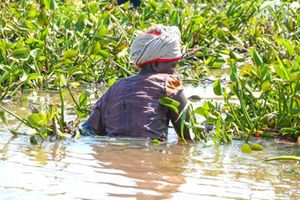
Water hyacinth covers a section of Lake Victoria on January 18. The invasive weed has reared its ugly head again,interfering with the scenic view of the lake, fishing activities, movement and excursion.
Photo credit: ONDARO OGEGA i NATION MEDIA GROUP
Parts of the lake in Entebbe have been turning green due to an algal bloom, a result of untreated urban effluent and agricultural waste.
“The researchers also observed an increase in sediments, especially on Winam Gulf, resulting from erosion. We have also seen massive growth of water hyacinth which at times blocks ships from docking,” he said.
The report follows a 37-day water sampling exercise that kicked off on June 9, 2025, drawing researchers from the three East African Community Member states.
Researchers from Kenya, Tanzania and Uganda partnered in a regional water sampling exercise in an effort to assess the extent and sources of pollution in Lake Victoria.
Led by the Lake Victoria Basin Commission (LVBC) with support from the German Development Agency (GIZ) under the EAC for Nature project, the initiative aims to generate credible, science-based data to guide environmental conservation strategies and policy making in the region.
According to Dr Kyallo, the sampling exercise last done 20 years ago has been long overdue due to industrialization and increasing human activities.
The researchers sampled 44 water stations across the three countries in nine key locations, namely Mwanza, Bukoba, Entebbe, Jinja, Busia, Kisumu, Homa Bay, Musoma, and Kirewe.
“We had 17 sampling stations in Tanzania, followed by 15 from Uganda and 11 from Kenya, “said Mr Masinde.
The exercise covered a wide range of physical, chemical and biological parameters, including key nutrients like nitrogen and phosphorus, field data on pH, temperature and oxygen levels, as well as testing for heavy metals such as mercury, lead and arsenic.
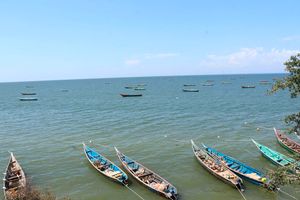
A section of Lake Victoria in Kisumu City on July 6, 2023. The freshwater lake is facing pressure due to encroachment, pollution, abstraction of water, invasive species, weeds, and climate change.
Photo credit: Francis Mureithi | Nation Media Group
The researchers also collected measurements including pH, temperature, turbidity, dissolved oxygen, and photosynthetically active radiation (PAR) from each sampling site, alongside location and depth data.
Selected sites were also tested for heavy metals such as arsenic, mercury, and lead, with samples collected from both surface and bottom water layers.
Phytoplankton monitoring was conducted to examine algal composition and abundance, providing insight into biological activity and potential risks of harmful algal blooms.
“This survey offers a detailed snapshot of Lake Victoria’s chemical, physical, and biological state, supporting more informed and effective environmental management and long-term protection of one of Africa’s most vital freshwater ecosystems,” said Dr Bwire.
The research findings, he said, will also reveal the impacts of the invasive water hyacinth threatening the freshwater lake’s biodiversity, economic activities and transport.
Boat riders wade through a section of Lake Victoria in Kisumu City on June 6, 2023. The freshwater lake is facing pressure due to encroachment, pollution, abstraction of water, invasive species, weeds, and climate change
Photo credit: FRANCIS MUREITHI| NATION MEDIA GROUP
“The results of this exercise will be crucial towards the development and sustainability of various projects and programmers within the larger Lake Victoria Basin,” said the LVBC Executive Secretary, Dr Masinde Bwire.
The sample results expected in due course will inform decision-making on the lake conservation and restoration activities.
Dr Bwire emphasized that water hyacinth remains a major threat to the lake’s ecological balance and economic potential, underscoring the urgency of the regional response.
“The report will influence regional water policy planning, formulate controls for pollution control and support efforts for restoring and preserving the vulnerable ecosystem of the lake, “he said.
The research comes five months after the Kenya Marine and Fisheries Research Institute (KMFRI) and the Kisumu County Fisheries Department attributed the massive fish kills witnessed in part of Lake Victoria to pollution.
According to the research, the fish kills that exposed cage fish farmers to a loss estimated at Sh1 billion were a result of oil spills, decomposing aquatic matter and discharge of untreated waste into the water.
The phenomenon was witnessed in Kisumu, Busia, Homa Bay, Siaya and Migori Counties in 2022 and 2023, leaving behind massive deaths of caged tilapia and Nile perch.
During an investigation, the researchers found that the areas affected most by the fish kills had a foul smell, a thick layer of algae and bubbling, all associated with lake pollution.
The research also found that most physicochemical parameters in the lake were not within the global standards to sustain fish and other aquatic animals.
“An oil layer was also present which likely prevented oxygen from dissolving in water and was suspected to coat the gills of fish eventually suffocating them,” said KMFRI Research Director Dr Christopher Aura.
Dr Obubu Peter, assistant commissioner at the ministry of water and environment, Uganda said the impacts of the lake pollution has seen fish moving deeper into the lake for clean water and good oxygen supply.
Algal bloom, witnessed in the lake, he says produces toxins which have been proven to be harmful to human health.
“They have been associated with cancers and a number of diseases, worse still, some of our water treatment technology cannot completely remove the toxins and algae from the water.
He added: “We need to ensure good water quality is available for domestic use around the water body. The focus should be how to improve the water quality by looking at what comes from the catchment areas.”