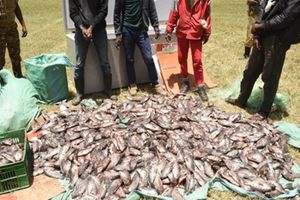
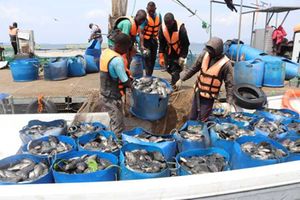
Why the tasty tilapia could disappear from your plate
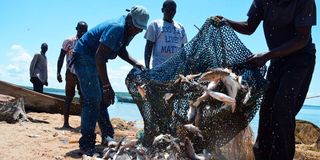
Fishermen let out their catch from a fishing net at the shores of Lake Victoria at Ndenda Island in Siaya County.

What you need to know:
- Beneath the deceptively calm surface of Lake Victoria lies an ecological graveyard where hundreds of unique fish species have vanished forever.
- Scientists estimate that as many as 200 endemic species may have been driven to extinction, though the true number will never be known.
In the pre-dawn darkness of Lake Victoria, fisherman Joseph Ochieng casts his nets into waters that his grandfather once described as "so thick with fish you could walk across their backs."
Today, after six hours of fishing in the world's largest tropical lake, his nets come up nearly empty — a catch barely worth the fuel it took to reach the fishing grounds.
What Mr Ochieng doesn't fully realise is that he's witnessing the aftermath of what scientists call "the greatest vertebrate extinction of the modern era."
Beneath the deceptively calm surface of Lake Victoria — a massive body of water shared by Kenya, Uganda, and Tanzania — lies an ecological graveyard where hundreds of unique fish species have vanished forever, victims of one of the most devastating biological invasions in recorded history.
It's crisis that threatens the food security and livelihoods of more than 85 million people across East Africa, where freshwater fisheries provide the backbone of nutrition, employment, and economic stability for some of the world's most vulnerable communities.
"Africa is a global hotspot of freshwater fish diversity, home to over 3,200 species, but it's also a hotspot of risk," warns Eric Oyare, World Wildlife Fund Africa Freshwater Lead.
"When these fish disappear, we lose much more than species: we lose food & nutrition security, livelihoods, ecosystem balance, and adaptive capacities to climate change."
What began with good intentions culminated in ecological catastrophe. The lake was once an evolutionary jewel, home to an estimated 600 endemic cichlid species that had evolved over millennia into one of nature's most spectacular displays of adaptive radiation.
These small, brilliantly coloured fish had diversified to fill nearly every ecological niche in the lake—some feeding on algae, others hunting smaller fish, many developing unique breeding behaviours that fascinated scientists worldwide.
Then, in 1954, colonial administrators made a decision that would doom an entire ecosystem. They deliberately introduced the Nile perch (Lates niloticus) to create a new commercial fishery, believing this large predatory fish would boost the local economy. What they unleashed was an aquatic monster.
The Nile perch is a voracious predator that can grow to 2 metres in length and weigh over 160 kilograms. By the 1980s, these introduced giants had exploded in population, systematically devouring the lake's native cichlid species. The ecological carnage was swift and merciless.
"By the 1990s, the Nile perch accounted for more than 90 per cent of fish exports from the three Lake Victoria basin countries—Kenya, Uganda and Tanzania," reveals the WWF report titled Africa's Forgotten Fishes. The fishery peaked in 2005 at US$322 million in export value, but this economic success was built on the bones of one of the world's most extraordinary evolutionary showcases.
Scientists estimate that as many as 200 endemic species may have been driven to extinction, though the true number will never be known due to inadequate monitoring and the rapid pace of species loss. Small, multicoloured cichlids known as Haplochromine cichlids—once the most diverse group in the lake, with around 300 species—became casualties of this ecological disaster. Many are now rarely seen, and some, like Haplochromis lividus, are feared extinct.
The irony is devastating: while international markets celebrated cheap fish fillets flowing from East Africa, entire evolutionary lineages that had taken millions of years to develop vanished in mere decades.
Tanzania, with its 61 million people, depends on freshwater fisheries for at least 85 per cent of its fish production. Uganda, the world's sixth-largest producer of wild-caught inland fish, has built much of its Lake Victoria economy around fishing, processing, and trading—activities that support hundreds of thousands of families. Kenya's portion of the lake sustains countless communities where fishing has been a way of life for generations.
"The disappearance of freshwater fish is not just a biodiversity crisis, it is a direct threat to food, livelihoods and cultural identity for millions across Africa," explains Machaya Chomba, Africa Freshwater Protection Manager at The Nature Conservancy. "These species are the backbone of local economies and daily life."
The ripple effects are already devastating communities across the region. As native fish populations shrink, fishers like Ochieng are forced to work longer hours but end up with smaller catches. Some turn to destructive fishing methods, including the use of mosquito nets that capture juvenile fish and speed up population declines.
The economic impact is staggering. Lake Victoria's fisheries, at their peak, generated over US$320 million annually for the three countries. But these official figures represent only the tip of the iceberg — most fishing in the region is small-scale, artisanal, and undocumented, meaning the true economic value of these collapsing fisheries is likely far higher.
While the introduction of this predator destroyed hundreds of endemic species, it also created one of Africa's most successful export fisheries, providing employment and foreign exchange for countries desperate for economic development.
The introduced perch supported a massive industrial fishing operation that processed fish fillets for European and international markets.
Processing plants sprouted around the lake, creating jobs in Kenya, Uganda, and Tanzania. For policymakers focused on economic indicators, the Nile perch appeared to be a conservation success story.
But this economic boom was built on a foundation of ecological destruction that is now crumbling. The very success of the Nile perch fishery has led to overfishing of the predator itself. Combined with the loss of the diverse prey species that once sustained a more complex ecosystem, Lake Victoria's fisheries are now showing signs of collapse.
"The Nile perch is not the only factor," researchers note. "The introduction of water hyacinth, which reduced light and oxygen levels in the lake's waters; unsustainable fishing practices; and habitat deterioration and eutrophication resulting from increasing lakeside agriculture, urbanisation, and deforestation also played their part."
The introduction of water hyacinth—an invasive plant from South America—has created another layer of stress. This floating plant forms dense mats that block sunlight, reduce oxygen levels, and make fishing extremely difficult. The hyacinth invasion, combined with increased nutrient loading from agricultural fertilisers, has contributed to the eutrophication that made the lake's waters less suitable for its native fish species.
Twenty African countries — including Kenya, Uganda, and Tanzania — have joined the Freshwater Challenge: a country-led initiative aimed at restoring 300,000 kilometres of degraded rivers and 350 million hectares of degraded wetlands globally by 2030. This represents the largest freshwater protection and restoration initiative in history.
"African countries signed up to the Kunming-Montreal Global Biodiversity Framework in December 2022, which explicitly includes the commitment to protect 30 per cent of 'inland waters' and restore 30 per cent of degraded inland waters," the report notes. "This ambitious agreement paves the way for a new approach to safeguard freshwater biodiversity."
The challenge now is implementation. Countries must translate these international commitments into practical, on-the-ground actions that can reverse decades of ecosystem degradation.
"The future of Africa's rivers and fishes is inseparable from the future of its people," emphasised Itai Chibaya, WWF Zimbabwe Country Director. "We need bold action at Ramsar COP15 (conference) to restore the life support systems of this continent, starting with our forgotten freshwater ecosystems."
"It's time we stopped treating freshwater fishes as an afterthought," declares Nancy Rapando, WWF Africa Food Futures Lead. "They are central to Africa's biodiversity, development and future. We must act now before the rivers dry out."
For fishermen like Joseph Ochieng, casting his nets into the waters his grandfather once knew, the stakes couldn't be higher. He hopes for a day the nets will be full again.