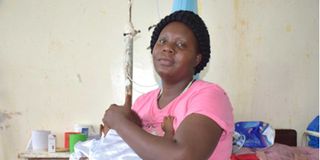
As Christians ushered in a long weekend on Good Friday, Purity Mwende’s world crumbled after a snake bit her 18-month-old daughter, Tabitha, on the left shoulder.
No amount of massaging and soothing calmed the girl.
The mother even tried to cover her daughter’s mouth, in vain. A neighbour, attracted by the incessant wailing, broke the news.
“We established that it was a red spitting cobra, one of the most venomous snakes. It had hidden in her bed,” Ms Mwende told the Nation at the hospital on Thursday.
Two weeks later, the mother of three has nothing to smile about, even after medics at Kitui County Referral Hospital saved her daughter’s life. The hospital has detained the mother and child over an unpaid bill. At the centre of the crisis is the Social Health Authority (SHA).
“The hospital has already discharged us, but a bill has stopped us from going home. The bill was initially Sh78, 000, but SHA has cleared Sh18, 000,” Ms Mwende said. “As a family, we cannot afford Sh60, 000 even after selling all our assets. My husband has been struggling to afford bus fare to visit us at the hospital. We are appealing to well-wishers to come to our rescue.”
The problem is replicated in the male ward. Maingi Nyamai, who survived an attack by a red spitting cobra while tilling his farmland, is among patients detained at the facility.
To secure his discharge, he must pay Sh43, 000.
“My fate lies with the owners of snakes. Kenya Wildlife Service should come to my rescue because SHA does not foot snakebite bills,” he said.
Kitui Governor Julius Malombe’s administration terms the insurance crisis a major stumbling block in the fight against snakebites.
Catherine Mbangula, a nurse who coordinates snakebite management in the county government, says the insurance hiccups risk discouraging patients from seeking care.
SHA has, however, exonerated itself from blame over the Kitui snakebite management crisis. The health insurer maintains it covers snakebite management under emergency care.
“Under the benefits package and tariff structure, snakebite management is provided for, including anti-snake venom, under emergency care. The published benefits package also provides for emergency resuscitation and stabilisation services, which should not be withheld for financial reasons. In such cases, patients presenting with snakebites should receive emergency care at the facility, including stabilisation and the necessary clinical intervention in line with the benefit package. Where a facility is unable to manage a case, it should refer the patient appropriately for continued treatment,” SHA CEO Mercy Mwangangi told the Nation in a statement.
SHA Chief Executive Officer Dr Mercy Mwangangi.
Photo credit: File | Nation Media Group
Ms Mwangangi said the detention of snakebite patients at Kitui County Referral Hospital does not reflect a policy exclusion under SHA and pledged to follow up on the specific cases.
The Nation has established that SHA covers only the first 24 hours of snakebite management. On its website, the insurer says it pays a maximum of Sh6, 600 for the first dose of anti-snake venom. After the first day, a patient must pay or upgrade to the Social Health Insurance Fund to continue receiving treatment.
Medics say the Sh6,600 covered by SHA is a drop in the ocean compared to the actual cost of treatment. “A vial of anti-snake venom goes for Sh6,000. Some patients require up to 20 vials depending on the type of snake involved,” said Ms Mbangula.
The World Health Organization classifies snakebites as a neglected tropical disease. They mainly affect poor rural communities in arid and semi-arid regions. The Ministry of Health estimates that around 20,000 people across the country are bitten by snakes every year, leading to about 1,000 deaths and 4,000 deformities annually.
Baringo, Kilifi, Kitui and Samburu are among the counties with the highest prevalence of snakebites. To streamline response to snakebite management, Dr Malombe’s administration has set up a dedicated department.
“We handle between 700 and 800 cases of snakebites annually. Most of them occur in the Kitui South region, which borders Tsavo East National Park,” said Ms Mbangula.