‘A headache for a headache’: Lamu activists give Dangote 14 days to address refinery grievances

Environmentalists, fishermen and members of the Lamu community under Save Lamu display placards with messages demanding transparency on the Sh2 trillion Dangote Refinery on Friday, October 9, 2026.

Lamu environmentalists and fishermen have issued a 14-day ultimatum to the government and the investor of the Sh2 trillion Dangote East Africa Petroleum Refinery and Petrochemicals SEZ, Aliko Dangote, to ensure they effectively address pending grievances surrounding the plant.
Before and even after the groundbreaking ceremony of the project took place in Lamu on September 30,2026, environmentalists, fishermen and a section of the Lamu Community have continued to put pressure on the refinery to ensure pending issues are resolved before any progress is undertaken.


On Friday, environmentalists, fishermen and members of various community-based organisations (CBOs) under the umbrella of Save Lamu fired back at Dangote’s groundbreaking taunt, promising both the government and the investor of the refinery an ‘extreme’ headache in 14 days if pending issues raised by the community and environmentalists are not addressed forthwith.
Save Lamu is a coalition of community networks incorporating over 40 local organisations, all of which advocate for sustainable, inclusive and responsible development to preserve the environmental, social and cultural integrity of Lamu and promote community participation in decision-making processes.
On Friday, the environmentalists, fishermen and community members called on the government and the project proponents to ensure they publish the applicable Strategic Environmental Assessment and any supplementary assessment; the project-specific Environmental Impact Assessment (ESIA), the National Environment Management Authority (Nema) decision and license conditions and a Health Impact Assessment.
Mohamed Athman, the Save Lamu Board Member, also demanded that the project financing structure, government equity, guarantees and other public financial commitments be made public.
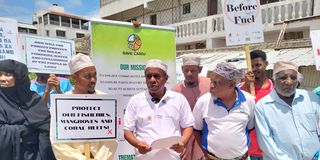
Save Lamu board member Mohamed Athman (centre in white t-shirt and cap) accompanied by other environmentalists, fishermen and community members to brief the media about their concerns over the Dangote refinery in Lamu Island on Friday, October 9, 2026.
Other issues they want addressed are the public participation record and plans for ongoing monitoring, engagement and grievance resolution, compensation and a conclusive resettlement plan for all the project land affected persons.
Mr Athman confronted Dangote’s remarks during the groundbreaking ceremony in Kililana, Lamu West, last week.
In his speech during the groundbreaking ceremony for the Lamu refinery, Mr Dangote was heard issuing a bold warning to critics and legal challengers, stating that ‘anybody who wants to cause trouble, we are ready for his trouble and will give him a headache.’
In response, Mr Athman expressed concerns over land rights, eviction, and threats to the marine ecosystem, turning Dangote’s words right back at him by issuing a 14-day ultimatum to address their grievances.
“We won’t relent. Dangote and the government of Kenya should just know that it’s a headache for a headache. We’re not opposing the project, but we want due diligence on matters of the project implementation. If doing so deserves a headache, then we shall see who’s giving who a headache,” said Mr Athman.
He added, “Our President, William Ruto, and Lamu County Government leaders, including our Governor, Issa Timamy, should listen to the cries of the local mwananchi down here. If you continue to despise and ignore our cries, then we shall have no option except seeking legal redress within 14 days.”
Abubakar Twalib, the Lamu Beach Management Unit (BMU) Chair, stressed that the sea is their only farm and that having an oil refinery of such a magnitude in Lamu is something that might affect their normal activities as the fisher community.

Lamu Fisherman spokesperson and Beach Management Unit (BMU) Chair Abubakar Twalib while addressing journalists on the Dangote project in Lamu on Friday, October 9, 2026.
Mr Twalib stressed that associated infrastructure such as servicing of new settlements, including the impacts of waste and sewage, should also be subject to assessment.
“The sea is our only farm, and if they pour their poison into it, they bury our future. We have pulled our nets from these waters for generations, but oil does not respect the fish or the tides. If the Indian Ocean is ruined by their waste, our boats will sit empty, and our children will have nothing but memories of a rich sea.” We need them to engage us directly on this rather than sidelining us,” said Mr Twalib.

Environmentalists, fishermen and members of the Lamu community under Save Lamu display placards with messages demanding transparency on the Sh2 trillion Dangote Refinery on Friday, October 9, 2026.
Adam Lali, a Save Lamu member, noted that a refinery of the size of the Sh2 trillion Dangote plant needs large volumes of water.
“This might likely be undertaken through desalination, and will bring crude-oil shipping into waters that support fisheries, mangroves and coral reefs. We’re, therefore, demanding that plans for water supply, discharge and spill prevention should be made public before construction proceeds,” said Mr Lali.
Mwanamina Amin, a resident of the area proposed for the Sh2 trillion Dangote refinery, questioned why it has not been made clear to them as project-affected persons what land has specifically been allocated to the plant, on what legal basis, or how affected households shall be compensated and resettled.
“We expect that where the project affects community or customary lands, then the government and project proponent should demonstrate how the rights of us, the affected communities, will be respected. This includes the application of Free, Prior and Informed Consent (FPIC) where applicable. But for them, they’re doing everything in secrecy. We won’t accept,” said Ms Amin.
Famau Ahmed, an elder, noted that the proposed Dangote 1000 megawatt power plant is similar in size to the Amu Power Coal-fired plant, whose license was revoked, blocked by the Malindi Environment and Land Court in October 2025 over a flawed assessment and inadequate public participation.
Mr Ahmed said if the Dangote refinery does not listen to the cries of the Lamu people, then they will ensure it is also thrown away by the court similar to what happened to the Coal-fired power plant.
“The refinery’s climate impact must be assessed under the Climate Change Act and against Kenya's climate commitments, and the terms on which surplus power will be sold should be disclosed. The refinery will sit next to Lamu Port, about 11 km from Lamu Old Town, a UNESCO World Heritage Site. Its emissions could include fine particulates, sulphur dioxide and benzene, a known carcinogen. Therefore, Health Impact Assessment and continuous, publicly reported air-quality monitoring is essential,” said Mr Ahmed.
Ali Hassan, a youth leader and local human rights activist, challenged the project proponents to demonstrate that they have undertaken appropriate human rights due diligence to identify, prevent and mitigate potential impacts on communities, workers, livelihoods, land and the environment, and put in place accessible mechanisms for remedy where harm occurs.
Mr Hassan stressed that Lamu and Kenya deserve nothing less than development that is transparent, properly assessed and consistent with the Constitution and the laws of Kenya.
He demanded that before the refinery construction moves further, the Government under President William Ruto and project proponents should disclose the evidence and allow the public to scrutinise it.
“We’re asking for responsible development. We aren’t asking the public to choose between development and the environment. The larger the project, the greater the obligation to show that the law has been followed and on the project proponents to demonstrate responsible business conduct and respect for human rights. Transparency must precede trust,” said Mr Hassan.
Follow our WhatsApp channel for breaking news updates and more stories like this.


