When the government signed an agreement with a United Kingdom-based company in 2024 to pump in Sh4.8 billion into the revival of the moribund Kenya Fluorspar Company in Elgeyo Marakwet County, there were high expectations of employment opportunities and economic development of the region.
But two years on, the company's revival has yet to begin, and President William Ruto has now given the new investor eight months to either breathe new life into the mining firm or leave.
“The investor has eight months to complete the revival of Fluorspar Company to create jobs for our youth or move out,” said President Ruto last month at Chepkorio during a tour of development projects in the North Rift region.
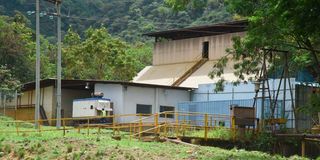
The entrance to the collapsed Fluorspar Mining Company at Kimwarer in Keiyo South, Elgeyo Marakwet County, on November 14, 2026.
Photo credit: Jared Nyataya | Nation
The directive from the Head of State means that the consortium led by M/S Soy Fluorspar Ltd in joint venture with M/S Fujax Ltd and M/S Fujax East Africa Ltd is expected to complete the revival of the company by June 2027.
Although the investor was expected to commence the revival work immediately after it entered into a multi-billion-shilling deal with the government in February 2024, a visit to the mining firm indicated that minimal activity has taken place at the site.
Two earth movers have been parked outside what used to be the offices of the collapsed Kenya Fluorspar Company, while the factory compound remains bushy, with parts of the perimeter fence falling off as a result of long-term neglect.
“The management of the firm is not here, and it remains unknown when they will be back. One of them has just left out for lunch,” said a security guard at the gate while confirming that minimal activity has taken place at the site.
The government in February 2024 signed a deal with the UK-based consortium to pump in Sh4.8 billion to revive the company that suspended operations more than 10 years ago.
Under the deal, the government was to retain a 15 per cent stake in the company.
The then Cabinet Secretary for Mining and Blue Economy, Salim Mvurya, Soy Fujax UK Director Hendrick Ryst and the firm’s boss for East Africa, John Masanda, signed the agreement, rising hopes for the long-awaited revival of the fluorspar mining company.
But when contacted, Mr Masanda was non-committal on when the revival process will kick off and whether they will beat the eight-month deadline set by President Ruto to have the company operational.
A section of an abandoned, water-filled fluorspar mine in Kimwarer, Keiyo South, Elgeyo Marakwet County, on 14 November 2026.
Photo credit: Jared Nyataya | Nation
“There are several logistical issues we are sorting out, and we are in consultation with the national and county governments as well as the local community among other stakeholders,” said Mr Masanda on the phone.
Sections of the local community are upbeat that the company will start operations within the eight-month timeline set by President Ruto.
“The revival efforts are ongoing and we expect the company to commence operation by mid-next year,” said Joseph Kandie, Chairman, Kimarer-Sugutek Fluorspar Community.
He disclosed that they are awaiting the gazettement of the Community Development Committee after they elected 14 members as part of the revival process of the company.
“The signing of the Community Development Agreement will be done once the elected members are gazetted. It is part of the mandatory conditions that will fast track the revival efforts,” said Mr Kandie.
But Keiyo South MP Gideon Kimaiyo has decried the slow revival of the company and wants the process made faster.
“We want the revival process to be hastened to enable the company to resume operation and offer jobs to our people and boost the local economy. The process is currently very slow,” said Mr Kimayo.
A tour at the mining field revealed huge craters left by the previous investor, which the locals said pose serious safety risks to humans and livestock.
"The open quarries are now filled with water and turned into lakes pissing serious safety risks," said James Kwambai from Kimwarer area.
It is, however, emerging that the new investor has committed substantial capital to evaluate and re-equip the site, aligning with the government push to add value to local minerals.
President Ruto’s administration prioritised the revival of the defunct Kenya Fluorspar Company in its pre-election campaigns, pitching it as a major economic driver in the Kerio Valley region after operations collapsed in 2016 due to a slump in global prices.
But even after the government entered a deal with the UK consortium, the revival of the company has been hit by logistical challenges that have slowed down the process.
“The local community has waited for far too long for the company to resume operations. Many unemployed youths are eager to get jobs and business opportunities,” said President Ruto during a previous tour of Elgeyo Marakwet County.
He asked Mining and Blue Economy Cabinet Secretary Ali Hassan to work with Governor Wesley Rotich in accelerating the revival efforts.
A central focus on the revival of the company has been resolving historical land and compensation grievances raised by the local community and leaders that President Ruto wants resolved after the investors commence operations.
“The investor should first restart operations and then handle compensation for the displaced families,” said President Ruto.
The compensation for the 500 families displaced from 9070 acres of ancestral land is demanding Sh3 million per acre.
At its peak, the company exported over 106,000 tonnes of fluorspar and had assets worth over Sh5 billion, while it employed over 3,000 people, propelling economic growth and development of the local community. The collapsed mining company is located in his constituency.
Fluorspar, also known as fluorite, is used locally and globally across heavy and chemical manufacturing sectors.
It is used in steel, iron and aluminium smelting and refining processes and in fluorochemicals and acids.
The mineral is also used in refrigerants and air conditioning and in glass and ceramics for thermal shock resistance.
Fluorspar mining at the Kerio Valley.
Photo credit: File | Nation
The collapse of the Kenya Fluorspar Company leaves South Africa and Morocco as the remaining African countries in the global market dealing in the mineral.
South Africa produces about 300,000 tonnes annually, while Morocco produces 100,000 tonnes. Kenya produced 120,000 tonnes annually before the exit of the mining firm.
The slump in global fluorspar prices and the entry of alternative products led to the closure of mining firms, including the Kenya Fluorspar Company and others in Bulgaria.