A pronouncement by President William Ruto that construction of the Sh2.2 trillion Dangote oil Refinery and Lokichar-to-Lamu crude oil pipeline may run concurrently has fuelled more confusion among locals in Lamu who insist pending issues should be urgently addressed first.
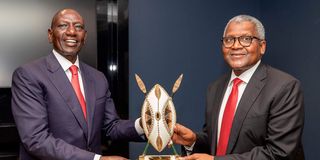
Speaking during a media engagement at the State Lodge in Kisumu, President Ruto announced that the Kenyan government was negotiating with the Nigerian conglomerate Dangote Group to construct a crude oil pipeline connecting the Turkana oil fields to Lamu.
According to the Head of State, the pipeline project will directly support the planned crude oil refinery in the region.
Work on the main pipes that connect Changamwe refinery with Kipevu Oil Terminal in Mombasa. PHOTO | FILE | NATION MEDIA GROUP
The 824 kilometre pipeline was a key component of the Turkana oil extraction plans, but its fate later became unclear after the government and Gulf Energy, which took over from Tullow Oil, indicated preference for trucking the oil to the old Changamwe Oil Refinery for storage and onward exportation through the Port of Mombasa.
In a February parliamentary briefing, Roads Cabinet Secretary Davis Chirchir clarified that the Lokichar–Lamu pipeline remains a long-term element of the oil development plan but is not ready for the initial production timeline. The plan is therefore to use road transportation during Phase One, followed by rail evacuation during Phase Two as the government targets first oil exports later this year.
Locals under the Kililana Farmers Association, a community group representing landowners and residents mostly bordering the Lamu Port-South Sudan-Ethiopia Transport (Lapsset) corridor, questioned why plans for the proposed Lamu oil refinery seem to be moving fast while crucial issues affecting communities are pending.
Kililana Farmers Association Organising Secretary Mohamed Rajab called on the need for public participation and compensation issues to be initiated first before any further developments can be considered.
Mr Rajab questioned why up to date, the State has remained silent concerning the exact location where the Dangote Oil Refinery will be established in Lamu. The groundbreaking ceremony for the project is scheduled for September 30, according to government officials.
Mr Rajab insists failure by the State to disclose the exact project site raises eyebrows and could later haunt the entire plan.
“Why is the state leaving us, the locals, in the dark surrounding the exact site where the intended oil refinery project will be established? Why is the rushed timeline? No one has come down to tell us where the site is,” said Mr Rajab.
He added that issues are still pending concerning lands taken to construct the pipeline in previous years.
“Our lands were taken and no compensation made. We shall seek legal redress on all these issues,” he said.
Mr Mbwana Shee, the Chairperson of the Shungwaya Welfare Association, a community-based civil society organisation championing indigenous Bajuni land rights in Lamu expressed disappointment that every time the government plans to invest a mega project in the county, the locals are excluded from decisions that directly threaten their livelihoods.
“We want the project to be paused until comprehensive public participation and exhaustive environmental and social impact assessments are made public,” said Mr Shee.
Mohamed Mbwana Shee, the Chairperson of the Shungwaya Welfare Association, a community-based civil society organization championing indigenous people's rights, both historical and land justices in Lamu, displaying land documents during an interview with the Nation on September 22,2026. He has called for full involvement of the local community on matters surrounding the Sh2.2 trillion Dangote Oil Refinery Project set to be launched in the county on September 30,2026.
Photo credit: Kalume Kazungu | Nation
Ms Raya Famau, an environmental activist and Executive Director of the Lamu Women Alliance, pleaded with the state to ensure there is continuous, transparent, and genuine consultation with all affected communities in accordance with the Constitution of Kenya.
“We’re citizens of this country. Community voices must be heard throughout planning, implementation, and operation. We’re calling on the state and local leadership to come forward and tell us what exactly is happening surrounding all these projects rather than hearing blanket announcements in the media,” said Ms Famau.
Nigeria's Dangote Group seeks to set up a 700,000-barrel-per-day oil refinery project. It is an investment that will be financed through internal cash flow, bonds and an Initial Public Offering (IPO).
The venture is expected to take up to three years to build and would supply refined petroleum products to Kenya and neighbouring countries, helping to reduce East Africa’s dependence on imported fuels.