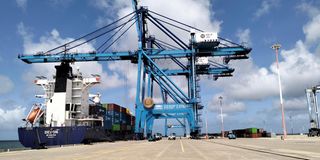
Kenya is courting American companies seeking access to landlocked markets across East and Central Africa to use Lamu Port as a logistics hub, capitalising on increased shipping activity triggered by disruptions in the Middle East.
The Sh310 billion port recorded increased ship call-ins earlier this year after shipping operators diverted vessels away from the Middle East, particularly the Strait of Hormuz and Red Sea, amid the conflict involving the United States, Israel and Iran.
Major shipping lines, including Maersk, Hapag-Lloyd and CMA CGM, rerouted vessels around Africa, away from the Suez Canal and Bab el-Mandeb Strait, following US and Israeli strikes on Iran and disruption of traffic around the Strait of Hormuz.
The increased activity has strengthened Kenya’s case for positioning Lamu as an alternative regional logistics gateway as the country seeks to attract more American investment into manufacturing, trade and logistics.
Investments, Trade and Industry Cabinet Secretary Lee Kinyanjui told American investors in Nairobi that the Lamu corridor gives businesses operating through Kenya alternative access to a larger market, including Ethiopia and South Sudan.
“We believe that we will be able to open to a 130 million market,” Mr Kinyanjui told the two-day American Chamber of Commerce Business Summit, which ended in Nairobi on Thursday. “We believe that some of the American firms in that particular space will be able to take advantage of that.”
The pitch was part of the government’s strategy to persuade US companies to view Kenya as a regional production and distribution base rather than simply a market of about 55 million consumers.
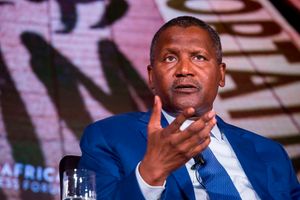
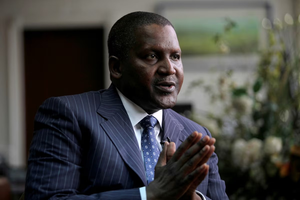
The Lamu corridor pitch to big-ticket investors has started to gain momentum, with Africa’s richest man, Aliko Dangote, already preparing to begin construction of a 650,000-barrel-a-day oil refinery later in the year.
“For those of you who are thinking of coming to manufacture in Kenya, I think we need to look at Kenya beyond the country to the regional markets,” Mr Kinyanjui said. Lamu Port’s physical advantages strengthen the case, with its first three operational berths measuring 17.5 metres deep and 400 metres long, compared with Port of Mombasa’s 15-metre depth and 300-metre quay length. The port is designed to accommodate vessels carrying up to 12,000 twenty-foot equivalent units, compared with a capacity of up to 10,000 TEUs at Mombasa. This gives Lamu an advantage in handling larger modern vessels as Kenya seeks to build a second major maritime gateway and expand its role in regional trade.
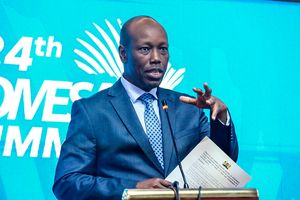
Cabinet Secretary for Investments Trade and Industry Lee Kinyanjui before the Senate on May 6, 2026
Photo credit: Dennis Onsongo | Nation Media Group
Mr Kinyanjui said the recent disruption in the Middle East had demonstrated the growing importance of the East African coast as a trans-shipment route.
“The East African coast has gained significance, especially as a trans-shipment centre,” he said, noting that Kenya handled trans-shipment for the Middle East during the peak of the crisis. “Logistics and efficiency are very critical. We see these as our centres of efficiency to try to reduce the time it takes to export or to import, and also to create predictability.”
The Lamu pitch comes as Kenya seeks to deepen its economic relationship with the US beyond traditional trade, with the government identifying agriculture, digital trade, energy and infrastructure, manufacturing, health, critical minerals and the creative economy as priority investment areas.
Dangote Group founder Aliko Dangote.
Photo credit: Pool
Kenya also wants American companies to use its regional market position to process minerals locally. Mr Kinyanjui said more than 95 percent of African mining output is exported to other parts of the world, presenting an opportunity for processing and value addition in Kenya.
TradeMark Africa chief executive David Beer said Kenya has an opportunity to capture more value from mineral discoveries across the region by combining its logistics infrastructure, power, finance and skills with minerals from neighbouring countries.
“The other major opportunity here is not simply offtake and extractives and concessions. It’s how Kenya can become the regional hub for processing minerals right across the region,” Mr Beer said.
He said much of the infrastructure needed for higher-value mineral processing was already in place, including logistics, green power, capital markets, finance, skills and standards.
Mr Beer, however, said the country would need to improve the scale and reliability of power supplies and, crucially, remove bottlenecks at regional borders.