Grand oil refinery dream set in motion with project launch
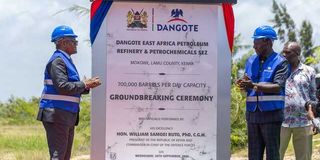
President William Ruto (right) and President of the Dangote Group Aliko Dangote during the groundbreaking ceremony for the Dangote East African Refinery in Lamu County, Kenya.


Kenya has officially launched the construction of the much-awaited Sh2 trillion Dangote East Africa Petroleum Refinery and Petrochemicals SEZ in Lamu County.
President William Ruto and Nigerian billionaire Aliko Dangote led the groundbreaking ceremony for the refinery project on Wednesday.
Ugandan President Yoweri Museveni, Ethiopian Prime Minister Abiy Ahmed, President Romuald Wadagni of Benin and Togo’s President Jean-Lucien Savi de Tové were present.


Dr Ruto said that Tanzanian President Samia Suluhu could not attend the event because she was recently bereaved, while Rwanda and Burundi sent delegations.
Leaders said the project was part of a broader push to build an Africa capable of processing its own resources and meeting its own industrial needs. They said that Africa must stop exporting its raw materials and importing manufactured goods if the continent is to create jobs, retain wealth and achieve economic self-sufficiency.
"This is bigger than a refinery. It is an investment in energy security, industrialisation, and regional integration. Above all, it is a declaration that Africa has entered a new age in which we will increasingly finance, build, process and add value here at home.This is African ambition, backed by African capital, building African industry for African prosperity," Dr Ruto said.
The president said that Africa has supplied the raw materials while others captured the processing, manufacturing, jobs, and commercial benefit for too long.
He said the trend must change for the continent's prosperity, adding that last year, Kenya spent Sh530 billion to import petroleum products alone.
"The argument is simple. We must produce more of what we consume. We must add value to more of what we produce. And we must progressively replace what we import with what we manufacture," he said.
President Museveni echoed the sentiments. He said industrialisation would open up the East African region to more opportunities.
He cited Uganda's earlier refusal to supply iron ore to a proposed processing plant in Mombasa as an example, because Kenya would gain jobs and tax revenues while Uganda exported raw materials.
Mr Museveni explained that his push for an East African federation would go a long way to help the region achieve its industrialisation goals.
He said that integration should allow citizens to freely move and work across the region, while ensuring countries benefit from investments.
Prime Minister Ahmed expressed optimism that the project will have a positive impact on the East African region. He said overdependence on other regions on the globe has always left Africa exposed to high risks.
"This leaves us exposed to shocks in the market. As industries expand and the population grows, demand for fuel expands.
Once complete, the plant will bring refining closer to the African market and have significant impact to this part of the continent," he said.
Mr Dangote said the project is expected to be completed in the next 40 months. He said this demonstrates what could be achieved when African countries, institutions and investors work together.
The tycoon said the African continent is rich in resources, but continues to lose value by exporting minerals and other raw materials while importing manufactured goods.
“Africa should be sufficient. No one should threaten Africa with export bans. Ninety-Four per cent of the drugs that we use are imported. We must make Africa resource-sufficient and end importation,” Mr Dangote said.
“We need to see more ship leaving ports with goods manufactured in Africa, not imports. We want to reverse the trend,” he said.
Mr Dangote said agreements on the Lamu project were signed on Tuesday, and issues affecting local communities were being addressed.
He asked regional governments to view the refinery as an East African project rather than a facility serving Kenya alone. The project, he said, would require partnerships, trust and strong institutions across the region.
Mr Dangote said his firm was also looking beyond the refinery, with plans to invest up to $50 billion across Africa by 2030 in mining, manufacturing, ports and other sectors.
The Lamu project is expected to anchor a broader industrial city around Lamu port, to boost demand for logistics, engineering, construction, energy, housing and other services.
Mr Dangote called for a shift towards creating industries and retaining more value from the continent's mineral, agricultural and energy resources. He said the refinery should be seen as part of Africa's attempt to build a more integrated industrial economy.
Follow our WhatsApp channel for breaking news updates and more stories like this.