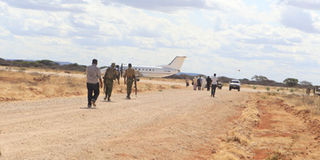
A week after the government revived plans to build an international airport in Mandera, the local community has voiced strong opposition to the project.
The airport project was first proposed in 2014, but the local community took the matter to court, arguing that it could spark clan clashes and was not a priority. The courts ruled against the county government at the time.
In 2013, the Mandera County Government had planned to construct an international airport at Karo, where there is an existing airstrip.
After spending Sh300 million on a feasibility study, locals opposed the plan. The proposed project was expected to occupy 48 square kilometres (about 12,000 acres), though the construction costs were never disclosed. The plan was spearheaded by Senator Ali Roba, who was then serving as governor.
Thirteen years later, another plan has been proposed, but it still faces opposition from sections of the local community.
Led by Lafey Member of County Assembly (MCA) Adan Haji Rahoy, residents insist that development should be inclusive and not imposed on the community.
“The proposed Karo Airport project was successfully stopped in court after residents of Karo, Libihiya and Arabia raised serious concerns about land rights, livelihoods and lack of public participation.
“It is therefore surprising that the project has resurfaced without clear explanations or renewed consultations with the affected communities. We do not understand what has necessitated its revival, especially when the initial objections were never adequately addressed,” Mr Rahoy said.
On February 18, 2026, a high-level multi-agency delegation, including officers from the Kenya Defence Forces (KDF), Kenya Airports Authority (KAA), Kenya Civil Aviation Authority (KCAA), the Kenya Meteorological Department, the County Security Committee and County Government officials visited the area to formally assess and confirm the proposed site for the new airport.
The visit raised eyebrows among the locals, prompting mobilisation to oppose the second attempt.
According to a post on the Mandera County Government’s Facebook page, the delegation’s visit focused on evaluating the land’s suitability, reviewing technical and regulatory requirements and outlining the scope of works.
“The planned development will include upgrading the runway and apron to bitumen standards to enhance aircraft safety and reliability. A modern passenger terminal will also be constructed, along with key facilities such as fencing, security installations, access roads, drainage systems, and essential utility services,” the post stated.
On Friday, 10 MCAs, flanked by community leaders, strongly opposed the project.
“The leadership and people of Mandera East maintain that the project should not proceed without proper consultation, transparency, and firm commitments to protect ancestral land and ensure participation of local residents,” Mr Rahoy said.
The group challenged the national government to understand local dynamics and respect the voices of the communities directly affected. Residents raised concerns that the project could lead to the loss of grazing land and threaten livelihoods.
“We oppose the project. Proceeding without adequate consultations is a clear violation of our rights under Articles 10 and 40 of the Constitution. This project contravenes the Community Land Act of 2016,” Mr Rahoy said.
The Community Land Act requires free, prior and informed consent from affected residents for any dealings on community land. Decisions affecting community land must be transparent and participatory.
When the project was first opposed in 2014, then-Governor Ali Roba blamed “greedy and selfish” businessmen and “clan politics” for the opposition. He argued that the new airport would protect locals from dangers posed by aircraft at the existing airstrip and claimed that powerful individuals exaggerated the land required.
Even after the project was relocated to Wargadud in Mandera South, it failed to take off. The community maintained that the area earmarked was a vital water catchment zone for their livestock.
Local leaders and residents argue that no project should proceed without proper consultation, transparency, and firm commitments to safeguard ancestral land.
“We will not accept a project imposed on us that could lead to dispossession of our land,” Mr Rahoy said.
The community also highlighted that the airport project would affect settlements in Karo, Lafey, Libehiya, Arabia, Odha and Ledhi.
“The proposed airport will occupy 48 square kilometres. This is not a small parcel—it directly affects homes, grazing fields, livelihoods, cultural heritage and the future survival of our communities,” he said.
He argued that such massive land acquisition cannot be justified without full transparency, lawful procedures and genuine consent.
“Under Article 63 of the Constitution, community land is recognised and protected. It belongs collectively to the community and cannot be taken arbitrarily. The Constitution clearly states that community land shall not be disposed of or used except in accordance with the law,” Mr Rahoy said.
However, Warankara MCA Abdullahi Shikri acknowledged the complexity of the issue.
“While there is a genuine need for improved air transport infrastructure, there appears to be a lack of transparency from local leaders regarding the exact land required for the project,” he said.
According to Mr Shikri, Mandera needs an airstrip, not a full-scale international airport.
“Case studies of underutilised facilities in places like Isiolo and Wajir show that building large airports without sufficient traffic demand can waste resources. It would be more practical to upgrade the current airstrip to standard specifications while compensating neighboring residents to allow runway expansion,” he said.