The greatest impediment in the fight against corruption is the government itself, with multiple ministries, state departments, agencies and county governments being listed as notorious graft dens, a new report has shown.
According to the latest Ethics and Anti-Corruption Commission’s (EACC) annual report, tens of State agencies and counties are under investigation for corrupt dealings running into billions of shillings.
Topping State agencies being investigated for procurement irregularities in a tender worth Sh2.5 billion for the construction of an effluent treatment plant is the Kenya Leather Development Council. The treatment plan was to be constructed at the Kenya Leather Park in Machakos in the 2017/18 financial year.
Another investigation into alleged procurement irregularities in a tender worth Sh2 billion targets the Kenya National Highway Authority. The contract for the construction of Greenpark terminus was awarded to China Road and Bridge Corporation in 2023/2024 financial year.
Greenpark matatu terminus.
Photo credit: File | Nation
Mandera County government is being investigated for allegations of conflict of interest against its former governor for irregular payments to ten companies that traded with the country between 2013 and 2020. The money involved is Sh1.67billion.
Still in the same county, the Commission is checking into allegations of conflict of interest implicating a former Assembly Speaker in award of contracts worth Sh1.42 billion to Frontier Engineering Limited between 2014/2015 as well as 2024/2025.
The National Industrial Training Authority has also attracted the anti-graft watchdog’s eyes, with its involvement in suspicious procurement dealings for the provision of ERP System upgrade and Human Capital Transformation Platform worth Sh1.62 billion.
Kitui County government is also being probed for allegations of conflict of interest and embezzlement of funds worth Sh1.42 billion.
Other high-profile cases include investigations into Sh1.3 billion allegedly irregularly awarded by the Kenya Medical Practitioners and Dentists Council for a tender for the construction of a simulation centre, and another Sh1.3 billion inquiry into alleged misappropriation of funds by Kenya Power and Lighting Company in the construction of the Wind Power Plant in Lamu West Constituency.
Kenya Power's offices on Aga Khan Walk, Nairobi.
Photo credit: File | Nation Media Group
The Kenya Medical Supplies Agency (Kemsa) is also under investigation over alleged procurement offences amounting to Sh1.1 billion, while the National Treasury faces scrutiny over questionable payments totalling more than Sh956 million made to various companies.
There is also a separate inquiry into Sh681million allegedly embezzled public funds by National Treasury officials in the Programme for Rural Outreach of Financial Innovations and Technologies.
The Kenya Water Towers Agency is also being investigated for embezzlement of funds worth Sh147 million, with the Nuclear Power and Energy Agency being probed for procurement irregularities worth Sh100million. The Anti-Doping Agency of Kenya has seen EACC knock its doors over the alleged fraudulent payment of Sh95.5million for daily sustenance allowance to employees without following the approved government rates.
Two senior police officers are being investigated for unexplained wealth worth Sh54.8million and a civil society boss is on the spotlight for allegations of bribery worth Sh3million to withdraw allegations of procurement irregularities against a senior official of Kenya International Convention Centre.
The Kenyatta International Convention Centre in Nairobi.
Photo credit: File | Nation Media Group
Counties have not been spared in the corruption scourge. Kajiado, Wajir, Kiambu, Turkana, Trans Nzoia, Bomet, Embu, Garissa, Trans Nzoia and Siaya are among the devolved units under active probe for inflated tenders, conflict of interest and fraudulent payments linked to officials. The County Government of Kiambu alone is facing separate investigations amounting to more than Sh500 million.
The Kenya Urban Roads Authority (Kura), Kenya Electricity Generating Company, Ewaso Nyiro South Development Authority, Kenya Ports Authority are all being investigated for alleged procurement irregularities and conflict of interest matters with each case involving over Sh400 million.
The EACC is further probing rampant bribery and falsification of documents, including cases involving the Nairobi City Water and Sewerage Company that accounted for over eight cases with a combined value of over Sh130 million.
There were also similar cases involving Kenya Ports Authority employees, an officer at the Office of the Auditor General, customs officials, Kenya Revenue Authority officers as well as employees at the Independent Electoral and Boundaries Commission accused of forging academic qualifications to secure employment.
These inquiries into suspected corrupt dealings are expected to lead to asset recovery, prosecution of culpable officials and reforms within institutions implicated in misuse of public funds.
Other than highlighting the state agencies involved in suspected graft, the Commission also revealed that it received 4,183 corruption complaints, with 1,846 taken up for investigation in the period under review.
Bribery remained the most prevalent form of graft, accounting for 37 per cent of reported offences, followed by embezzlement of public funds at 19 per cent, unethical conduct (13 percent) and fraudulent disposal of public property (10 percent). Other economic crimes made up the remaining 21 percent, including procurement fraud, conflict of interest and money laundering.
Over the same period under review, the anti-corruption body had 838 active corruption and economic crime investigations during the year and submitted 175 completed files to the Office of the Director of Public Prosecutions. Proactive enforcement also intensified, with 14 undercover probes and 166 integrity tests conducted—actions that averted an estimated Sh16.5 billion in potential losses to taxpayers, the highest figure recorded in recent years.
The Commission also boosted its asset recovery efforts, tracing properties worth Sh22.9 billion, preserved assets valued at Sh2.685 billion and filed 79 recovery suits seeking Sh4.8 billion. Assets worth Sh3.4 billion were successfully reclaimed.
On prosecutions, 213 corruption cases were before court, with 54 concluded, resulting in 33 convictions, 15 acquittals and six withdrawals.
The year also saw intensified integrity enforcement, with 33,973 self-declaration forms processed and 2,783 verifications conducted. Fifty applicants were barred from public office after failing integrity vetting.
EACC further pushed key legal reforms under the Anti-Corruption Laws (Amendment) Bill, 2025, including six-month timelines for corruption trials, expanded investigative powers and enhanced whistle-blower protection.
In the last one year, the Commission conducted 166 integrity tests on officers in key government agencies, including the Kenya Revenue Authority, National Police Service, Eldoret Airport and the Ministry of Lands. Of these, 152 officers failed, four passed and 10 cases were declared inconclusive.
It also blocked 50 individuals from being appointed to public positions over ethical concerns. Of these, 47 had been shortlisted for national government jobs, while three were lined up for county roles.
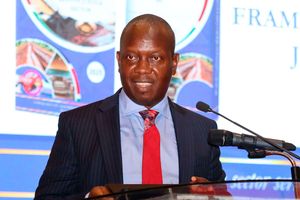
EACC Chairperson, Dr David Oginde, while launching the report, said that the improved results reflect stronger collaboration with prosecutors and better evidence standards.
“These achievements are not mere statistics. They represent schools reclaimed, hospitals protected, land restored and public funds redirected toward public good. They demonstrate clearly and decisively, that corruption does not pay, and it will not prevail,” he said.
Whereas there were notable achievements, Dr Oginde highlighted that weak enforcement on the constitution’s provisions on leadership and integrity values, interference with witnesses, growing threats and intimidation targeting EACC’s officers, non-collaboration among state agencies and rising public apathy and normalization of unethical behavious still remained challenges faced by the Commission.
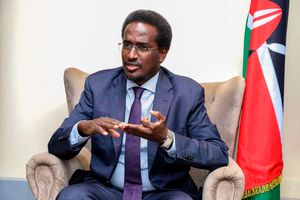
Ethics and Anti-Corruption Commission CEO Abdi Mohamud.
Photo credit: Wilfred Nyangaresi | Nation Media Group
On his part, EACC CEO, Abdi Mohamed cautioned that the recent successes by the Commission should not lull anyone into thinking that the fight against corruption has been won already.
“Corruption remains a dynamic and persistent threat that adapts to our defenses. The Commission will continue to implement activities and programmes outlined in our strategic plan for a sustained and impactful fight against graft and unethical conduct,” he said.
The EACC, Mr Mohamed said, will prioritise key areas including monitoring capital-intensive projects, bribery at service delivery points, asset recovery and forfeiture of unexplained assets, engagement with regulatory bodies as well as public awareness programmes.