Familiar sound of climate promises: Will New York summit deliver concrete action?
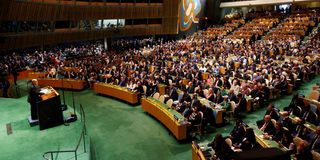
United Nations Secretary-General Antonio Guterres addresses the 79th United Nations General Assembly at the UN headquarters in New York on September 24, 2024.

Nearly 100 countries gathered in New York last week to announce new climate targets ahead of COP30, representing two-thirds of global emissions. UN Secretary-General António Guterres called it a moment when "the science demands action, the law commands it, the economics compel it, and people are calling for it".
But for those tracking climate negotiations from Africa, the New York summit felt less like a breakthrough and more like déjà vu; another round of ambitious pledges announced at a high-profile gathering, with the hard questions about implementation, accountability, and finance left, once again, for another day.
Close to 40 heads of State and government took to the podium during the Climate Summit on September 24, convened by Guterres and Brazilian President Luiz Inácio Lula da Silva on the sidelines of the 80th UN General Assembly (Unga). For the first time, China, the world's largest emitter, announced economy-wide emissions reduction targets covering all greenhouse gases and sectors. Nigeria followed suit.
"It is still possible to limit global temperature rise to 1.5 degrees by century's end," Guterres told the assembled leaders in his opening remarks, emphasising the economic case alongside the scientific imperative. "Clean energy is powering jobs, growth and sustainable development... Despite vast fossil fuel subsidies distorting markets, clean energy received double the investment of fossil fuels last year."
"Leaders from across the world have stood together to show that even at a moment of division and uncertainty, the resolve and determination to fight the climate crisis is alive and strong," Deputy Secretary-General Amina Mohammed declared in her closing remarks.
Yet none of these declarations are new. At COP29 in Baku just months earlier, African nations watched as the global community agreed to a $300 billion annual climate finance goal, a figure deemed inadequate for a continent facing climate disasters it did not cause.
The summit heavily emphasised that COP30 must show "a credible path" to mobilising $1.3 trillion annually in climate finance by 2035, as agreed at COP29.
"We need urgent action to unlock funds for developing countries – to seize clean energy benefits and protect lives and economies," Guterres stated, calling for reforms to the international financial architecture, effective debt relief, and increased lending capacity of multilateral development banks.
"That requires reforming the international financial architecture to strengthen developing country participation. We need effective debt relief, and scaled-up solutions like debt swaps and disaster pause clauses."
Mohammed echoed this, noting that "many countries are increasingly incorporating adaptation considerations and financing costs into their new NDCs."
But here's the problem: developed countries have a documented history of failing to deliver on climate finance promises. The original $100 billion annual pledge made in 2009 was only reached in 2022—two years late. Africa currently receives about $30 billion annually in climate finance, yet the continent needs $2.8 trillion between 2020 and 2030 to meet its Paris Agreement commitments, leaving a gap of $200-400 billion per year by 2030.
The New York summit offered no binding commitments, no concrete allocation mechanisms, and no accountability measures beyond the promise of "credible accountability measures to verify progress" to be worked out at COP30.
For Kenya, this matters deeply. Our country has already committed to reducing greenhouse gas emissions by 35 percent relative to business-as-usual levels by 2035 and achieving 100 percent renewable electricity by 2035. These are not abstract targets—they require billions of dollars in investment for grid infrastructure, renewable energy deployment, and adaptation measures.
The reality on the ground
While world leaders spoke of "clean energy opportunities" and "economic growth," they said far less about the brutal reality facing countries like Kenya right now.
"As emissions continue to climb, climate extremes are accelerating," Mohammed told the closing session. "They are destroying lives, demolishing livelihoods, and upending economies. It is also pushing millions into poverty, driving mass displacement and exacerbating insecurity and conflict."
Her words resonate painfully here. Climate change costs our country between 3 percent and 5 percent of GDP annually. The 2023 drought caused $650 million in losses. The 2024 floods cost $1.46 billion.
These are not future projections—they are present-day catastrophes draining resources that could have gone to schools, hospitals, and infrastructure. When Guterres spoke about "climate disasters inflicting damages that exceed the GDP of some small islands," and how "droughts and floods are taking lives, fuelling hunger, and inflaming conflict," he could have added that for many African nations, annual climate damages already exceed what we receive in climate finance.
The summit celebrated that countries are "incorporating adaptation considerations and financing costs into their new NDCs." But incorporating costs into plans is meaningless if there's no mechanism to ensure those costs are actually covered.
Mohammed urged that "ahead of COP30 every country that has not yet finalised its new NDC must do so without any further delay." Fair enough—but shouldn't developed nations be held to the same standard of urgency when it comes to delivering promised finance?
Guterres outlined five crucial areas requiring urgent attention: energy transition, methane reduction, forest protection, heavy industry decarbonisation, and climate justice. Specifically, regarding methane, he noted that "the International Energy Agency estimates fossil fuel operations could cut 40% of methane emissions today with no net cost." Yet there's no enforcement mechanism to ensure this happens.
What Kenya needs vs what we're getting
Kenya has done its part. We submitted our ambitious second NDC in May 2025. Despite contributing less than 0.1 percent of global emissions, we're leading on renewable energy and climate action in the region. We're not asking for charity, we're asking for climate justice.
What we need is not more eloquent speeches about "solidarity" and "multilateralism." We need:
Debt relief that works: Not "consideration" of debt swaps and disaster pause clauses, but actual, implemented programs that free up fiscal space for climate investment.
Direct access to finance: The current system funnels climate money through layers of intermediaries, each taking a cut and adding delays. African countries need simplified, direct access mechanisms.
Grant-based adaptation finance: Much of what's counted as "climate finance" is actually loans, adding to debt burdens. Adaptation to unavoidable climate impacts should be grant-based, not loans that must be repaid.
Technology transfer: Real technology sharing agreements, not just purchases at market rates that developing countries can't afford.
Accountability mechanisms: Binding commitments with consequences for non-delivery, not voluntary pledges that can be quietly abandoned.
The summit positioned COP30 in Belém as the moment when rhetoric must become reality—"a turning point," as Mohammed called it, "the beginning of a decade of acceleration, delivery, and implementation."
"It is therefore essential that COP30, under the leadership of Brazil, delivers a bold and credible response to the NDC ambition gap," she emphasised in her closing remarks, adding that it must address "gaps in ambition on adaptation and finance."
We've been promised turning points before. The question is whether Brazil will demand the binding commitments and accountability that previous COPs have avoided, or whether we'll see another round of announcements followed by incremental progress while the planet continues warming and African nations continue paying the price.
Guterres noted with approval that "China met its 2030 wind and solar target six years ahead of schedule," and that "India reached percent electricity capacity from non-fossil fuels five years early." He declared, "We are in the dawn of a new energy era. We must seize this moment of opportunity."
These are indeed impressive achievements by countries with access to capital, technology, and massive domestic markets.
For Kenya and other African nations, achieving similar acceleration requires the international community to deliver on its promises with the same urgency it demands from us in submitting NDCs.
There is no doubt that climate action is accelerating globally. Clean energy investments are rising, renewable costs are falling, and political will exists among many nations. The science still says limiting warming to 1.5 degrees is possible, barely.
But possibility is not destiny. And for those watching from Nairobi, Accra, or Dar es Salaam, the New York summit felt like an expensive reminder that in climate negotiations, developed countries expect developing nations to act on faith while they deliver on promises... eventually.
The three days of Climate Solutions Dialogues that preceded the summit identified concrete recommendations across ten areas. These will feed into the chair's summary for COP30. It's telling that dialogue recommendations, "concrete" though they may be, still require another COP to translate into action.
As Mohammed said, "We have the solutions, tools and technologies to transform and decarbonise our energy systems." She's absolutely right. What we lack is not just "speed and scale," as she suggested, but trust, equity, and a system that treats climate finance commitments with the same seriousness it treats emissions targets.
COP30 will reveal whether the "resolve and determination" lauded in New York translates into the binding commitments, enforceable timelines, and actual resource flows that Africa desperately needs.
Until then, forgive us for greeting another set of ambitious announcements with cautious skepticism. We've been here before.