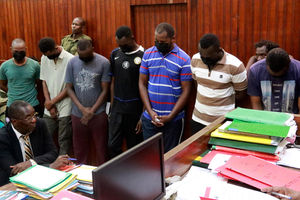
Six Iranian nationals have suffered a setback after the court in Shanzu, Mombasa found that they have a case to answer over a Sh8.2 billion methamphetamine haul recovered from their boat in the Indian Ocean last year.
The court ruled that the prosecution had established a sufficient case against the six, requiring them to respond to the charges.
“The court is satisfied that the evidence presented by the prosecution was sufficient to require the accused persons to respond to the charges,” the court said on September 11.
In its ruling, the court noted the unusual nature and scale of the case, observing that the evidence presented originated from the high seas and involved a vessel allegedly carrying more than one tonne of methamphetamine.
The finding means the six will now be required to defend themselves, one after another, against the trafficking charges.
The prosecution presented evidence from 12 witnesses, including Kenya Navy personnel who recovered the drugs, experts from the Government Chemist and other documentary evidence before closing its case. The six are Jaseem Darzadeh Nia, Nadeem Jadgal, Hassan Baloch, Raheem Baksh, Imran Baloch and Imtiyaz Daryay.
They are charged with trafficking 1,036.044 kilograms of methamphetamine valued at approximately Sh8.2 billion. The prosecution alleges that the accused, jointly with others, transported the consignment aboard a vessel named MV Mashaallah.
The vessel was allegedly unregistered and stateless and was intercepted on the high seas while carrying the suspected narcotics. The six are alleged to have committed the offence between October 17 and 20, 2025, in international waters.
The prosecution’s case is that the six were not fishermen, as they allegedly claimed, but were knowingly involved in a coordinated drug trafficking operation using the stateless vessel to transport a large consignment of methamphetamine through the Indian Ocean.
The State relied on evidence showing that the vessel had no fishing equipment, despite the occupants’ claim that they were fishermen. It also had no national flag, registration documents, manifest or cargo list.
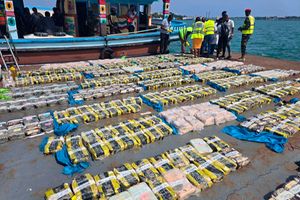
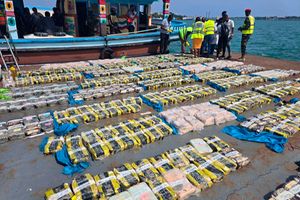
Packages of substances weighing 1,035.986 kilograms suspected to be methamphetamine valued at Sh8.2 billion at the Mombasa Port on October 25, 2025.
Photo credit: Pool
The prosecution told the court through its 12 witnesses that these circumstances undermined the accused persons’ explanation for their presence in the high seas.
The evidence presented in court showed that the operation leading to the recovery of the narcotics began after the Regional Coordination of Operations Centre in Seychelles provided intelligence about two vessels suspected of trafficking drugs in the Indian Ocean.
The prosecution said updated information supplied on October 18, 2025, provided the coordinates, direction and speed of the vessels, enabling Kenyan authorities to track one of them, codenamed Igor.
A tasking order was subsequently issued to Kenya Navy Ship Shupavu to locate, monitor and, if necessary, intercept the vessel under the Safe Seas Africa framework. Naval officers travelled eastwards from Mkunguni Jetty before intercepting the vessel on October 20, 2025.
According to the State, the vessel could not respond to radio communications because it lacked radio equipment. The naval team boarded the vessel and found six men who could not provide satisfactory documentation to support their identities or explain the cargo they were carrying.
The prosecution told the court that a search uncovered 769 packets containing a white crystalline substance concealed in a compartment beneath the forward section of the vessel.
The packages were wrapped and placed in containers designed to disguise their contents before being concealed in gunny bags. The prosecution argued that the manner in which the substance was packaged and hidden pointed to deliberate concealment rather than an innocent cargo.
The substance was subsequently subjected to forensic examination as part of investigations into its nature and weight. The prosecution also relied on the circumstances of the voyage to demonstrate knowledge and intent, arguing that the accused were deep in international waters, far from their home country, aboard a vessel carrying a substantial quantity of narcotics.
The State maintained that their presence on the vessel, coupled with the manner in which the drugs were concealed, was consistent with a deliberate trafficking mission.
On jurisdiction, the prosecution told the court that Kenya has authority to prosecute the case despite the interception occurring beyond its territorial waters.
It relied on the Constitution’s incorporation of international treaties and provisions of the United Nations Convention on the Law of the Sea concerning cooperation among states in suppressing drug trafficking on the high seas.
The prosecution said its evidence was intended to establish that the six foreigners knowingly participated in transporting the narcotics, rather than being innocent crew members unaware of what the vessel was carrying.