On Thursday, the court granted investigators additional time to finalise the probe, which the State described as complex and involving extensive forensic work and transnational inquiries.
Investigators told the court that the inquiry was still ongoing and that they required more time before recommending appropriate charges against the suspects.
In a fresh application before Shanzu Chief Magistrate Anthony Mwicigi, detectives argued that the scale of the operation, the nature of the seized substances and the suspected international networks involved necessitated more time to conclude the intricate investigation.
The State, through Prosecution Counsel Anthony Musyoka, further argued that the matter touches on national security and forms part of broader efforts to combat and disrupt transnational organised crime.
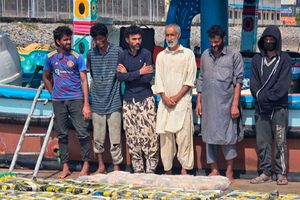
Five of the six Iranians accused of trafficking meth when they appeared at the Shanzu Law Courts on October 28, 2025.
Photo credit: Wachira Mwangi | Nation Media Group
The prosecution said detectives required adequate time to piece together all essential details before the Director of Public Prosecutions could take action.
The DPP is expected to decide in January on whether to charge the six foreign nationals, depending on the findings of the investigation.
The suspects, Jasem Darzaen Nia, Nadeem Jadgai, Imran Baloch, Hassan Baloch, Rahim Baksh and Imtiyaz Daryayi, are under investigation for drug trafficking contrary to section 4(a)(ii) of the Narcotic Drugs and Psychotropic Substances Control Act of 1994.
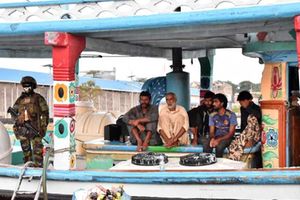
The Iranians, who were arrested aboard a dark vessel intercepted by the Kenyan Navy at Kilindini Port on 24 October, have now been in custody for two months as investigations into the ownership and destination of the drugs intensify.
The dhow, crewed by the suspects, was seized on October 19, in a joint operation involving the Kenya Navy, the Directorate of Criminal Investigations, the Anti-Narcotics Unit, the Kenya Coast Guard Service, the Kenya Revenue Authority, the Port Police, the National Intelligence Service and the Kenya Ports Authority Police.
The vessel, believed to belong to a cartel operating along the East African coast, was towed to Kilindini Port, where detectives obtained a search warrant that led to the recovery of more than 1,000 kilogrammes of methamphetamine, a synthetic drug whose long-term use can lead to malnutrition, severe weight loss and psychological dependence.
The seizure placed Kenya on the international radar as a narcotics transit hub exploited by cartels to move drugs across the world.
The destination of the dhow, named MV Mashallah, has not been disclosed, but authorities believe the shipment was intended for distribution within the region.
The stateless vessel was intercepted by an international multi-agency team about 630 kilometres east of Mombasa and escorted to the Port of Mombasa for further processing.
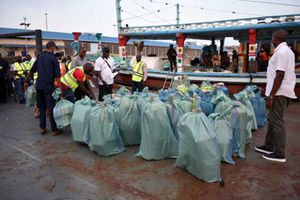
Packages of substances weighing 1,035.986 kilograms suspected to be methamphetamine valued at Sh8.2 billion at the Mombasa Port on October 25, 2025.
Photo credit: Pool
The 1,024 kilogrammes of crystalline methamphetamine were concealed in black polythene bags wrapped in yellow tape labelled “100 per cent roasted and ground Arabica coffee.”
However, tests by the Government Chemist confirmed the substance to be 98 per cent pure methamphetamine.
This is the second-largest narcotics haul in Kenya’s history after 1.1 tonnes of cocaine valued at Sh6 billion were seized in Nairobi and Malindi in 2006.
In 2014, the vessel MV Amin Darya was intercepted with a massive heroin consignment, although the foreign crew members were later acquitted on appeal.
In the current case, investigators are relying on seven electronic devices seized from the six Iranian suspects to trace the owner and destination of the methamphetamine shipment.
Inspector Shadrack Kemei told the court that the devices may contain critical data linking the suspects to financiers and accomplices in a sophisticated transnational drug network.
Detectives have secured court orders compelling the suspects to provide unlock codes so that forensic experts at DCI headquarters can analyse the devices.
Investigators believe the recovered communication may reveal the consignment’s ownership, contacts in other jurisdictions and expose the wider trafficking syndicate.
Preliminary findings already suggest a large organised network using maritime routes to transport synthetic drugs.
The court has been told that releasing the suspects now would jeopardise the multi-agency, internationally coordinated investigation involving sensitive digital evidence.