Hello

Your subscription is almost coming to an end. Don’t miss out on the great content on Nation.Africa

Ready to continue your informative journey with us?

Hello

Your premium access has ended, but the best of Nation.Africa is still within reach. Renew now to unlock exclusive stories and in-depth features.

Reclaim your full access. Click below to renew.

Government releases Sh175 billion to unblock stalled Coast highway projects
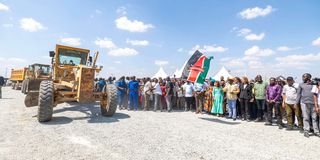
President William Ruto launches the 30-kilometre Kwa Jomvu-Mariakani (A8) Dual Road in Kilifi County on February 26, 2025.

Photo credit: Photo | PCS

What you need to know:

  • The government has released Sh175 billion to settle pending bills and compensation claims

  • The projects are vital for the Northern Corridor, linking the Port of Mombasa to landlocked nations like Uganda, Rwanda, and the DRC, while the Kilifi stretch forms part of the "Silk Road" connecting Kenya to Tanzania.

Construction of sections of the Mombasa-Mariakani and Mombasa-Kilifi highways in the Coast region, which had stalled due to contractor payments and compensation delays affecting people affected by the project, will now resume after the government released Sh175 billion for the payment of verified road-construction bills.

Roads and Transport Cabinet Secretary Davis Chirchir said the long-standing arrears have weighed down the construction sector and increased construction costs.

Speaking in Mombasa while touring the projects, Mr Chirchir said the payments were made possible through the securitisation of the Road Maintenance Levy, a financing approach that allowed the government to access funds upfront against future levy collections.

“We have just rolled out the roads, a pending bill of Sh175 billion, and we expect an immediate impact on the construction sector as the stalled projects are set to resume. Part of my visit to the Coast was to ensure ongoing projects continue without delays and where we had compensation issues, like in Mazeras, Kanamai and Bombolulu are resolved,” said Mr Chirchir.

He added, “The settlement of pending bills is a plus to the projects as contractors can now embark on work, retain their retrenched workers, and plan projects more effectively.”

Construction of the six-lane Mombasa-Mariakani road consists of the dualling of the Mombasa–Mariakani Highway with flyovers, bus bays, service roads, truck parking, pedestrian foot bridges, walkways, street lighting and associated soft components.


The Jomvu-Mariakani road which is now at 75 percent, is the second lot of Sh22 billion, being co-financed by the Bank Group (42.2 percent), German Development Bank (KfW) (22.2 percent), European Investment Bank (22.2 percent), Africa Infrastructure Trust Fund (8.9 percent), and the Government of Kenya (4.5 percent).
 
The 41.7 kilometres has remained a traffic bottleneck where truck drivers spend about 2 hours with the government identifying Jomvu-Mazeras, which is a 5-kilometre stretch, as the worst section.

The route, which is the only exit for traffic from Mombasa, has also affected other commuters, including public service vehicles whose owners say it has increased turnaround time.

The project road is an important section of the Northern Corridor (NC), which links the port of Mombasa in Kenya with the land-linked eastern and central African countries of Uganda, Rwanda, Burundi, and the Democratic Republic of Congo (DRC) through Nairobi.

Truckers who enjoys smooth flow of traffic from the port through Southern-bypass which was completed in 2019, have now asked the government to hasten the process of compensation to allow expansion of the road to reduce the delays.

The Mombasa-Kilifi highway, where the first lot of the Mtwapa-Kwa Kadzengo-Kilifi (A7) road, which is at 80 percent complete, is part of the Sh789 billion of the much-awaited East Africa’s dream of a ‘Silk Road’ route, Mtwapa-Malindi and Baga Moyo-Lunga Lunga to boost trade and transport between Coastal countries.

The project that is being implemented in partnership with the African Development Bank (AfDB), African Development Fund (AFD), and the European Union (EU) was expected to be completed by December 2025, but it was delayed due to the compensation of the affected persons.


