Hassan Omar: Coast remarks were satire, not an election offence
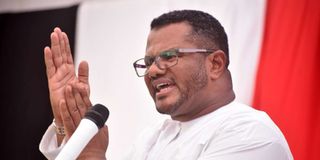
Hassan Omar during a past press conference. Omar seeks to succeed Hassan Joho as Mombasa Governor under the UDA party.

United Democratic Alliance (UDA) Secretary-General Hassan Omar has asked the electoral commission to dismiss allegations of electoral misconduct arising from his remarks suggesting that deceased voters could participate in the 2027 General Election, arguing that his comments were satirical and intended to encourage voter turnout in the Coast region.
The former Mombasa senator, who appeared before the Independent Electoral and Boundaries Commission's (IEBC) Electoral Code of Conduct Enforcement Committee on Wednesday, maintained that his September 11 remarks had been taken out of context and did not amount to an invitation to engage in electoral malpractice.
At the centre of the proceedings at Anniversary Towers in Nairobi were remarks Mr Omar made during a political rally in Mombasa County, which appeared to suggest that fingerprints belonging to deceased persons could be used to cast ballots in their names.


Through his lawyers Emmanuel Kibet and Adrian Kamotho, Mr Omar asked the committee to exonerate him, arguing that there was insufficient evidence to establish a breach of the Electoral Code of Conduct.
He alternatively pleaded for a warning should the committee find him liable.
His lawyers argued that the statement was political hyperbole intended to challenge eligible voters to turn out in large numbers, rather than an endorsement of electoral fraud.
Mr Kibet told the committee that the remarks were meant to encourage residents to register as voters, verify their details in the register and participate in the 2027 elections.
“It is in the public domain that the people from the Coast region have not registered as voters. We do believe that what he said should be put into context for the proper meaning to come out. The SG in his position was encouraging people to come out and register,” he said.
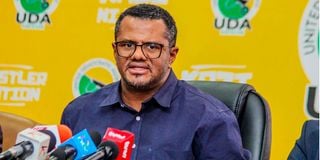
UDA party secretary general Omar Hassan addresses journalists at the party offices in Nairobi on September 19, 2024.
He argued that Mr Omar had used satire to challenge those who were alive but reluctant to vote, asking them to imagine a situation in which even the dead could participate in elections.
The lawyer maintained that the statement could not be interpreted in isolation from the rest of the speech, pointing to the audience's laughter as evidence that those present understood it as a figure of speech.
He further argued that voter apathy had remained a major concern in the Coast region, where turnout had historically fallen below 50 per cent in some elections, making voter mobilisation a central theme of the UDA secretary-general's address.
The defence maintained that the remarks did not constitute an instruction to use biometric information belonging to deceased persons, noting that the responsibility for voter registration and the administration of elections rested with the IEBC rather than political parties.
In his submissions, Mr Omar told the committee that his remarks had been interpreted without sufficient consideration of the historical and cultural circumstances of the Coast region, where he said low voter registration and turnout had weakened political representation.
He cited figures indicating that Mombasa had registered only about 12,000 to 13,000 new voters despite having an estimated 200,000 eligible residents who had yet to register.
According to Mr Omar, his political mobilisation efforts were intended to address years of marginalisation affecting Coast residents, including difficulties obtaining identification documents and accessing citizenship rights.
He said his political activism had consistently focused on ensuring that historically marginalised communities were adequately represented in national affairs.
The UDA secretary-general also defended the use of exaggeration and metaphor in political communication, arguing that statements made during campaign rallies should not always be subjected to literal interpretation.
“Political jargon is political jargon. We will not in any way erode institutional authority. I am fully aware of my constitutional mandate and I am m privy to the audiences that I am addressing. It is common knowledge that how I speak in the Coast region is different from how I will speak in Northern Kenya. That is political communication,” he said.
He insisted that the controversial remarks were made during a voter registration drive and that the event's live transmission also carried messages encouraging residents to obtain identification documents and register as voters.
Mr Omar also rejected suggestions that he was encouraging electoral fraud, maintaining that he had no reason to undermine an electoral process in which he believed his party and its coalition could emerge victorious.
Instead, he challenged the electoral commission to safeguard the integrity of the voters' register and ensure that deceased persons were not used to cast ballots.
The IEBC commissioners observed that allegations involving votes cast in the names of deceased persons had previously featured in Kenya's electoral disputes, raising concerns that such remarks could be interpreted as encouraging electoral malpractice.

Independent Electoral and Boundaries Commission (IEBC) Chairperson Erastus Edung Ethekon (right) Vice-Chairperson Fahima Araphat Abdallah (centre) and commissioner Hassan Noor Hassan before the Constitution Implementation Oversight Committee at Parliament Buildings in Nairobi on September 25, 2025.
Commissioner Hassan Noor invoked Kenya's history of election-related violence, recalling the political tensions associated with the two-finger salute during the 1992 elections.
He said the electoral commission had a responsibility to address potentially inflammatory political rhetoric before it escalated, particularly as political competition intensified ahead of the 2027 polls.
Mr Noor maintained that political leaders had an obligation to exercise restraint in their public statements and safeguard the peace that Kenyans had worked to maintain.
Mr Omar's lawyers questioned whether the electoral commission was applying its enforcement powers consistently across political parties.
Mr Kamotho argued that several UDA politicians, including Kipipiri MP Wanjiku Muhia and Nakuru East MP David Gikaria, had appeared before the committee in recent months, questioning why politicians affiliated with other parties were not facing similar scrutiny.
He urged the commission to investigate alleged violations by other political actors, while maintaining that UDA remained committed to ensuring its members complied with electoral laws.
Committee chairman Moses Alutalala Mukhwana dismissed suggestions that the commission was targeting UDA, saying the appearance of several party officials before the committee did not necessarily amount to selective enforcement.
Dr Mukhwana acknowledged concerns over allegations that the IEBC could manipulate election results, saying such claims also posed a challenge to public confidence in the electoral process.
He cautioned political parties against using alleged misconduct by their opponents to justify their own actions, urging them instead to engage the commission through established consultative platforms.
The chairman singled out the Political Parties Liaison Committee as an important forum through which parties could raise grievances, address concerns over electoral preparations and promote peaceful political competition.
Mr Omar said he had previously sent representatives to the meetings and undertook to communicate the committee's concerns to the UDA leadership.
The proceedings come as the IEBC faces growing scrutiny over its preparations for the 2027 General Election, including the credibility of the voters' register, enforcement of electoral laws and the conduct of political leaders.
The Electoral Code of Conduct, contained in the Second Schedule to the Elections Act, 2011, establishes standards governing the conduct of political parties, candidates and other electoral actors, including provisions intended to promote peaceful campaigns and public confidence in elections.
The committee will deliver its ruling on October 27.
Follow our WhatsApp channel for breaking news updates and more stories like this.