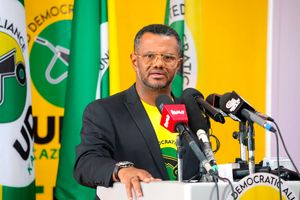
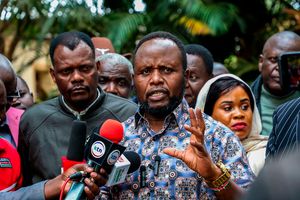
Hassan Omar is in trouble again. This time, at a political gathering in Mombasa, the UDA secretary-general suggested that even the dead could be made to vote for President William Ruto . The remarks sounded less like those of a former human-rights commissioner than of a politician intoxicated by proximity to power.
“Even if someone has died,” Omar declared, “we should take his finger before we bury him, put it in the BVR and cast his vote.”
For a man eyeing the Mombasa governorship in 2027, Omar’s choice of language was revealing. He described the coming election as a do-or-die contest and the vote as a bullet, a weapon and a shield, not merely for his own political ambitions, but for UDA and President Ruto’s re-election campaign.
A former human rights activist, Hassan Omar has turned out to be UDA’s Mr Loose Tongue and perhaps the party's biggest liability.
Opposition leaders raise concerns over Hassan Omar remarks of deceased casting votes in 2027
His remarks were inflammatory enough to draw what appeared to be a rebuke from within the government, which is struggling to promise a free and fair election. “We do not want William Samoei Ruto to win through shortcuts,” Prime Cabinet Secretary Musalia Mudavadi said, without mentioning Omar by name. “We want him to win through the front door.”
Though Omar’s reference to dead voters might have been dismissed as reckless campaign rhetoric, it was not an isolated episode. It followed an earlier controversy in which he was accused of ethnically profiling the Kikuyu community, portraying its members as arrogant and oppressive. Together, the statements have drawn attention to the political transformation of a man who built his reputation defending constitutionalism and human rights but now speaks as one of the ruling party’s most combative enforcers.
Though his attacks have occasionally been directed at the Jomo Kenyatta family and questioned why they hold land in the coast region, he always adds a tribal twist by targeting Mt Kenya communities, describing them as arrogant. Recently, he also questioned why Mombasa’s waterfront was named after Mama Ngina Kenyatta and promised, if elected governor, to propose renaming it after Mekatilili wa Menza.
Since the fallout between President Ruto and his former deputy, Rigathi Gachagua , Omar has emerged as one of the most aggressive critics of Mt Kenya’s political leadership, even as opinion polls indicate that UDA has lost considerable support in the region. In remarks that provoked anger among the party’s Mt Kenya officials, Omar declared: “We have been struggling while you oppressed us as we watched.” He recalled that politicians from the region had dismissed Daniel arap Moi as a “passing cloud” and warned that Ruto, like Moi, would withstand their opposition and complete two terms in office.
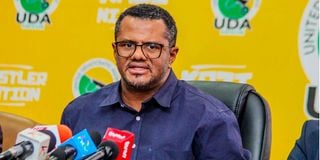
Mr Hassan Omar Hassan.
Photo credit: File | Nation Media Group
The remarks provoked an unusually fierce rebellion within UDA. Kirinyaga Governor Anne Waiguru called them ethnic baiting intended to isolate Mt Kenya, while a group of the party’s MPs, led by led by Laikipia Woman Representative Jane Kagiri and including Thika Town MP Alice Ng’ang’a and Kiambaa MP John Kawanjiku, gave Omar 48 hours to resign. They rejected his apology as inadequate and threatened to reconsider their place in UDA if he remained secretary-general. As the National Cohesion and Integration Commission opened an inquiry, Omar apologised to those who felt offended but insisted that his remarks had been misunderstood and arose from his advocacy over historical land injustices at the Coast.
For a man who built his reputation as a human rights defender, the current transformation is especially remarkable. As a student leader, Muslim-rights activist and commissioner at the Kenya National Commission on Human Rights, he presented himself as an adversary of authoritarianism, extrajudicial killings, enforced disappearances and ethnic politics.
Today, he increasingly speaks as though political power excuses the very conduct he once opposed. Yet his story is not simply that of a principled reformer who suddenly became a government propagandist.
Born in Mombasa in 1975, Omar was an only child. His mother, Aisha Abdallah Suleiman Mazrui, was the sister of the celebrated scholar Ali Mazrui, whom Omar credited with shaping his intellectual development. In his young days, Omar attended madrasa, Mombasa Primary School and Lenana School before briefly joining the Kenya Air Force as a cadet. But the military life did not last, and Omar left and enrolled at Moi University to study law, entering the environment that would make him a national figure.
He contested and became chairman of the Moi University Students Organisation and held positions in national and regional student bodies. In 1999, he led protests demanding changes to the university's identity. Among his provocative proposals was that the institution should cease carrying President Moi’s name and become Kesses University or the University of Eldoret. Omar argued that a university should not be named after a “non-intellectual.”
Mt Kenya UDA MPs to Omar Hassan: An apology is not enough
As Moi publicly rebuked him for disrespecting his elders and had him expelled from the university, Omar became an operative in civil society groups and was a darling of the media and the opposition parties. It was not until Kanu’s defeat in 2002, when President Mwai Kibaki directed that politically expelled students be readmitted. Omar returned to Moi University and completed his law degree in 2004.
But Omar never sought admission to the Bar, arguing that he did not study law to become a courtroom advocate. “I needed the knowledge of law to advance the course of justice and human rights,” he said.
In 2007, President Kibaki appointed him to the Kenya National Commission on Human Rights, where he rose to become vice-chairman. Omar used the commission’s platform to confront extrajudicial killings, enforced disappearances and abuses associated with the 2007–08 post-election violence.
Since becoming UDA secretary-general, Omar’s language has grown increasingly indistinguishable from that of the authoritarian establishment he once resisted. After the Gen Z June 25, 2025 protests, Omar blamed the violence on “prolonged incitement by individuals, civil society and sections of the mainstream media”. He praised the police for courage and restraint even as human-rights organisations documented deaths, gunshot injuries and hundreds of casualties.
In May 2026, as anger rose over fuel prices and a public-transport strike, Omar accused President Ruto’s opponents of destroying the country and its infrastructure. He told those dissatisfied with the government to wait for the 2027 election and warned that former deputy president Rigathi Gachagua would be arrested if the law pointed towards him, declaring: “We will arrest him.”
The current Omar is different from the young Omar who once cultivated the image of a radical intellectual. In those days, he said he read Cabral, Mandela, Che Guevara, Marx, Castro, Nyerere, Nkrumah and Tambo and spoke of sacrifice, justice and resistance to authoritarianism. “You can hardly find a solid intellectual mind in Kenya,” he once complained.
Shortly after the 2007/8 post-election violence, Omar was vocal in rejecting the argument that the International Criminal Court was merely an imperialist institution. The victims, he argued, were Africans, while the imperialism defence demonstrated Africa’s unwillingness to confront impunity. He supported mechanisms capable of protecting innocent life when national institutions failed.
Pundits say that this was Hassan Omar at his best: combative, articulate, constitutionally grounded and willing to confront the state. He then belonged to what he called the “Constitution generation”—the heirs of the second liberation who had a duty to guard faithful implementation of the new constitutional order.
By then, he was equally alert to ethnic capture and lamented that district and tribal organisations had transformed university students into ethnic spokesmen. “It didn’t matter how highly you went,” he said, “but you spoke on behalf of the tribe.”
The words now read like a warning from the younger Omar to the man he would become. He has risen high, yet his recent interventions repeatedly speak to and about political blocs as though communities possess a common intention and collective guilt.
After serving as Mombasa’s first senator and later losing the governorship, Omar moved through Wiper, NASA and eventually UDA. A 2017 profile considered it “highly unlikely” that the old reformist would join the Jubilee establishment. Yet he eventually became one of Ruto’s most aggressive defenders.
Today, the man who once confronted the state now speaks as though he owns a share of its coercive authority.
Once upon a time, Hassan Omar presented himself as a custodian of the Constitution and an uncompromising opponent of impunity. Today, he increasingly speaks as though political power excuses the very conduct he once opposed. Yet his story is not simply that of a principled reformer who suddenly became a government propagandist. There is also a revealing continuity: the combativeness has remained while its target has changed. The young Omar directed his rebellion at power; the older Omar increasingly directs the power of the state at its critics.
For a man who once preached constitutional vigilance, Hassan Omar’s descent is disturbing. Having secured a place at the ruling party’s high table, he increasingly sounds intoxicated by the authority it has conferred upon him. Statements that threaten national cohesion, criminalise dissent and corrode public confidence in elections have become part of his political method.
As a lawyer and former human-rights commissioner, Omar cannot be unaware of where reckless political rhetoric can lead, having witnessed the 2007/8 clashes that followed reckless talks. As pundits say, Omar has not been betrayed by what he does not know. He is being betrayed by power, and by his apparent intoxication with it.