Investigators in the ongoing Shakahola massacre cases have found themselves in unfamiliar territory, having to shoulder heavy financial burdens every time witnesses appear in court.
Ordinarily, the police, in consultation with prosecutors, are tasked with bonding witnesses to ensure they attend court and give evidence. This is usually financed from state coffers. Once a witness testifies, the presiding judge or magistrate issues an order for reimbursement based on an application by the prosecution for travel and subsistence allowance.
The Nation has, however, learnt of a recurring problem: Although courts issue these reimbursement orders, witnesses are often told at the accounts department to leave their details and await payment later.
These delays place investigators in a difficult position, forcing them to dig into their own pockets to keep the trial going, often losing their money in the process. The cost of justice is now weighing heavily on those enforcing it.
High Court Judge Diana Kavedza recently took note of the issue, cautioning officers against using their personal funds to support witnesses.
“The police should not get into their pockets and use money meant for their children. What are their children going to eat?” the judge asked.
Bodies exhumed at Shakahola Forest being loaded into a police van in this picture taken on May 16, 2023.
Photo credit: File | Nation Media Group
The issue came to light after Senior Assistant Director of Public Prosecutions Jami Yamina highlighted the challenges investigators face in bonding witnesses. Mr Yamina cited cases where delayed or failed reimbursements make witnesses reluctant to appear in subsequent hearings.
“The challenge is the reluctance of witnesses to show up due to failure of reimbursement in other cases,” said Mr Yamina.
The Nation observed several incidents where frustrated witnesses harassed investigators after testifying, demanding immediate payment. This has become a daily struggle for investigators, who are under pressure to ensure witnesses appear and testify as scheduled.
With the courts demanding that a set number of witnesses be heard each day, investigators are compelled to bankroll a prosecution already straining with limited state resources.
They often do so hoping that witnesses will refund the money once paid by the Judiciary. However, this goodwill rarely materialises, as most witnesses keep the entire reimbursement without repaying the officers.
Consider a scenario where 10 witnesses from the Chakama area, where Shakahola is located, must testify over a week but lack funds to travel. The officers facilitating them must pay out of pocket, and when the Judiciary later releases the money, the witnesses pocket everything without refunding the police.
In some cases, prosecutors have also contributed personally to facilitate witnesses when courts are unable to refund them, perhaps because they do not qualify, but insist on getting something. Investigators said that the situation has been worsened by the lack of a dedicated fund at Vigilance House to support witnesses in the Shakahola trials.
Locals from Shakahola Centre help dig up graves at Shakaola forest part of the 800 acres linked with cult leader Paul Mackenzie of Good News International Church on June 6, 2023.
Photo credit: File | Nation Media Group
Justice Kavedza attributed part of the problem to poor communication between the Judiciary and the police.
“There is a team of judges, led by Justice Eric Ogola, monitoring this case. Any financial challenges should be communicated to the Judiciary so that Chief Justice Martha Koome can intervene,” she said.
This week, the judge, who is presiding over the murder trial against controversial preacher Paul Mackenzie and 30 others, directed that more than 20 civilian witnesses who appeared before her be reimbursed their travel expenses after giving evidence.
Most of these witnesses are not residents of Mombasa, where the trial is being conducted. They travel from far-flung areas including Nyanza, Western, Nairobi, and the remote villages of Chakama, where Shakahola is situated.
For instance, a witness travelling from deep within Chakama to Mombasa receives an average of about Sh4,500 for transport, an amount that can rise to Sh6,500 if the witness needs to spend a night in Mombasa due to transport challenges.
One of the witnesses travelled from Nairobi and was reimbursed Sh3,300, while another from Voi in Taita Taveta County received Sh2,100.
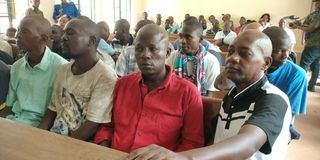
Shakahola cult leader Paul Mackenzie (in pink) is pictured with some of his followers at the Shanzu Law Courts in Mombasa County on May 2, 2023.
Photo credit: File I Nation Media Group
The financial challenge cuts across the four separate cases that Mr Mackenzie and his co-accused face in different courts. These include a murder trial before the High Court in Mombasa, a manslaughter case before the Chief Magistrate’s Court in Mombasa, a children’s torture case before the Tononoka Children’s Court, and a radicalisation case before the Shanzu Court.
These cases are heard approximately two weeks apart. For instance, if the manslaughter case is scheduled this week, the Shanzu case follows two weeks later, then Tononoka, before returning to Mombasa after another fortnight.
Each hearing runs for a full week, often back-to-back. Across all cases, the number of witnesses exceeds 70, with projections suggesting it could reach 100 in some cases depending on the prosecution’s focus.
Mr Joseph Sulubu, one of the witnesses who testified in court on Wednesday, recalled his frustrating experience last year after appearing before the Tononoka Court.
“I waited for two months without any reimbursement. I got tired and eventually forgot about it, then one day I just received an M-Pesa message,” he recounted.
On Wednesday, history seemed to repeat itself. After completing his testimony at 3pm, Mr Sulubu was informed that his reimbursement of Sh6,500 would be sent to him later, either that evening or the following day.
In such situations, the burden of ensuring that witnesses like Mr Sulubu safely return to their homes in Kisiki, Chakama, often falls on the investigators who contacted them to appear in court. To avoid this burden, the investigators and the prosecutors sometimes arrange for a virtual hearing for witnesses not required to produce any documents in court.
Generally, the ongoing effort to hold Mackenzie and 95 other suspects accountable has become an expensive undertaking; from the exhumation of bodies in Shakahola Forest two years ago, to carrying out DNA tests for identification purposes, preserving the bodies in refrigerated containers, and the current ongoing prosecution. This is not to mention the upkeep of all the suspects in custody.
Bodies exhumed from mass graves in Shakahola forest, Kilifi County are loaded into a vehicle during the operation on May 12, 2023.
Photo credit: File | Nation Media Group
At one point, even the Office of the Director of Public Prosecutions (ODPP) admitted to being financially overwhelmed by the Shakahola trials. The ODPP told the Tononoka Children’s Court that it was struggling to facilitate prosecutors’ travel to Mombasa.
Most prosecutors involved in the matter are based in Nairobi and must travel to the Coast to join their colleagues. Consequently, several hearings at the Chief Magistrate’s Court, Tononoka Court and Shanzu Court have had to be adjourned to allow the ODPP to address logistical and financial constraints.
Mackenzie and his followers are being tried for the murder of 191 children in Shakahola Forest during a deadly fasting ritual that led to the deaths of more than 450 members of the Good News International Church.