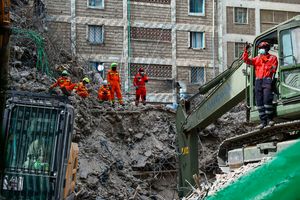
Kwa Bi Nzaro: How SIM cards linked to Mackenzie were smuggled into prison
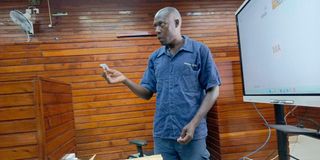
Kalume Kitsao Rimba. He described how he concealed the SIM cards in his clothing, even after changing into prison uniform.

A Shimo La Tewa Maximum Security Prison inmate serving a 50-year jail term for bhang trafficking has informed a court how he smuggled two SIM cards into the facility, raising questions about security loopholes that may have enabled controversial preacher Paul Mackenzie to communicate with people outside prison and send and receive money while behind bars.
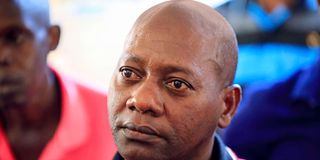
Pastor Paul Mackenzie at the Mombasa Law Courts on October 19, 2026, where he faces murder charges over the deaths of 191 children in the Shakahola massacre in Kilifi County.
Testifying before the High Court in Mombasa in a case in which Mackenzie and six others are accused of murder as a crime against humanity over the deaths of 52 people at Kwa Bi Nzaro forest, Kalume Kitsao Rimba described how he concealed the SIM cards in his clothing, even after changing into prison uniform.


“I hid the SIM cards in the cloth lining along the waistline. Even when I changed into prison attire, I kept them in the same position,” he said.
Kitsao’s testimony has drawn attention to how prohibited communication devices find their way into the country’s maximum security prisons and whether existing security measures are sufficient to prevent inmates from maintaining contact with the outside world.
He told the court that although mobile phones and other communication devices are prohibited inside the prison, he found many inmates using them when he began serving his sentence.
Kitsao argued that prison warders should be held responsible for the presence of such devices, claiming inmates could not smuggle them into the facility without assistance from officers responsible for security.
“I can't lie to the court. The gadgets are in use in the prison. But if you are caught, you take responsibility without mentioning the prison warder who helped smuggle the item,” he said.
He, however, said a change in the prison's leadership ushered in stricter security measures, with the new management conducting thorough searches to confiscate contraband items.
Kitsao said he removed the two Safaricom SIM cards from his mobile phone when he was arrested on March 6, 2024, because they contained confidential banking information he did not want to leave with his wife. He left the handset at home but carried the SIM cards with him when he was remanded at Shimo La Tewa Prison the following day.
“I had six Safaricom SIM cards registered in my name and an Equitel line. I then removed the two, which I kept in the cell whenever I was escorted to court and continued possessing them after my conviction,” he said.
He maintained that he never used either line to make or receive calls or to send or receive money through M-Pesa or mobile banking while in prison.
Kitsao said prison officers first searched his cell in Block D on September 20, 2025, and took two Bibles and a piece of paper bearing names and telephone contacts from his bag. During the search, the officers told him that one of his Safaricom numbers had allegedly been used fraudulently. He denied knowing of any illegal use of the line.
The following day, officers conducted another search and recovered two SIM cards, one registered in his name and the other in the name of his wife, Tatu Safari. He said he had possessed both since his remand.

The entrance to Shimo La Tewa Prisons in Shanzu.
Police subsequently informed him that his SIM card had been inserted into an Itel handset bearing another telephone number and was suspected of having been used by Mackenzie in connection with criminal offences under investigation.
Kitsao denied any direct link to Mackenzie, saying he had never met, spoken to or interacted with the preacher. He said he knew Mackenzie only through news reports about the deaths of his followers in Shakahola.
“I have never borrowed any handset from him or interacted with him in any other way,” he said.
However, Kitsao admitted that he had occasionally lent one of his SIM cards to fellow inmate Charles Kalume, who told him he needed to make phone calls. According to Kitsao, Charles would borrow handsets from other remandees or convicts to make the calls.
“Charles is better placed to explain because he is the only person to whom I have given my mobile phone line,” he told the court.
Kitsao said Charles, a convicted prisoner deployed as a cook, had an advantage because his duties supplying meals allowed him to move freely within the prison. He suggested that Charles could explain how his SIM card might have ended up in the handset suspected of being used by Mackenzie.
Sergeant Stanslous Bongo Chikute, the officer in charge of searches at Shimo La Tewa Prison, told the court that he could not establish whether prison officers were involved in smuggling the SIM cards, saying Kitsao was better placed to explain how he brought them into the facility.
“The convict can explain how he smuggled the SIM cards into the prison. I don't know whether prison officers help smuggle the items into the prison,” he said.
Chikute said contraband items were concealed in various places, including sewer systems inside and outside prison buildings, roofs, mattresses, clothes and bags. Some inmates also made holes in walls and floors to hide prohibited items.
He acknowledged that CCTV surveillance did not cover every section of the prison, leaving some areas beyond the cameras' reach.
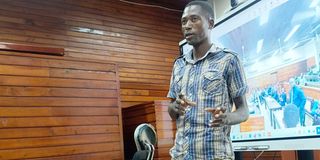
Prison officer James Mnjala testifies in court on October 27, 2026. He said prison surveillance had been stepped up, but inmates still found ways to smuggle illegal items into the facility.
James Mnjala, another prison warder at Shimo La Tewa, told the court that inmates and those seeking to supply them with contraband had devised numerous ways of defeating security checks, including concealing items in their private parts.
“There are many tricks used in prison. There are so many unorthodox ways of hiding items and smuggling them into the facility. You never know,” he said.
Mnjala recalled that contraband items were previously thrown over the prison walls, sometimes with officers manning the watchtowers aware of what was happening. He said security restrictions had since been tightened, although smuggling could still be taking place.
He argued that the presence of contraband inside the facility pointed to possible collusion between inmates and prison warders.
“If contraband items are found inside the prison, then the prison warders must have been involved,” he said when questioned by Mackenzie's lawyer.
Chikute told the court that officers recovered two mobile phones and eight SIM cards during searches in August and September 2025, including six SIM cards concealed inside Bic shaving sticks in the cells occupied by Mackenzie and three of his co-accused.
Chikute, who has headed the prison's search section since 2023, said his team comprised 26 officers working in shifts to prevent mobile phones, SIM cards, bhang, cigarettes and other prohibited items from entering the facility.
He said searches were conducted following intelligence reports, with officers using a metal detector to locate concealed items.
On August 30, 2025, he led a team to search Block B, which housed 52 male remandees facing charges relating to the Shakahola deaths.
Acting on intelligence that some inmates were using mobile phones to communicate, officers recovered an Itel handset without a battery or SIM card after remandee Erick Otieno allegedly threw it away while fleeing from them. A second Itel phone, fitted with Safaricom and Airtel SIM cards, was recovered from Stephen Ominde.
“The prisoners are not allowed to be in possession of mobile phones or SIM cards,” Chikute said, explaining that inmates could make calls only through designated phones kept at the welfare office between 8am and 4pm.
Officers also confiscated ropes, nails, boxes and plastic containers from the cells, saying the items were unauthorised and could be used to harm inmates or officers or facilitate escapes.
On September 19, 2025, Chikute joined a team led by prison security officer Assistant Superintendent of Prisons Douglas Ouma in searches targeting Mackenzie's cell in Block G and the segregation cells occupied by co-accused Smart Deri Mwakalama, Kelvin Sudi Asena and Titus Munyao Musyoka.
Chikute said the teams searched the cells simultaneously to prevent inmates from learning about the operation beforehand.
In Mackenzie's cell, officers recovered three Airtel SIM cards concealed inside Bic shaving stick handles lying on the floor. One was discovered after an officer noticed tissue paper stuffed into the rear end of a shaving stick handle and removed it, revealing a SIM card inside. The discovery prompted further checks of similar items.
Chikute took possession of the three SIM cards and shaving sticks and alerted the team searching the segregation cells to inspect similar items.
That team recovered three more SIM cards concealed inside Bic shaving sticks, bringing the total recovered during the September 19 operation to six.
The following morning, September 20, police investigating the deaths at Kwa Bi Nzaro forest obtained a court order to search Mackenzie's cell. Chikute accompanied the officer in charge, the deputy officer in charge and other prison officers during the exercise, which he estimated lasted about 40 minutes.
Police recovered a notebook bearing names and telephone numbers, some of which had been overwritten to make them illegible, handwritten notes, including one bearing the name Emily Ayugi, and a Bible.
Mackenzie was present throughout the search and signed the inventory of recovered items. Chikute also signed the document to confirm that he had witnessed the exercise.
At about 11.40am that day, Chikute joined another team searching Kitsao's cell after investigators reported that a telephone number registered in the inmate's name had previously been used in the same handset as another number believed to have been used by Mackenzie.
Officers recovered two Bibles, including one titled God's Word: Your Journey to Freedom, and three pieces of paper bearing handwritten names and telephone contacts.
Chikute said the two phones, eight SIM cards, five Bic shaving sticks and items recovered from Kitsao were handed over to investigators through the prison's officer in charge. He signed an inventory acknowledging his involvement in the recoveries.
He added that the ropes, nails, boxes and plastic containers seized during the searches were disposed of in accordance with prison procedures.
Kisumu resident Emily Achieng, a salonist who testified virtually, told the court that DCI officers informed her in 2025 that her national identity card number had been used to register one or more mobile phone numbers allegedly being used by a person in Kilifi for unlawful activities.
Achieng said she presented herself to DCI officers in Kisumu, where she recorded a statement. She denied knowing that her identity details had been used to register the SIM card in question and disclosed that she had two mobile phone numbers registered in her name.
She told the court that she knew Mackenzie only through television reports and had never visited Kilifi.
The testimonies have brought renewed scrutiny to the movement of mobile phones and SIM cards into Shimo La Tewa Prison, where such items are prohibited. However, the accounts of the possible smuggling methods and the recovery of the devices do not, on their own, establish who supplied the SIM cards or how the particular line allegedly reached a handset linked to Mackenzie.
Mackenzie and six others are accused of murder as a crime against humanity over the deaths of 52 people at Kwa Bi Nzaro forest in Kilifi County in 2025.
Mackenzie and five co-accused, including self-styled priestess Shallyne Anindo Temba, are jointly charged in the main counts. The prosecution alleges that they participated in killings carried out as part of a widespread and systematic attack against members of Good News International.
The victims identified in the 23 counts are children aged between six months and 17 years whose remains were identified through grave references following exhumations.
The prosecution has also brought 23 alternative counts of ordinary murder against the six accused over the same deaths.
Two other suspects, Charles Mutua Musee and James Kazungu Kahindi, face separate charges of being accessories after the fact to murder. Musee is accused of harbouring one of the suspects at his home to help him evade arrest, while Kahindi is alleged to have assisted three other accused persons to evade arrest in Mombasa between July 19 and 21, 2025.
All the accused have denied the charges.
A total of 53 witnesses have testified in the case.
Follow our WhatsApp channel for breaking news updates and more stories like this.