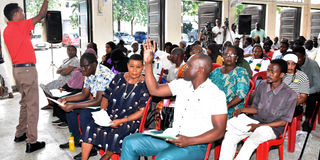
Confusion, frustration, and sharp criticism of government spending dominated a public participation forum on the proposed Finance Bill, 2026 in Mombasa, as residents questioned both the tax measures before them and Parliament's commitment to listening to their views.
Some participants complained that the proposals had not been adequately explained, while others accused leaders of using public participation as a mere constitutional formality without providing meaningful feedback to taxpayers.
Several residents also urged Parliament to rein in what they described as extravagant government expenditure and frequent foreign travel instead of relying on additional tax measures to raise revenue.
The session, held at Tononoka Social Hall on Monday, was convened by the National Assembly's Departmental Committee on Finance and National Planning, which is collecting public views on the Finance Bill, 2026, the Sovereign Wealth Fund Bill, 2026, the Central Bank Amendment Bill, 2026, and the Kenya Revenue Authority Amendment Bill, 2026.
Led by committee chairperson and Molo MP Kimani Kuria, the exercise attracted residents from all six sub-counties of Mombasa, many of whom raised concerns over the contents of the proposed legislation.
According to Mr Simon Aloo, a resident of Kadzandani in Nyali Sub-County, the process ought to have allowed Kenyans and other stakeholders to meaningfully interrogate the proposed tax measures, but many participants lacked sufficient information to understand the proposals.
"My brother, please break down for us these proposals regarding the exemption of 16 per cent VAT on various goods and supplies. We have just been given the document, yet many of the people here do not understand," he said.
In a quick rejoinder, Mr Kimani Kuria highlighted more than 10 annexures containing tax relief measures aimed at benefiting Kenyans. He cited exemptions on the local supply of second-hand clothing, among other goods and services.
The Chairperson, National Assembly Committee on Finance and National Planning, Kuria Kimani, addressing the press after conducting the Public Participation on the Proposed Finance Bill 2026 in Mombasa in this photo taken on June 8, 2026.
Photo credit: Kevin Odit| Nation Media Group
"People want a single tax to be imposed on bales of mitumba (second-hand clothes) only upon entry into the country and be given a reprieve from further charges such as the corporate tax rate of 30% on their actual net profit," he explained.
The Bill also proposes introducing 16 per cent VAT on commissions charged by payment service providers for services such as money transfers, payment processing, settlement, merchant acquiring, gateway and aggregation services offered through software or digital platforms.
A section of residents, however, called out the Executive over extravagant government spending and lavish foreign travel, urging Parliament to regulate the expenditures and divert the money towards meeting the country's financial obligations.
According to Mr Omar Jilo from Kisauni Sub-County, Parliament has failed Kenyans in its oversight role and is now dancing to the tune of the highest office in the land. He wants the legislature to exercise its oversight powers over the travel budget by putting in place strict statutory frameworks.
"As Parliament and our representatives, why can't they regulate presidential foreign trips and make sure the money used is reduced?" he asked.
Another resident called for the introduction of a different approach for the government to raise revenue through reasonable tax measures so as to cushion Kenyans from the burden of an already overtaxed public amid the high cost of living.
"According to the way they have been introducing these taxes, it is clear that life is going to get even more difficult. We are requesting alternative ways to help Kenyans navigate the current economic situation," said Mr Ali Mohammed.
Others questioned the authenticity of such public forums, citing insufficient sensitisation and limited room for debate.
They criticised the committee for failing to adequately address what they called "important revenue proposals which target taxpayers".
"Is it fair to hold civic education on the Finance Bill, 2026, for only an hour? This is our life and I think that is not enough time," said Mr Ali Hassan.
They also demanded feedback regarding all the issues they raised, accusing leaders of often using such constitutional requirements to gather public views without granting taxpayers a right of reply before the passage of the proposed legislation.