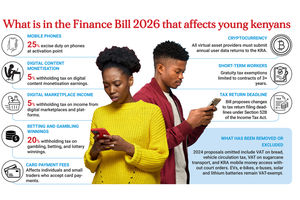
Social media reaction to the Finance Bill 2026 is overwhelmingly negative, with much of the conversation centered around the hashtag #RejectFinanceBill2026, according to an analysis of 3,000 posts on X published between May 2 and May 26.
The bill is largely framed by users as punitive, misleading and economically burdensome, with only a small fraction of posts expressing support. Even neutral posts tend to focus on questioning provisions or fact-checking claims rather than endorsing the proposed law.
Three issues, in particular, dominate the online backlash: expanded powers for the Kenya Revenue Authority (KRA), proposed taxation on digital payment platforms, and confusion over smartphone excise duty.
1. Expansion of KRA powers
The most prominent concern centres on a proposal that would allow the Kenya Revenue Authority (KRA) to use pre-populated data from third-party sources such as banks and telecommunications firms to estimate taxpayers’ income and determine the tax they are expected to pay.
Tax analysts warn that this could shift the burden of proof to taxpayers. In cases where individuals dispute KRA’s assessment, they may be required to prove the figures are inaccurate, rather than KRA justifying how it arrived at them.
Critics also point to a lack of transparency, noting that the authority would not be obligated to disclose the sources or methodology behind its calculations.
2. VAT on digital payment platforms
Another widely discussed proposal is the introduction of a 16 per cent value-added tax (VAT) on digital payment platforms such as M-Pesa, Airtel Money and Pesapal.
The National Treasury has defended the proposal saying “The person who supplies ICT to enable payments, including paybills or tills, is the one subject to VAT” but analysts warn that the cost is likely to be passed on to consumers through higher transaction fees.
Given the widespread reliance on mobile money in Kenya, especially among low-income earners, critics argue that the measure could disproportionately affect those who depend on such platforms for everyday transactions.
3. Smartphone excise duty confusion
The proposal on smartphone taxation has also generated significant debate online, largely driven by conflicting interpretations.
Treasury Cabinet Secretary John Mbadi has said the government intends to reduce the overall tax burden on phones from 55 per cent to 25 per cent by consolidating existing levies. However, many social media users remain unconvinced, arguing that the messaging around the changes is unclear and potentially misleading.
Concerns persist among traders and consumers about whether the changes will ultimately make smartphones more affordable or more expensive.
Misinformation and counter-campaigns
Beyond policy concerns, the online conversation is also marked by a surge in misinformation and counter-efforts to correct it.
Some posts falsely claim that the bill proposes new taxes on basic goods such as bread, provisions that do not exist in the proposed law. In response, other users have actively pushed back, calling out inaccuracies and urging verification before sharing information.
The hashtag #FB2026Lies has emerged as a signal of these concerns, with users warning against what they describe as propaganda and false narratives. More than 170 posts have used the hashtag to flag misleading claims.
At the same time, a parallel campaign under the hashtag #FB2026Facts appears to be attempting to shape the narrative in favour of the bill.
Analysis of posts using this hashtag shows high-frequency activity and the repeated sharing of near-identical graphics, suggesting a coordinated messaging effort rather than organic engagement.
The hashtag has generated more than 1,400 posts, many of which follow similar formats and language, pointing to a centrally driven communication strategy.
Overall, the Finance Bill 2026 has triggered not just widespread opposition online, but also a highly contested information environment, where competing narratives ranging from genuine public concern to coordinated messaging and misinformation are shaping public perception in real time.